

Archive position — measured, not model output
0 likes on Devpost
2,263 of the 7,850 archived projects have more likes, and 5,587 share exactly 0 — so this project's #7,759 place in the like-ranked listing is a tie-break inside that group, not a ranking.
Projects (log scale)
Likes on Devpost. ▲ marks this project's group.
Show the figures
| Likes | Projects | Share of archive |
|---|---|---|
| 0 | 5,587 | 71.2% |
| 1 | 1,758 | 22.4% |
| 2 | 284 | 3.6% |
| 3–4 | 132 | 1.7% |
| 5–9 | 75 | 1.0% |
| 10+ | 14 | 0.2% |
 User Stories BotA demo video on every pull request
Get a demo video on every new feature
GitHub App that watches your pull requests and records a narrated, captioned demo.
Save time on demo prep and make informed decisions faster with a video walkthrough of every new feature.
Executive Summary
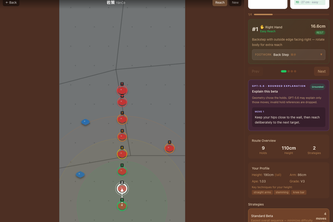
What the company appears to be: YanCe (岩策) is a self-reported browser-based tool that uses AI and computer vision to generate body-aware climbing beta from a single photo of an indoor bouldering wall. The author states it allows climbers to input personal physical data, calibrate the image, correct holds, and receive a sequence of moves tailored to their reach and body mechanics.
What changed: The project description is a self-reported submission for the OpenAI 2026 hackathon. It describes an early-stage prototype with no evidence of revenue, customers or production use beyond a demo on Vercel.
Single most important open question: Is there any evidence that YanCe has been used by real climbers in real gyms, or that it has moved beyond the proof-of-concept stage?
Analysis basis: This report is based entirely on the self-reported project description provided by the author. No independent verification or historical data is available.
What The Product Actually Is
The description states YanCe is a browser-based application built with React, TypeScript, and Vite. It uses computer vision and AI (specifically GPT-5.6) to process calibrated photos of indoor bouldering walls. The tool allows users to enter personal data (height, arm span, experience, grade), calibrate the image to real wall distance, correct detected holds, and mark start/finish points.
The core function is to build a "reach graph" and search for legal sequences shaped by the user's body dimensions. It generates move-by-move plans with one MOVED limb and three SUPPORT contacts, labeled left/right hand/foot, and includes geometry-based ease scores and explanations.
Evidence: The description states this is a browser app using React, TypeScript, Zustand, Canvas, and Vite. It uses computer vision and GPT-5.6 for vision and coaching functions. The tool builds reach graphs and searches for sequences based on body dimensions.
Inference: The system appears to be an early-stage prototype designed to demonstrate a proof-of-concept rather than a production-ready product.
Positioning & Claim Evolution
The description states YanCe aims to solve the problem of "universal" climbing beta not fitting individual climbers. It positions itself as a tool that makes route reading less opaque and dependent on copying others' body mechanics, giving climbers more autonomy.
The author claims it asks "a more personal question: can one ordinary wall photo become a clear, correctable plan for the person actually climbing?" This suggests a shift from generic beta to personalized beta.
Evidence: The description states this is about making route reading less opaque and dependent on copying others' mechanics. It positions itself as solving the problem of universal beta not fitting individual climbers.
Inference: The positioning appears to be evolving from a basic tool for solo climbers to one that addresses fundamental issues in climbing instruction and learning.
Target Customer & ICP
The description states YanCe targets solo climbers and beginners who struggle with converting a wall into a sequence they can understand and try. It specifically mentions "beginners" and "solo climbers" as the primary user groups, noting that these users often face challenges not related to strength but to understanding how to translate visual information into physical movement.
Evidence: The description states it targets "beginners" and "solo climbers" who struggle with converting a wall into a sequence they can understand. It notes that the hardest part for these climbers is often not strength but converting a wall into a sequence they can understand.
Inference: The target customer appears to be individuals who climb alone or are new to climbing, seeking personalized instruction rather than generic beta.
Business Model & Pricing Evidence
Not evidenced. The description does not contain any information about pricing, monetization, or business model.
Evidence: No mention of pricing, subscriptions, or revenue models in the description.
Inference: Since this is a hackathon submission with no evidence of commercial use, it's unclear if there is any business model beyond the demo.
Technical & Delivery Signals
The description states YanCe uses React, TypeScript, Zustand, Canvas, and Vite for frontend development. It employs computer vision techniques including pixel-to-distance calibration, candidate generation, and GPT-5.6 for semantic verification. The system has a deterministic search engine that preserves complete before/after stances and enforces a testable invariant: one limb moves per step.
The author notes that GPT-5.6 is deliberately bounded - it receives numbered candidates and verifies semantics but never invents coordinates. The system fails open to a zero-key classic planner if model stages fail.
Evidence: Built with React, TypeScript, Zustand, Canvas, Vite. Uses computer vision for calibration and hold detection. Employs GPT-5.6 for verification only, not generation. Has deterministic search engine with testable invariants.
Inference: The technical approach suggests a hybrid system combining deterministic algorithms with bounded AI components, designed to be inspectable and correctable rather than opaque.
Traction & Maturity Signals
Not evidenced. The description contains no information about users, customers, revenue, or adoption beyond the demo.
Evidence: No mention of users, customers, revenue, or adoption metrics in the description.
Inference: This appears to be a proof-of-concept prototype with no evidence of traction or market adoption.
Competitive Context
Not evidenced. The description does not contain any information about competitors or market positioning relative to existing tools.
Evidence: No mention of competitors or existing tools in the description.
Inference: Without any competitive analysis, it's impossible to assess how YanCe compares to other climbing tools or platforms.
Open Questions & Risks
- Unproven commercial viability: The project is described as a hackathon submission with no evidence of revenue, customers, or production use beyond a demo.
- Limited scope: The system only works with indoor bouldering walls and requires manual calibration and hold correction.
- AI dependency: While GPT-5.6 is bounded, the system's core functionality still relies on AI for vision and verification.
- Single-person team: The project has only one team member, which may limit development capacity.
- No scalability evidence: No indication of how the system would scale to multiple gym locations or handle real-world variations.
Evidence: The description states it's a hackathon submission with no revenue or customer data. It's a single-person project with no evidence of scaling beyond demo.
Inference: These are typical risks for early-stage prototypes, but they're particularly concerning given the lack of any commercial traction or validation.
Questions the description leaves open
- What is the actual user base beyond the demo?
- How does YanCe handle real-world variations in gym walls and lighting conditions?
- What are the technical limitations that prevent it from being used at scale?
- Has there been any feedback from actual climbers or gyms about its utility?
- What is the path to monetization if any exists?
- How does the system handle edge cases or failures in vision detection?
- What are the plans for expanding beyond indoor bouldering walls?
Overall Assessment
Not evidenced. The description contains no information about funding, valuation, or investment status.
Evidence: No mention of funding rounds, valuations, or investment status in the description.
Inference: This appears to be an early-stage prototype with no evidence of commercial development or investment interest beyond the hackathon submission.
User Stories BotA demo video on every pull request
Get a demo video on every new feature
GitHub App that watches your pull requests and records a narrated, captioned demo.
Save time on demo prep and make informed decisions faster with a video walkthrough of every new feature.
Source
Submitted to the OpenAI 2026 hackathon on Devpost. Project home on Devpost. Back to the full gallery on Devpost.
This competitive analysis was produced by top-founders.com (opens in a new tab)
Generated by a language model from this project's public Devpost page — its tagline, the author's own write-up and any built-with tags listed there — as captured in August 2026. Short quotations are the author's words. It is an opinion on the idea as a business, not on the people behind it, and it reflects the description as published then. If the project has moved on, request a correction below. The analysis is not independent research and contains no verified traction, revenue or customer data.
An independent guide by KFG International LLC — not affiliated with, endorsed by, or connected to Devpost or OpenAI.