

Archive position — measured, not model output
0 likes on Devpost
2,263 of the 7,850 archived projects have more likes, and 5,587 share exactly 0 — so this project's #7,760 place in the like-ranked listing is a tie-break inside that group, not a ranking.
Projects (log scale)
Likes on Devpost. ▲ marks this project's group.
Show the figures
| Likes | Projects | Share of archive |
|---|---|---|
| 0 | 5,587 | 71.2% |
| 1 | 1,758 | 22.4% |
| 2 | 284 | 3.6% |
| 3–4 | 132 | 1.7% |
| 5–9 | 75 | 1.0% |
| 10+ | 14 | 0.2% |
 User Stories BotA demo video on every pull request
Get a demo video on every new feature
GitHub App that watches your pull requests and records a narrated, captioned demo.
Save time on demo prep and make informed decisions faster with a video walkthrough of every new feature.
Executive Summary
What the company appears to be
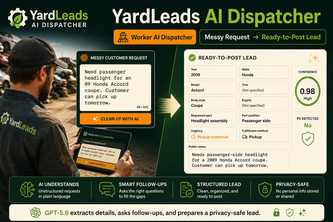
YardLeads AI Dispatcher is a self-reported tool built for salvage-yard workers to help them convert incomplete customer requests into structured, privacy-safe leads using GPT-5.6. It is described as a modern version of a shared "red phone" system used in the salvage yard business.
What changed
The author states that an early version of the product was simulated and did not actually use AI. After discovering this during self-audit, they replaced it with a real server-side GPT-5.6 integration.
The single most important open question
Is there any evidence of traction or customer feedback from actual salvage yards? The description contains no data on adoption, usage, revenue, or customer validation beyond the author’s own claims and testing in a development environment.
What The Product Actually Is
The description states that YardLeads AI Dispatcher is a tool designed for salvage-yard workers. It allows them to input customer requests in natural language, which are then processed by GPT-5.6 to extract structured data about vehicle and part details.
Key technical components include:
- A React-based frontend with TypeScript and Vite
- Firebase backend services including authentication, cloud functions, Firestore, and secret management
- Server-side integration with OpenAI's GPT-5.6 via the OpenAI Node SDK and Responses API
- Structured output using JSON schema to avoid guessing missing information
- Human review step before any lead is posted to Firestore
The system does not automatically post leads; instead, it produces a structured draft that must be confirmed by the worker.
Inference The product appears to be an MVP (minimum viable product) built for a specific niche use case — helping workers in salvage yards process customer requests more efficiently. It is not described as a full marketplace or network platform.
Positioning & Claim Evolution
The author positions YardLeads AI Dispatcher as a modern digital red-phone system for the salvage yard industry, aiming to improve lead quality and reduce time spent on incomplete requests.
Claims made
- The tool helps workers quickly turn an incomplete request into a clean lead.
- It avoids guessing missing details and asks targeted follow-up questions.
- It preserves privacy by not storing raw customer text in public documents.
- It is built with human review as a core part of the workflow.
Evolution noted
The author explicitly mentions that the first version was simulated and did not actually use AI. They replaced it with a real GPT-5.6 integration after self-audit.
Inference This suggests a rapid iteration cycle driven by internal validation rather than external feedback or market testing.
Target Customer & ICP
The description states that YardLeads AI Dispatcher is intended for salvage-yard workers, specifically those who receive incomplete customer requests through phone calls, text messages, handwritten notes, etc.
It targets:
- Workers at salvage yards
- Those dealing with informal automotive language
- Users needing to identify missing vehicle or part details
Inference The target customer profile is narrow and specific — not a general-purpose AI tool but one tailored for a niche B2B segment within the automotive recycling industry.
Business Model & Pricing Evidence
There is no evidence of pricing, monetization strategy, or business model in the provided description. The author does not mention any revenue streams, subscription plans, or customer acquisition costs.
Inference The product appears to be a prototype or MVP without a defined commercial path. No indication exists whether it will be sold directly to yards, offered as SaaS, or integrated into existing platforms.
Technical & Delivery Signals
The project is built using:
- Frontend: React, TypeScript, Vite
- Backend: Firebase (authentication, cloud functions, Firestore, hosting, secret manager)
- AI Integration: GPT-5.6 via OpenAI Node SDK and Responses API
- Security: Server-side API key handling, no direct browser calls to OpenAI
- Structured Output: JSON schema-based extraction with strict output formatting
Notable implementation details:
- Clarification questions are asked when needed
- Human review is required before lead confirmation
- Raw customer requests are not stored in public Firestore documents
- Authentication and secret management are handled via Firebase
Inference The technical stack shows a focus on security, structured data handling, and user control. However, the lack of production deployment or scalability metrics raises questions about readiness for real-world use.
Traction & Maturity Signals
There is no evidence of traction, customer adoption, or performance metrics beyond the author’s own testing and documentation.
The description mentions:
- Testing in a development environment
- A judge login for evaluation purposes
- Automated frontend and backend tests
- Deployment to Firebase Hosting and Cloud Functions
Inference The product has reached a functional prototype stage but lacks any data on real-world usage, user engagement, or business impact. It is not yet proven in the market.
Competitive Context
No mention of competitors or competitive landscape is provided in the description.
Inference The author does not reference existing tools or platforms that might address similar problems in the salvage yard industry. This leaves open whether there are comparable solutions already available or if this is a unique niche space.
Open Questions & Risks
- Unverified AI Integration: The product was initially simulated and only later replaced with a real GPT-5.6 integration, raising concerns about early-stage validation.
- No Customer Feedback: No evidence of testing with actual salvage yards or customer feedback loops.
- Limited Scope: The current version focuses on intake and clarification but does not include full network features like shared leads or yard routing.
- Self-Reported Only: All information is self-reported and unverified; no third-party validation or external data exists.
- Single Developer: The team size is listed as one, which may limit scalability and ongoing development capacity.
Questions the description leaves open
- How many actual salvage yards have you tested this with? What were their responses?
- Have you validated that the AI actually improves lead quality or worker efficiency compared to manual methods?
- Is there a plan for scaling beyond a single developer?
- What is your long-term vision for monetization and customer acquisition?
- How do you intend to handle data privacy compliance at scale, especially with multiple yards involved?
- Are there any existing partnerships or pilot programs with salvage yard networks?
Overall Assessment
Not evidenced.
The description provides no information on financials, funding history, revenue, or customer base. It also lacks evidence of traction, market validation, or a clear path to profitability.
Inference This is an early-stage prototype submitted as part of a hackathon. While the idea shows promise in addressing a real pain point for salvage-yard workers, there is insufficient evidence to assess its viability as an investment or partnership opportunity at this stage.
User Stories BotA demo video on every pull request
Get a demo video on every new feature
GitHub App that watches your pull requests and records a narrated, captioned demo.
Save time on demo prep and make informed decisions faster with a video walkthrough of every new feature.
Source
Submitted to the OpenAI 2026 hackathon on Devpost. Project home on Devpost. Back to the full gallery on Devpost.
This competitive analysis was produced by top-founders.com (opens in a new tab)
Generated by a language model from this project's public Devpost page — its tagline, the author's own write-up and any built-with tags listed there — as captured in August 2026. Short quotations are the author's words. It is an opinion on the idea as a business, not on the people behind it, and it reflects the description as published then. If the project has moved on, request a correction below. The analysis is not independent research and contains no verified traction, revenue or customer data.
An independent guide by KFG International LLC — not affiliated with, endorsed by, or connected to Devpost or OpenAI.