

Archive position — measured, not model output
0 likes on Devpost
2,263 of the 7,850 archived projects have more likes, and 5,587 share exactly 0 — so this project's #3,836 place in the like-ranked listing is a tie-break inside that group, not a ranking.
Projects (log scale)
Likes on Devpost. ▲ marks this project's group.
Show the figures
| Likes | Projects | Share of archive |
|---|---|---|
| 0 | 5,587 | 71.2% |
| 1 | 1,758 | 22.4% |
| 2 | 284 | 3.6% |
| 3–4 | 132 | 1.7% |
| 5–9 | 75 | 1.0% |
| 10+ | 14 | 0.2% |
 User Stories BotA demo video on every pull request
Get a demo video on every new feature
GitHub App that watches your pull requests and records a narrated, captioned demo.
Save time on demo prep and make informed decisions faster with a video walkthrough of every new feature.
Executive Summary
What the company appears to be
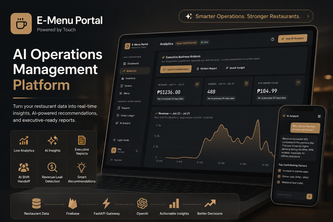
E-Menu Portal is an AI-powered restaurant operations platform that the author describes as an “operational assistant” for small and medium-sized restaurants. It integrates real-time restaurant data, analytics, and AI to generate executive reports, shift handoffs, revenue leak detection, and recommendations.
What changed
The project was submitted as a hackathon entry (OpenAI 2026) and is described as having moved from prototype to pilot stage with a real café. It includes deployment on cloud infrastructure and integration of AI models via a secure backend gateway.
Single most important open question
Is there evidence of actual customer adoption or revenue generation beyond the author’s own pilot test?
Note: This analysis is based entirely on the self-reported, unverified description provided by the project author. No external verification, traction data, or financials are available.
What The Product Actually Is
The description states that E-Menu Portal is an AI-powered restaurant operations platform. It combines:
- Real-time synchronization of restaurant data via Firebase
- Business metrics processing through a FastAPI gateway
- AI analysis powered by OpenAI models
- A React.js dashboard for management and interaction
It generates outputs such as:
- Executive Reports
- AI Shift Handoffs
- Live Operations Analysis
- Revenue Leak Detection
- AI-powered Recommendations
- Natural language conversations with an AI Business Analyst
The system is built using:
- Frontend: React + Vite
- Backend: FastAPI, Firebase (auth and DB), OpenAI, Railway
- Architecture: Server-side OpenAI integration, secure API gateway
Inference: The platform appears to be a hybrid of data ingestion, processing, and AI-driven insights, designed for restaurant owners who want more than just sales totals.
Positioning & Claim Evolution
The author positions E-Menu Portal as an “operational assistant” that goes beyond traditional POS systems. It is described as answering not only “What happened?” but also “Why did it happen?” and “What should I do next?”
Key claims:
- The platform helps small and medium-sized restaurants gain access to operational intelligence typically available only to large enterprises.
- It transforms live business data into actionable insights.
- It acts like an operations manager rather than a reporting dashboard.
Inference: The positioning has evolved from a hackathon prototype to a product aiming for enterprise-grade accessibility, though the description does not confirm whether this evolution is real or aspirational.
Target Customer & ICP
The author states that E-Menu Portal targets:
- Small and medium-sized restaurants
- Restaurant owners who make hundreds of daily decisions
- Users who lack access to detailed operational insights beyond sales totals
Inference: The target customer segment is clearly defined as restaurant operators, but the description does not specify whether this includes franchisees, independent cafes, or full-service restaurants.
Business Model & Pricing Evidence
No information is provided about pricing, monetization, or business model. The author only describes the platform’s functionality and its use in a pilot test with one café.
Not evidenced: No evidence of revenue streams, pricing tiers, customer acquisition costs, or monetization strategy.
Technical & Delivery Signals
The platform uses:
- Firebase for real-time data sync
- FastAPI as an authenticated AI gateway
- OpenAI models server-side (not exposed to frontend)
- React + Vite for frontend
- Railway for backend hosting
Key technical decisions:
- Server-side AI integration
- Secure API gateway
- Authentication via Firebase
- Deployment in production-ready architecture
Inference: The team appears to have made deliberate architectural choices around security and scalability, though no evidence of performance or reliability metrics is provided.
Traction & Maturity Signals
The author claims:
- E-Menu Portal has been deployed and connected to real restaurant data
- A pilot test was conducted with a local café
- The system was built in a hackathon but evolved into a functional product
Inference: There is limited evidence of traction beyond one pilot. No mention of customer retention, usage frequency, or expansion plans.
Competitive Context
The author does not reference existing competitors or market positioning. The platform appears to be positioned as an AI-enhanced operations tool for restaurants, but no comparison with other solutions (e.g., POS systems, analytics platforms) is made.
Not evidenced: No competitive landscape or differentiation analysis provided.
Open Questions & Risks
- Unverified pilot results: Only one café was tested; no data on impact or adoption.
- No revenue or customer data: The platform is described as a prototype/pilot, with no evidence of monetization or real-world traction.
- Single founder team: The project is built by one person (Patrick Fitzroy Hofer), raising questions about scalability and execution capacity.
- Hackathon origin: The product was built in a short timeframe; long-term viability and robustness are unproven.
Inference: The lack of verified traction, revenue, or customer data makes it difficult to assess commercial viability.
Questions the description leaves open
- What were the results of the pilot test with the local café? Did it lead to measurable improvements in decision-making or operational efficiency?
- How is the AI model being trained or fine-tuned for restaurant-specific use cases?
- Are there any plans to expand beyond a single pilot, and if so, what are the key steps toward that?
- What is the current architecture’s scalability, and how does it handle data volume and latency?
- Is there any plan to monetize the platform, and if so, what pricing model or revenue streams are being considered?
Overall Assessment
The description indicates a product in early-stage development with a pilot test completed. It is not evidenced that E-Menu Portal has achieved product-market fit, customer traction, or revenue generation.
Assessment: Not ready for investment or partnership at this stage. The platform shows promise in concept and execution but lacks verified commercial signals. A follow-up evaluation would require evidence of customer adoption, monetization, and scalability beyond the initial pilot.
User Stories BotA demo video on every pull request
Get a demo video on every new feature
GitHub App that watches your pull requests and records a narrated, captioned demo.
Save time on demo prep and make informed decisions faster with a video walkthrough of every new feature.
Source
Submitted to the OpenAI 2026 hackathon on Devpost. Project home on Devpost. Back to the full gallery on Devpost.
This competitive analysis was produced by top-founders.com (opens in a new tab)
Generated by a language model from this project's public Devpost page — its tagline, the author's own write-up and any built-with tags listed there — as captured in August 2026. Short quotations are the author's words. It is an opinion on the idea as a business, not on the people behind it, and it reflects the description as published then. If the project has moved on, request a correction below. The analysis is not independent research and contains no verified traction, revenue or customer data.
An independent guide by KFG International LLC — not affiliated with, endorsed by, or connected to Devpost or OpenAI.