

Archive position — measured, not model output
0 likes on Devpost
2,263 of the 7,850 archived projects have more likes, and 5,587 share exactly 0 — so this project's #3,833 place in the like-ranked listing is a tie-break inside that group, not a ranking.
Projects (log scale)
Likes on Devpost. ▲ marks this project's group.
Show the figures
| Likes | Projects | Share of archive |
|---|---|---|
| 0 | 5,587 | 71.2% |
| 1 | 1,758 | 22.4% |
| 2 | 284 | 3.6% |
| 3–4 | 132 | 1.7% |
| 5–9 | 75 | 1.0% |
| 10+ | 14 | 0.2% |
 User Stories BotA demo video on every pull request
Get a demo video on every new feature
GitHub App that watches your pull requests and records a narrated, captioned demo.
Save time on demo prep and make informed decisions faster with a video walkthrough of every new feature.
Executive Summary
What the company appears to be
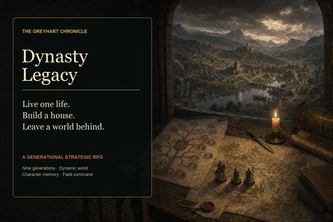
Dynasty Legacy is a self-developed generational strategic RPG set in a fictional medieval valley, built by one developer (Alfred) using Godot 4.7.1 and AI tools including Codex and GPT-5.6. The project is described as map-first, with systems for travel, relationships, family succession, governance, battles, and persistent world simulation across nine generations.
What changed
The author states that the project began as a personal exploration of dynasty mechanics, aiming to blend elements from several existing games while introducing an intimate focus on continuity, consequences, and character-driven storytelling. The development process was iterative and AI-assisted, with Codex and GPT-5.6 used throughout.
Single most important open question
Is there any evidence of commercial traction or product-market fit beyond the author’s own development effort? The description contains no data on users, revenue, monetization, or adoption — only a self-reported account of a single-person project.
What The Product Actually Is
The description states that Dynasty Legacy is:
- A map-first generational strategic RPG set in the fictional Greyhart Valley.
- A game where players can travel between nine settlements, engage in 27 local actions across 12 professions, and build a family through nine playable generations.
- It includes systems for governance of holdings, commanding armies, and exploring a persistent family tree.
- The simulation features continuous calendar, seasons, mortality, injuries, illness, aging, stress, and traceable consequences.
- It has 530 bilingual events, 30 named characters, 23 heirlooms, 36 lasting marks, 26 achievements, and six systemic endings.
The project is built in Godot 4.7.1 with GDScript, and uses deterministic systems for simulation, data-driven narrative content, and atomic save handling.
Inference: The product is a single-player, persistent-world strategy game that emphasizes long-term consequences and generational storytelling. It is not described as a commercial product or service but rather an experimental development effort.
Positioning & Claim Evolution
The author states:
- The project draws inspiration from games like Crusader Kings, Kenshi, Mount & Blade II, and Taiko Risshiden V.
- It aims to ask a more intimate question: what if every system remembered who paid for your success, and your heir had to live with the answer?
- The goal was not to imitate those games but to explore dynastic continuity, relationship webs, and personal fragility in a persistent world.
Claim: The game is positioned as an experimental, narrative-driven strategy RPG that explores generational consequences and personal agency within a living world.
Not evidenced: No claims about market positioning, competitive differentiation, or user feedback are provided.
Target Customer & ICP
The description does not state:
- Who the target customer is.
- What the ideal customer profile (ICP) looks like.
- Whether the game targets specific demographics or gaming communities.
Not evidenced: No evidence of a defined customer segment or target market.
Business Model & Pricing Evidence
The description states:
- The project was submitted to an OpenAI hackathon.
- It includes a bilingual, controller-ready macOS build.
- There is no mention of monetization, pricing, or business model.
Not evidenced: No evidence of revenue streams, pricing strategy, or commercial viability.
Technical & Delivery Signals
The description states:
- Built with Godot 4.7.1, GDScript, and AI tools including Codex and GPT-5.6.
- The simulation is separated into deterministic systems for calendar, mortality, travel, factions, family succession, relationships, economy, battles, saves, and content selection.
- UI uses native Godot controls, not pre-rendered art.
- Save data uses atomic replacement, backup recovery, and versioned migration path (v40).
- The workflow involved iterative engineering using Codex to generate code, UI, content, and test harnesses.
Inference: The project shows technical sophistication in simulation design and AI-assisted development.
Not evidenced: No evidence of scalability, performance metrics, or delivery pipeline beyond the single developer’s process.
Traction & Maturity Signals
The description states:
- The current build contains 530 bilingual events, 30 named characters, 23 heirlooms, 36 lasting marks, 26 achievements, and six systemic endings.
- There are 78 automated suites, 512 seeded full-history simulations, and 530/530 event coverage.
- A bilingual, controller-ready macOS build with verified archive integrity is available.
Not evidenced: No evidence of user engagement, retention, or adoption. No data on downloads, reviews, or usage metrics.
Competitive Context
The description states:
- The game draws inspiration from Crusader Kings, Kenshi, Mount & Blade II, and Taiko Risshiden V.
- It aims to explore dynastic continuity and personal fragility in a persistent world.
Not evidenced: No evidence of competitive analysis, market positioning, or differentiation from existing games. The author does not state whether the project is intended to compete with any specific product or market segment.
Open Questions & Risks
- Single developer: The entire project was built by one person (Alfred). This raises questions about scalability, long-term maintenance, and team capacity.
- No commercial traction: There is no evidence of users, revenue, or monetization.
- Self-reported only: All claims are from the author’s own description — there is no independent verification.
- AI dependency: Heavy reliance on AI tools (Codex, GPT-5.6) may raise concerns about reproducibility and long-term viability if those tools change or become unavailable.
Inference: The project is a personal development effort with no commercial dimension or evidence of traction. It is not yet a product in any meaningful sense.
Questions the description leaves open
- What are the key assumptions about user demand for this type of game?
- Is there any evidence of early user feedback, playtesting, or community interest?
- How does the author plan to monetize or scale the product beyond a single-person effort?
- What is the long-term roadmap for the project beyond the current build?
- Are there any plans to expand beyond macOS or add multiplayer features?
Overall Assessment
The description states that this is a self-developed game submitted to an OpenAI hackathon, built by one developer using AI tools.
Not evidenced: No evidence of commercial viability, traction, or investment-ready product.
Inference: The project is an experimental development effort with no demonstrated market or revenue potential. It is not yet a product that could be considered for investment or partnership.
User Stories BotA demo video on every pull request
Get a demo video on every new feature
GitHub App that watches your pull requests and records a narrated, captioned demo.
Save time on demo prep and make informed decisions faster with a video walkthrough of every new feature.
Source
Submitted to the OpenAI 2026 hackathon on Devpost. Project home on Devpost. Back to the full gallery on Devpost.
This competitive analysis was produced by top-founders.com (opens in a new tab)
Generated by a language model from this project's public Devpost page — its tagline, the author's own write-up and any built-with tags listed there — as captured in August 2026. Short quotations are the author's words. It is an opinion on the idea as a business, not on the people behind it, and it reflects the description as published then. If the project has moved on, request a correction below. The analysis is not independent research and contains no verified traction, revenue or customer data.
An independent guide by KFG International LLC — not affiliated with, endorsed by, or connected to Devpost or OpenAI.