

Archive position — measured, not model output
0 likes on Devpost
2,263 of the 7,850 archived projects have more likes, and 5,587 share exactly 0 — so this project's #3,834 place in the like-ranked listing is a tie-break inside that group, not a ranking.
Projects (log scale)
Likes on Devpost. ▲ marks this project's group.
Show the figures
| Likes | Projects | Share of archive |
|---|---|---|
| 0 | 5,587 | 71.2% |
| 1 | 1,758 | 22.4% |
| 2 | 284 | 3.6% |
| 3–4 | 132 | 1.7% |
| 5–9 | 75 | 1.0% |
| 10+ | 14 | 0.2% |
 User Stories BotA demo video on every pull request
Get a demo video on every new feature
GitHub App that watches your pull requests and records a narrated, captioned demo.
Save time on demo prep and make informed decisions faster with a video walkthrough of every new feature.
Executive Summary
What the company appears to be: Dystronic is an AI-powered platform that transforms hardware ideas described in natural language into structured, build-ready projects. The platform generates wiring diagrams, bills of materials, code, 3D models, assembly instructions and sourcing links based on user input.
What changed: The project began as a hackathon prototype (Devpost submission) with a focus on solving hardware sourcing problems in the Dominican Republic. It is described as an AI-powered ecosystem for building technology that aims to connect artificial intelligence with practical education and maker communities.
Single most important open question: Does Dystronic have any evidence of traction, revenue, customers or adoption beyond the hackathon prototype?
What The Product Actually Is
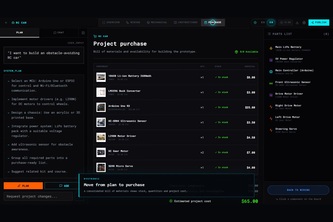
The description states that Dystronic is "an AI-powered platform that transforms hardware ideas into structured, build-ready projects." It takes user descriptions such as "I want to build an automatic irrigation system" and generates complete project workspaces including:
- Wiring and connection diagrams
- Bill of materials with compatible components
- Embedded software and example code
- 3D models or mechanical design guidance
- Step-by-step assembly instructions
- Safety considerations and troubleshooting guidance
The platform is described as converting user requests into organized projects that can be saved, reviewed, modified and eventually built. It operates through both WhatsApp (as an entry point) and a web platform where users access diagrams, costs, code, component availability, kits, project history, and assembly instructions.
The system uses OpenAI models to separate the generation process into specialized stages including understanding objectives, dividing ideas into subsystems, selecting components, generating wiring structures, producing code, creating assembly sequences, and matching projects with sourcing options.
Positioning & Claim Evolution
The description states that Dystronic was inspired by a problem in the Dominican Republic where technology projects are delayed by component unavailability. It positions itself as an AI-powered ecosystem that connects four elements: artificial intelligence + hardware sourcing + practical education + maker community.
The platform is described as transforming "the concept of an electronics store into a broader AI-powered ecosystem for building technology." It aims to solve the fragmented journey from idea to build, where users currently must search across multiple sources for components and guidance.
The positioning evolved from addressing a specific local problem (Dominican Republic) to a global opportunity that can support builders throughout Latin America, the Caribbean, and other emerging technology communities. The authors state they are "starting in the Dominican Republic, but we are building for every student, maker, teacher, entrepreneur, and engineering team that has ever had a great idea stopped by missing parts, fragmented information, or a lack of technical guidance."
Target Customer & ICP
The description identifies several target groups:
- Students
- Makers
- Teachers
- Laboratories
- Small engineering teams
- University students
- Engineering teams in Santo Domingo (specifically INTEC community)
It states that Dystronic begins by helping Dominican students and makers, but the same system can support builders throughout Latin America, the Caribbean, and other emerging technology communities.
The platform is designed for users with varying experience levels who describe hardware ideas, including those who may not know correct component names, voltage requirements, communication protocols, mechanical limitations, or programming concepts.
Business Model & Pricing Evidence
Not evidenced. The description does not contain any information about pricing, monetization strategies, revenue streams, or business model details beyond the platform's functionality.
Technical & Delivery Signals
The platform is built with:
- OpenAI models (Codex used for development acceleration)
- Next.js, React, Node.js, TypeScript
- GitHub for version control
- Vercel for deployment
- AI/ML technologies including generative AI and artificial intelligence
- Hardware-focused tech stack including electronics, motion, JSON, REST APIs
The system is described as a web-first platform because complex outputs such as diagrams, bills of materials, code, sourcing links, 3D assets, and project history require an organized workspace. WhatsApp is used as an accessible entry point, especially for users in the Dominican Republic.
The development approach was to treat Dystronic as a "project-generation system rather than a generic AI chatbot." The user begins by describing a hardware idea with available budget, experience level, preferred controller, required functions, and any components they already own. The platform then converts that unstructured request into a structured project specification.
Traction & Maturity Signals
Not evidenced. There is no evidence of revenue, customers, adoption, or traction beyond the hackathon prototype described in the submission.
The description states that the hackathon prototype focuses on demonstrating the complete journey from idea to build-ready project, but there are no claims about actual usage, user numbers, or market validation.
Competitive Context
Not evidenced. The description does not mention any competitors, existing solutions in this space, or competitive positioning beyond stating that "a traditional electronics store sells individual parts" and Dystronic helps people understand what they need, why they need it, where to obtain it, and how to transform those components into a working solution.
Open Questions & Risks
Risk 1: The platform is described as a hackathon prototype with no evidence of traction or commercial viability. The entire description is self-reported and unverified.
Risk 2: Component compatibility validation is stated as a major challenge, yet there's no evidence that this has been solved in the prototype or how it would scale.
Risk 3: Sourcing was identified as a difficult problem with distributed inventory across stores, informal sellers, social networks, importers, couriers, and international suppliers - none of which provide standardized APIs or reliable real-time availability. No solution for this is evidenced.
Risk 4: The platform must ask the right questions without overwhelming beginners, but there's no evidence of user testing or validation of this approach.
Risk 5: The description states that "a long conversational response is not enough" and users need organized requirements, diagrams, compatible parts, estimated costs, code, testing steps, and actionable decisions - yet no evidence exists that these features are implemented or working in the prototype.
Questions the description leaves open
- What specific user feedback have you received from the INTEC community or other early adopters?
- How do you plan to validate component compatibility at scale?
- What is your approach to sourcing and inventory management for international users?
- How do you intend to monetize this platform?
- What are the technical limitations of current AI models in generating accurate hardware designs?
- Have you conducted any user testing beyond the hackathon prototype?
- What is your timeline for moving from prototype to commercial product?
- How do you plan to handle safety considerations and error correction in generated code and diagrams?
- What partnerships or supplier relationships have you established?
- How do you plan to scale beyond the Dominican Republic?
Overall Assessment
Not evidenced. The description provides no information about revenue, customers, traction, or commercial viability beyond a hackathon prototype. The entire analysis is based on self-reported claims that have not been independently verified. There is no evidence of any business development, customer acquisition, or market validation.
The platform appears to be in early conceptual/prototype stage with no demonstrated commercial traction. Any investment or partnership decision would require additional evidence of product-market fit, user adoption, revenue generation, or clear path to monetization that is not present in the provided description.
User Stories BotA demo video on every pull request
Get a demo video on every new feature
GitHub App that watches your pull requests and records a narrated, captioned demo.
Save time on demo prep and make informed decisions faster with a video walkthrough of every new feature.
Source
Submitted to the OpenAI 2026 hackathon on Devpost. Project home on Devpost. Back to the full gallery on Devpost.
This competitive analysis was produced by top-founders.com (opens in a new tab)
Generated by a language model from this project's public Devpost page — its tagline, the author's own write-up and any built-with tags listed there — as captured in August 2026. Short quotations are the author's words. It is an opinion on the idea as a business, not on the people behind it, and it reflects the description as published then. If the project has moved on, request a correction below. The analysis is not independent research and contains no verified traction, revenue or customer data.
An independent guide by KFG International LLC — not affiliated with, endorsed by, or connected to Devpost or OpenAI.