

Archive position — measured, not model output
0 likes on Devpost
2,263 of the 7,850 archived projects have more likes, and 5,587 share exactly 0 — so this project's #5,796 place in the like-ranked listing is a tie-break inside that group, not a ranking.
Projects (log scale)
Likes on Devpost. ▲ marks this project's group.
Show the figures
| Likes | Projects | Share of archive |
|---|---|---|
| 0 | 5,587 | 71.2% |
| 1 | 1,758 | 22.4% |
| 2 | 284 | 3.6% |
| 3–4 | 132 | 1.7% |
| 5–9 | 75 | 1.0% |
| 10+ | 14 | 0.2% |
 User Stories BotA demo video on every pull request
Get a demo video on every new feature
GitHub App that watches your pull requests and records a narrated, captioned demo.
Save time on demo prep and make informed decisions faster with a video walkthrough of every new feature.
Executive Summary
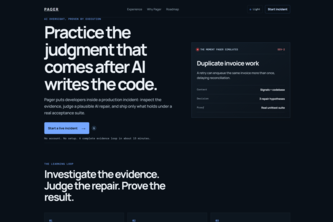
Pager is a browser-based incident simulation platform for developers working with AI coding tools. The product allows users to practice judging AI-generated fixes in realistic production scenarios, using execution-verified tests to determine whether proposed patches are safe.
The description states that Pager simulates real incidents and uses AI (GPT-5.6) to generate repair proposals, but execution of the actual test suite determines if a fix is valid. It includes five initial labs across Python and TypeScript, each tagged with fault classes for transferable learning.
Key commercial signals:
- No revenue or customer data evidenced
- No pricing information provided
- No traction indicators (users, adoption, usage metrics)
- No market positioning beyond self-description
Most important open question: Is there a viable market need for execution-verified AI trust training? The description claims this addresses a gap in current AI assistance tools, but no evidence of demand or competitive response is provided.
What The Product Actually Is
The description states that Pager is:
- An "execution-verified incident simulator for developers working next to AI coding tools"
- A browser-based platform that drops users into realistic production incidents
- An environment where users judge AI repairs and prove fixes through execution of real acceptance suites
- A system with five initial labs (invoice-queue retry, inventory reservation, settlement replay, webhook replay, concurrent-checkout race)
- Built using Next.js, TypeScript, Monaco editor, WebContainer API, Pyodide, Playwright, and GPT-5.6
The product is described as running entirely in-browser with isolated execution environments for Python and TypeScript labs.
Positioning & Claim Evolution
The description states that Pager addresses the gap where "AI writes code fast now. It does not tell you when that code is wrong."
Claims:
- The scarce skill is no longer writing patches, but knowing whether to trust them
- There is no safe place to practice judgment, so developers learn it the hard way from bad production deploys
- Pager is "that safe place" for practicing this judgment
The positioning evolved from a problem statement (AI-generated code breaks in production) to a solution (execution-verified training environment).
Target Customer & ICP
The description states that Pager targets:
- Developers working next to AI coding tools
- Users who want to practice judging AI-generated fixes
- Anyone who needs to evaluate whether AI patches are safe for production
No specific customer segments, personas or job functions are detailed beyond "developers."
Business Model & Pricing Evidence
Not evidenced. The description does not contain any information about:
- Revenue streams
- Pricing models
- Monetization strategy
- Customer acquisition costs
- Unit economics
Technical & Delivery Signals
The description states that Pager uses:
- Next.js App Router with strict TypeScript
- Monaco editor for code editing
- Real in-browser execution via WebContainer API (TypeScript) and Pyodide (Python)
- Playwright for end-to-end testing
- GPT-5.6 for generating incidents and repair proposals
- Codex for platform architecture
- Cross-origin isolation headers for sandboxing
- Manifest-driven content model with JSON manifests
- Browser-based local storage for drafts and progress
Technical claims:
- Real execution, not fake green checks
- Deterministic grading through execution verification
- No hardcoded test results
- Execution as the only grading authority
- Private by default (no account required)
- Optional live coach with bounded AI assistance
Traction & Maturity Signals
Not evidenced. The description does not contain any information about:
- User base or adoption metrics
- Revenue or monetization
- Customer feedback or testimonials
- Product usage patterns
- Market traction indicators
- Growth rates or retention data
Competitive Context
Not evidenced. The description does not contain any information about:
- Competitors in the market
- Market size or growth trends
- Competitive positioning
- Differentiation from existing solutions
- Industry benchmarks or standards
Open Questions & Risks
Inferences based on self-reported information:
- Market validation risk: No evidence of demand, customer traction, or revenue model
- Execution risk: The description states the product runs in-browser with isolated execution, but no details about performance, scalability, or reliability are provided
- AI dependency risk: Heavy reliance on GPT-5.6 and Codex for both content generation and platform architecture
- Limited scope risk: Only five initial labs across two languages (Python and TypeScript)
- Privacy/Security risk: The description mentions "OpenAI key stays server-only" but doesn't clarify how this works or what data is processed
- Sustainability risk: Team size of only 2 members for a complex technical product
Questions the description leaves open
- What specific market problem are you solving, and how do you know there's demand?
- How did you validate the need for this type of training with potential users?
- What is your go-to-market strategy and customer acquisition approach?
- How do you plan to monetize this product given its current free, browser-based nature?
- What are the technical limitations of running execution-verified tests in browsers vs. server-side environments?
- How do you plan to expand beyond the current five labs and two languages?
- What is your roadmap for adding team/classroom functionality?
- How do you handle edge cases where AI-generated fixes might be correct but fail execution due to environmental differences?
Overall Assessment
Not evidenced. The description does not contain any information about:
- Financial performance or projections
- Valuation or funding history
- Strategic fit for potential partners
- Investment thesis or return expectations
- Market opportunity size or competitive advantages
The product appears to be a proof-of-concept with strong technical execution but lacks commercial evidence of traction, demand, or monetization strategy. The self-reported description contains no data about revenue, customers, or market validation.
User Stories BotA demo video on every pull request
Get a demo video on every new feature
GitHub App that watches your pull requests and records a narrated, captioned demo.
Save time on demo prep and make informed decisions faster with a video walkthrough of every new feature.
Source
Submitted to the OpenAI 2026 hackathon on Devpost. Project home on Devpost. Back to the full gallery on Devpost.
This competitive analysis was produced by top-founders.com (opens in a new tab)
Generated by a language model from this project's public Devpost page — its tagline, the author's own write-up and any built-with tags listed there — as captured in August 2026. Short quotations are the author's words. It is an opinion on the idea as a business, not on the people behind it, and it reflects the description as published then. If the project has moved on, request a correction below. The analysis is not independent research and contains no verified traction, revenue or customer data.
An independent guide by KFG International LLC — not affiliated with, endorsed by, or connected to Devpost or OpenAI.