

Archive position — measured, not model output
1 like on Devpost
505 of the 7,850 archived projects have more likes, and 1,758 share exactly 1 — so this project's #2,234 place in the like-ranked listing is a tie-break inside that group, not a ranking.
Projects (log scale)
Likes on Devpost. ▲ marks this project's group.
Show the figures
| Likes | Projects | Share of archive |
|---|---|---|
| 0 | 5,587 | 71.2% |
| 1 | 1,758 | 22.4% |
| 2 | 284 | 3.6% |
| 3–4 | 132 | 1.7% |
| 5–9 | 75 | 1.0% |
| 10+ | 14 | 0.2% |
 User Stories BotA demo video on every pull request
Get a demo video on every new feature
GitHub App that watches your pull requests and records a narrated, captioned demo.
Save time on demo prep and make informed decisions faster with a video walkthrough of every new feature.
Executive Summary
What the company appears to be
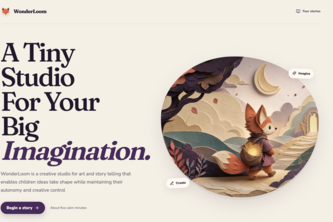
WonderLoom is a self-reported creative storytelling platform for children that uses AI to help them express ideas while maintaining autonomy and creative control. The product is described as an "agentic canvas" where children contribute to story creation through voice or text, with AI acting as a patient guide rather than an autonomous author.
What changed
This appears to be a hackathon project submitted to the OpenAI 2026 hackathon. No evidence of commercial traction, revenue, customers or funding is provided in the description.
Single most important open question
Is there any evidence that this product has been tested with children or parents, and what are the actual technical implementation details for the AI interaction patterns described?
Analysis basis
This analysis is based entirely on the self-reported project description supplied by the caller. It contains no independent verification, archived data, third-party sources or confirmed metrics.
What The Product Actually Is
The description states that WonderLoom is:
- A "multimodal creative canvas" for children
- A web application built with Next.js, React, and TypeScript
- Powered by OpenAI models and SDKs across voice, story, image, narration, and safety systems
- Designed as a "web application" using OpenAI's Realtime Agents SDK and WebRTC
- Built around a "typed story-state machine" that moves through six phases: seed → reveal → edit → transform → pages → finished
The product is described as not being an AI story generator but rather an "experiment in designing creative interfaces for the intelligence augmentation future."
Evidence strength Self-reported, unverified.
Positioning & Claim Evolution
The description states WonderLoom's positioning:
- It is positioned as a "creative studio for art and storytelling"
- The core principle is "the agentic canvas for creative expression that maintains autonomy and self-direction"
- It is described as "not an AI story generator" but rather "an experiment in designing creative interfaces for the intelligence augmentation future"
- The product aims to explore how AI can "augment human imagination while preserving autonomy, authorship, and the ability to create"
The authors claim this represents a different approach from current digital products designed for children that are "optimized primarily for consumption" and "compete for attention through endless feeds, passive entertainment, and highly stimulating experiences."
Evidence strength Self-reported claims about positioning and intent.
Target Customer & ICP
The description states:
- The primary target is "children"
- The product is designed to help children develop "narrative thinking, literacy, self-expression, and creative agency through storytelling"
- It is specifically designed for "childhood" when "imagination, confidence, taste, curiosity, and creative identity are still forming"
- The experience is intended to be "trustworthy for parents"
- The interface uses a "warm, tactile visual language inspired by paper craft, illustrated storybooks, and physical creative materials"
The description does not provide evidence of:
- Specific age ranges
- Parental involvement patterns
- Market segmentation beyond "children"
- Customer personas or user research
Evidence strength Self-reported target demographics and positioning.
Business Model & Pricing Evidence
Not evidenced. The description provides no information about:
- Revenue streams
- Pricing models
- Monetization strategy
- Customer acquisition costs
- Unit economics
- Commercial relationships or partnerships
The description states this is a hackathon submission, with no indication of commercial viability or business model development.
Evidence strength Not evidenced.
Technical & Delivery Signals
The description states:
- Built with JavaScript, Next.js, OpenAI, React, TypeScript
- Uses OpenAI's Realtime Agents SDK and WebRTC for voice interaction
- Implements a "typed story-state machine" moving through six phases
- Uses structured outputs from GPT-5.6 with constrained creative plans
- Has "canonical story state" that records child contributions, characters, locations, story goals, visual descriptions, suggestions accepted/rejected, image revisions, undo history, generation status
- Voice experience supports low-latency speech-to-speech interaction, semantic turn detection, interruptions, transcripts, typed tools
- Image generation operates as a coordinated workflow with "image director" deciding when to wait, reveal, transform, or advance
- Maintains evolving image for active scene rather than generating unrelated illustrations after every sentence
Evidence strength Self-reported technical architecture and implementation details.
Traction & Maturity Signals
Not evidenced. The description provides no evidence of:
- Customer adoption or usage metrics
- Revenue or ARR
- User growth or retention
- Product-market fit validation
- Market traction or customer feedback
- Product development milestones
- Commercial partnerships or pilot programs
The project is described as a hackathon submission to the OpenAI 2026 hackathon, with no indication of commercial deployment or user testing.
Evidence strength Not evidenced.
Competitive Context
The description mentions several research projects and papers that shaped the product:
- Tinker Tales (voice interaction, tangible story elements, educational scaffolding)
- StoryPrompt (AI-supported storytelling and comic creation)
- Connection Is All You Need (multimodal storytelling through drawing, speaking, question-based interaction)
- StoryBuddy (collaborative storytelling with flexible parental involvement)
The description states that current digital products for children are "optimized primarily for consumption" and "compete for attention through endless feeds, passive entertainment, and highly stimulating experiences."
However, no evidence is provided of:
- Direct competitors
- Market analysis or competitive positioning
- Differentiation from existing solutions
- Industry benchmarks or market size
Evidence strength Self-reported references to research projects, not competitive landscape.
Open Questions & Risks
Inferences based on the description:
- Unproven commercial viability: This is a hackathon project with no evidence of traction, revenue or customer validation.
- Technical implementation risks: The described architecture involves complex AI interaction patterns that may be difficult to implement reliably at scale.
- Safety and privacy concerns: The product involves children's data and voice interactions, but no specific safety measures beyond "content moderation" are detailed.
- Market timing risk: The described approach of AI as "creative material and collaborator" rather than autonomous author is novel, but there's no evidence of market demand or validation for this positioning.
- Scalability concerns: The described technical approach using OpenAI models may not be scalable or cost-effective for mass adoption.
Evidence strength Inferences from self-reported description, not independently verified.
Questions the description leaves open
- What specific user research was conducted with children and parents?
- How was the AI interaction pattern tested in practice?
- What are the actual technical limitations of the current implementation?
- Has there been any pilot testing or feedback from educators or child development experts?
- What is the plan for addressing safety, privacy, and ethical concerns around children's data?
- How does the product handle edge cases where children might not respond to prompts?
- What are the actual costs of implementing the described AI interaction patterns?
- How do you plan to validate that the product actually helps children develop narrative thinking and creative agency?
- What is the roadmap for moving from a hackathon prototype to a commercial product?
- How do you intend to measure success beyond user engagement metrics?
Evidence strength Questions based on gaps in self-reported description.
Overall Assessment
Not evidenced. The description provides no information about:
- Financial performance or projections
- Market opportunity size
- Team experience or track record
- Funding history or capital requirements
- Strategic fit for potential partners
- Commercial viability indicators
The project is described as a hackathon submission with no evidence of commercial traction, revenue, customers or funding. The description does not indicate whether this represents a viable business opportunity or strategic asset.
Evidence strength Not evidenced.
User Stories BotA demo video on every pull request
Get a demo video on every new feature
GitHub App that watches your pull requests and records a narrated, captioned demo.
Save time on demo prep and make informed decisions faster with a video walkthrough of every new feature.
Source
Submitted to the OpenAI 2026 hackathon on Devpost. Project home on Devpost. Back to the full gallery on Devpost.
This competitive analysis was produced by top-founders.com (opens in a new tab)
Generated by a language model from this project's public Devpost page — its tagline, the author's own write-up and any built-with tags listed there — as captured in August 2026. Short quotations are the author's words. It is an opinion on the idea as a business, not on the people behind it, and it reflects the description as published then. If the project has moved on, request a correction below. The analysis is not independent research and contains no verified traction, revenue or customer data.
An independent guide by KFG International LLC — not affiliated with, endorsed by, or connected to Devpost or OpenAI.