

Archive position — measured, not model output
0 likes on Devpost
2,263 of the 7,850 archived projects have more likes, and 5,587 share exactly 0 — so this project's #7,683 place in the like-ranked listing is a tie-break inside that group, not a ranking.
Projects (log scale)
Likes on Devpost. ▲ marks this project's group.
Show the figures
| Likes | Projects | Share of archive |
|---|---|---|
| 0 | 5,587 | 71.2% |
| 1 | 1,758 | 22.4% |
| 2 | 284 | 3.6% |
| 3–4 | 132 | 1.7% |
| 5–9 | 75 | 1.0% |
| 10+ | 14 | 0.2% |
 User Stories BotA demo video on every pull request
Get a demo video on every new feature
GitHub App that watches your pull requests and records a narrated, captioned demo.
Save time on demo prep and make informed decisions faster with a video walkthrough of every new feature.
Executive Summary
What the company appears to be
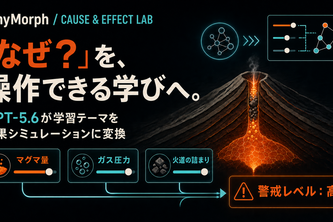
WhyMorph is a self-reported educational tool that transforms scientific “why?” questions into interactive simulations where learners manipulate variables to observe outcomes. It uses AI (specifically GPT-5.6 and Codex) to structure simulation designs, which are then implemented using React, TypeScript, and OpenAI APIs.
What changed
The author describes a shift from traditional educational methods—text, video, or static diagrams—to an interactive model that encourages hypothesis formation and discovery through cause-and-effect manipulation.
Single most important open question
Is there evidence of any traction, revenue, or user adoption beyond the single-person development effort described? The project is presented as a hackathon submission with no indication of commercial deployment or market validation.
Note: This analysis is based solely on the self-reported description provided by the author. No external verification, funding data, customer base, or performance metrics are available. All claims are treated as unverified statements made by the author.
What The Product Actually Is
The description states that WhyMorph:
- Turns “why?” questions into interactive simulations.
- Allows learners to change conditions and observe results.
- Focuses on scientific phenomena involving multiple interacting causes.
- Uses AI (GPT-5.6, Codex) for structuring simulation designs.
- Implements these designs using React, TypeScript, Cloudflare Workers, OpenAI API, and other tools.
- Separates input variables, derived values, state-transition rules, visual effects, explanations, and safety constraints into a reusable architecture.
Inference: The product appears to be an educational prototype or proof-of-concept tool built for learning environments, likely targeting K–12 science education. It is not described as a commercial product or platform with users beyond its creator.
Positioning & Claim Evolution
The author positions WhyMorph as:
- A shift from “read the answer” to “change the causes and discover the answer.”
- An alternative to traditional educational tools like text, videos, or static diagrams.
- A tool that uses AI not just to generate answers but to design interactive learning experiences.
Claim evolution:
The project starts with a personal inspiration—children asking “why?”—and evolves into a technical solution using AI and simulation frameworks. The author emphasizes curiosity-driven learning over rote memorization, suggesting a pedagogical positioning focused on exploration and understanding.
Inference: This is a conceptual and educational positioning rather than a market-ready commercial offering.
Target Customer & ICP
The description states:
- The tool targets learners who ask “why?” questions.
- It focuses on scientific phenomena such as volcanoes, weather systems, earthquakes, etc.
- It aims to support K–12 science education.
- Teachers and educators are mentioned as potential future users who could use GPT-5.6 to generate simulation specs.
Not evidenced:
No specific age groups, grade levels, or institutional buyers are named. No evidence of actual teacher or student adoption exists.
Business Model & Pricing Evidence
The description does not mention:
- Any pricing model
- Revenue streams
- Monetization strategy
- Subscription plans or licensing options
Inference:
There is no indication that WhyMorph has a business model beyond being a prototype. The author envisions a future platform but does not describe how it would be monetized.
Technical & Delivery Signals
The description states:
- Built with React, TypeScript, Cloudflare Workers, OpenAI API, Codex, GPT-5.6.
- Uses structured simulation design principles.
- Separates inputs, derived values, state transitions, visual effects, explanations, and safety constraints.
- Implements reusable architecture for expanding to new topics.
Inference:
The technical stack suggests a modern web-based application with AI integration. The modular architecture implies scalability, though no production deployment or performance data is provided.
Traction & Maturity Signals
The description states:
- It was built as part of an OpenAI 2026 hackathon submission.
- It is currently a single-developer project (team size: 1).
- No mention of users, customers, or adoption metrics.
- No evidence of revenue, ARR, or funding rounds.
Not evidenced:
No traction indicators such as user engagement, downloads, usage statistics, or pilot programs are mentioned. The project remains in early-stage development.
Competitive Context
The description does not reference:
- Competitors
- Existing tools in the educational simulation space
- Market positioning relative to other platforms like PhET, Khan Academy, or Labster
Inference:
No competitive landscape is described. The author does not claim to be solving a known gap or competing with existing solutions.
Open Questions & Risks
Key risks and open questions include:
- Single-person development: No team or support structure implies limited scalability.
- Unverified AI integration: GPT-5.6 is used for design but not validated in practice.
- No commercial traction: No evidence of users, customers, or revenue.
- Lack of product-market fit validation: The project is described as a prototype or hackathon submission.
- Unclear monetization path: No business model or pricing strategy is evident.
Inference: The lack of any commercial or user-facing signals raises concerns about viability beyond the author’s personal vision.
Questions the description leaves open
- Has WhyMorph been tested with actual students or teachers? What feedback was received?
- Are there any plans to validate scientific accuracy through domain experts?
- How does the current architecture scale to support multiple topics and users?
- What is the long-term vision for monetization, if any?
- Is there interest from schools, educational institutions, or EdTech partners?
- How will you ensure consistency between AI-generated simulation rules and real-world science?
Overall Assessment
Assessment:
Not evidenced.
There is no evidence of traction, revenue, customer base, or commercial viability beyond the single-person development effort. The project is described as a hackathon submission with no indication of market readiness or scalability.
Confidence level: Low. The description provides no data to assess product-market fit, financials, or team capability for execution. This is a conceptual prototype, not a validated business opportunity.
User Stories BotA demo video on every pull request
Get a demo video on every new feature
GitHub App that watches your pull requests and records a narrated, captioned demo.
Save time on demo prep and make informed decisions faster with a video walkthrough of every new feature.
Source
Submitted to the OpenAI 2026 hackathon on Devpost. Project home on Devpost. Back to the full gallery on Devpost.
This competitive analysis was produced by top-founders.com (opens in a new tab)
Generated by a language model from this project's public Devpost page — its tagline, the author's own write-up and any built-with tags listed there — as captured in August 2026. Short quotations are the author's words. It is an opinion on the idea as a business, not on the people behind it, and it reflects the description as published then. If the project has moved on, request a correction below. The analysis is not independent research and contains no verified traction, revenue or customer data.
An independent guide by KFG International LLC — not affiliated with, endorsed by, or connected to Devpost or OpenAI.