

Archive position — measured, not model output
1 like on Devpost
505 of the 7,850 archived projects have more likes, and 1,758 share exactly 1 — so this project's #1,796 place in the like-ranked listing is a tie-break inside that group, not a ranking.
Projects (log scale)
Likes on Devpost. ▲ marks this project's group.
Show the figures
| Likes | Projects | Share of archive |
|---|---|---|
| 0 | 5,587 | 71.2% |
| 1 | 1,758 | 22.4% |
| 2 | 284 | 3.6% |
| 3–4 | 132 | 1.7% |
| 5–9 | 75 | 1.0% |
| 10+ | 14 | 0.2% |
 User Stories BotA demo video on every pull request
Get a demo video on every new feature
GitHub App that watches your pull requests and records a narrated, captioned demo.
Save time on demo prep and make informed decisions faster with a video walkthrough of every new feature.
Executive Summary
What the company appears to be: RemNote MCP is a self-reported tool that enables AI agents (such as ChatGPT and Codex) to safely interact with a user's existing RemNote knowledge base through a secure Model Context Protocol (MCP) bridge. It allows agents to read, update, structure, and verify content within the RemNote system without generating isolated documents.
What changed: The author states that RemNote MCP evolved from an internal educational workflow for Phronesis, an educational platform they were building. The project was initially developed using GPT-5.5-based Codex sessions and later extended with GPT-5.6 during OpenAI Build Week to improve reliability, testability, media support, and product readiness.
Single most important open question: Is there any evidence of real-world usage or adoption beyond the author's own development workflow? The description provides no data on customers, revenue, or actual deployment in production environments — only a self-reported engineering narrative.
What The Product Actually Is
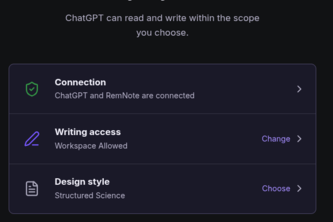
The description states that RemNote MCP is a secure Model Context Protocol bridge that gives MCP clients controlled access to a user's RemNote knowledge base. It consists of two cooperating runtimes:
- An MCP server, built with Node.js, handling discovery, authentication, tool profiles, permission policies, pairing, persistent job state, routing, and diagnostics.
- A RemNote desktop plugin, built with React/TypeScript, maintaining the live bridge, re-checking scope and permissions, performing actual RemNote Plugin API operations, and returning structured results for verification.
The system enables AI agents to:
- Read focused Rems, individual Rems, children, trees, breadcrumbs, cards, and rich text.
- Search existing knowledge.
- Navigate RemNote hierarchy while preserving parent/child ordering.
- Create and update structured notes.
- Preserve formulas, rich text, headings, and stable Rem identity.
- Create flashcards and work with Concept/Descriptor learning structures.
- Import large Markdown sources through resumable jobs.
- Reconcile uncertain operations using live evidence.
- Insert supported media (images, audio, YouTube, direct-video).
- Verify native RemNote structure through readback.
The model runs in the MCP client; RemNote MCP supplies narrowly defined tools through which the agent can operate on the knowledge base. The user remains in control over scope, writing level, and tool profiles.
Inference: This is a developer-facing tool designed to enable AI agents to safely interact with structured knowledge systems like RemNote — not a consumer-facing product or platform.
Positioning & Claim Evolution
The author claims that RemNote MCP was motivated by the need for an AI agent to work with existing knowledge rather than just generate new documents. The original problem was the gap between AI output and the knowledge base used in practice.
Key positioning elements:
- It is not a chatbot embedded in RemNote, but rather an agent-access layer for structured knowledge operations.
- It aims to allow agents to understand, modify, extend, and verify existing knowledge.
- The broader idea is that once useful knowledge lives inside a structured system, generating another isolated document is insufficient.
The project began from an education workflow, but the underlying tool is described as useful anywhere generated or maintained knowledge must remain structured, inspectable, editable, and verifiable after the model finishes responding.
Inference: The positioning has evolved from solving a specific internal problem (Phronesis) to a more general-purpose developer tool for AI interaction with structured knowledge systems. However, no evidence suggests this evolution has led to market traction or commercial adoption.
Target Customer & ICP
The description does not clearly identify a target customer segment or ideal customer profile (ICP). It implies that RemNote MCP is intended for users who already use RemNote and want AI agents to work with their existing knowledge base under their control.
It mentions:
- Users of RemNote desktop.
- Developers working on AI integrations.
- Educational platforms like Phronesis, where structured knowledge management is critical.
However, there is no explicit statement about who the primary users are beyond the author’s own workflow. No mention of enterprise customers, end-users, or specific personas.
Inference: The ICP appears to be technical users or developers working with RemNote and AI agents, but this remains speculative without further evidence.
Business Model & Pricing Evidence
There is no evidence provided regarding business model or pricing. The description focuses entirely on the technical architecture and functionality of RemNote MCP, not its monetization strategy.
Not evidenced: No indication of whether RemNote MCP will be sold as a standalone product, integrated into larger platforms, offered via subscription, or otherwise monetized.
Technical & Delivery Signals
The project is built using:
- Frontend: React 17, TypeScript
- Backend: Node.js, PostgreSQL
- AI Integration: GPT-5.5, GPT-5.6 (via Codex), OpenAI Codex
- Tools: WebSockets, Zod, Vitest, Webpack, Render
- RemNote API: RemNote Plugin API / SDK
Key technical features include:
- Resumable bulk-import jobs.
- Stable mutation identities and duplicate/replay protection.
- Explicit reconciliation for uncertain chunks.
- Revision-aware persistence and legal state transitions.
- Support for rich media insertion (images, audio, video).
- Structured verification through readback.
- Tool profiles and access controls.
The author also mentions:
- 349 automated tests in v0.1.1 release suite.
- Type checking, SDK validation, CI/CD pipeline with PostgreSQL-backed testing.
- Plugin artifact for RemNote review/release.
- Local development path documented for evaluation.
Inference: The tool is built as a developer-focused integration, likely targeting developers or technical teams who want to build AI workflows around structured knowledge bases. It shows signs of being a mature, test-driven engineering effort, but lacks evidence of real-world usage.
Traction & Maturity Signals
The description provides no evidence of traction or user adoption beyond the author's own development process.
It includes:
- A v0.1.1 release artifact.
- Automated regression coverage and CI/CD pipeline.
- Local development setup documented for judges.
- Proof layers across automated tests, CI, deployment, plugin connectivity, live mutation, readback, idempotency, and human media confirmation.
However, there is no mention of:
- Customers or users.
- Revenue or monetization.
- Market feedback or product usage metrics.
- Adoption beyond the author’s own workflow.
Inference: The project appears to be in a pre-commercial phase, likely at MVP or early prototype stage. It has undergone significant engineering effort, but there is no evidence of real-world traction or market validation.
Competitive Context
The description does not provide any information about competitors or the competitive landscape. No mention of similar tools or platforms that offer comparable functionality for AI interaction with structured knowledge systems.
Not evidenced: No indication of existing products or services in this space, nor how RemNote MCP differentiates from them.
Open Questions & Risks
Several potential risks and open questions are implied by the description:
- No market validation: The tool is described as being developed for internal use only (Phronesis), with no evidence of external adoption or demand.
- Highly technical nature: The product requires deep knowledge of both RemNote and AI integration, limiting its accessibility to a niche audience.
- Dependency on RemNote ecosystem: The tool is tied specifically to RemNote desktop, which may limit scalability or portability.
- Unproven commercial viability: There is no evidence of any business model, pricing strategy, or customer base — all claims are self-reported and unverified.
- Self-reporting bias: All information comes from the author’s own account; there is no independent verification or third-party data.
Inference: The tool may be technically sound but lacks commercial traction or viability in a broader market context.
Questions the description leaves open
- What specific use cases outside of your own educational workflow have you identified for RemNote MCP?
- Have you engaged with any external users or partners to validate the need for this tool?
- How do you plan to monetize or distribute RemNote MCP beyond the current open-source/developer preview approach?
- Are there any known limitations or edge cases in how the tool interacts with different versions of RemNote or AI models?
- What is your roadmap for expanding support beyond RemNote desktop and into other knowledge management platforms?
Overall Assessment
Based on the self-reported description, RemNote MCP appears to be a technically sophisticated developer tool designed to enable AI agents to safely interact with structured knowledge systems like RemNote. It demonstrates strong engineering rigor, including automated testing, CI/CD pipelines, and resumable workflows.
However, there is no evidence of traction, customers, or commercial viability beyond the author’s own development process. The tool is described as a solution to an internal problem (Phronesis), with no indication that it has been adopted by others or validated in the market.
Confidence level: Low — this analysis is based entirely on self-reported information, and the lack of external validation makes it difficult to assess commercial potential or risk.
Assessment: Not ready for investment or partnership at this stage. Further evidence of traction, customer engagement, or a clear path to monetization would be required before considering deeper due diligence.
User Stories BotA demo video on every pull request
Get a demo video on every new feature
GitHub App that watches your pull requests and records a narrated, captioned demo.
Save time on demo prep and make informed decisions faster with a video walkthrough of every new feature.
Source
Submitted to the OpenAI 2026 hackathon on Devpost. Project home on Devpost. Back to the full gallery on Devpost.
This competitive analysis was produced by top-founders.com (opens in a new tab)
Generated by a language model from this project's public Devpost page — its tagline, the author's own write-up and any built-with tags listed there — as captured in August 2026. Short quotations are the author's words. It is an opinion on the idea as a business, not on the people behind it, and it reflects the description as published then. If the project has moved on, request a correction below. The analysis is not independent research and contains no verified traction, revenue or customer data.
An independent guide by KFG International LLC — not affiliated with, endorsed by, or connected to Devpost or OpenAI.