

Archive position — measured, not model output
0 likes on Devpost
2,263 of the 7,850 archived projects have more likes, and 5,587 share exactly 0 — so this project's #5,722 place in the like-ranked listing is a tie-break inside that group, not a ranking.
Projects (log scale)
Likes on Devpost. ▲ marks this project's group.
Show the figures
| Likes | Projects | Share of archive |
|---|---|---|
| 0 | 5,587 | 71.2% |
| 1 | 1,758 | 22.4% |
| 2 | 284 | 3.6% |
| 3–4 | 132 | 1.7% |
| 5–9 | 75 | 1.0% |
| 10+ | 14 | 0.2% |
 User Stories BotA demo video on every pull request
Get a demo video on every new feature
GitHub App that watches your pull requests and records a narrated, captioned demo.
Save time on demo prep and make informed decisions faster with a video walkthrough of every new feature.
Executive Summary
What the company appears to be
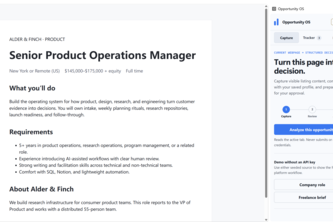
Opportunity OS is a self-reported local-first Chrome extension that supports job and freelance applicants by analyzing listings against a user’s profile, generating match scores, recommendations, evidence, risks, draft applications, and tailored CV suggestions — all while requiring human approval before any action.
What changed
The project started as a personal tool to automate repetitive steps in the job search process. It evolved into a structured extension with a local server, JSON schema, and deterministic demo mode, built using Codex and GPT-5.6.
The single most important open question
Is there evidence of user adoption or traction beyond the author’s own use cases?
Analysis basis
This report is based entirely on the self-reported description provided by the project author. No independent verification, revenue data, customer list, or traction metrics are available. All claims are treated as stated by the author and not proven.
What The Product Actually Is
- The description states that Opportunity OS is a local-first Chrome copilot for job and freelance applications.
- It consists of:
- A Manifest V3 Chrome extension
- A local Node.js server
- The extension captures visible content from job listings, extracts structured data (role, company, compensation, location, requirements, responsibilities), and compares it with a user-defined candidate profile.
- It provides:
- Match score
- Apply/Review/Skip recommendation
- Evidence from listing and profile
- Risk assessment
- Draft proposal or cover letter
- CV tailoring suggestions
- Questions to ask employer/client
- The result is saved locally in Chrome storage, with no automatic submission.
- The system includes a deterministic demo engine that works without an API key, and optional integration with the GPT-5.6 Responses API.
Inference The tool appears to be built for personal use or early-stage testing rather than large-scale deployment. It is not described as having any cloud-based data storage or external integrations beyond local Chrome storage and optional GPT APIs.
Positioning & Claim Evolution
- The description states that Opportunity OS was inspired by the author’s own job search frustrations.
- It evolved from a manual, repetitive process into an automated tool with structured workflows.
- The author claims it helps users:
- Avoid repeating decisions
- Make better choices before drafting applications
- Save time on repetitive tasks
- The positioning is that of a decision-support assistant, not a full automation or application submission tool.
- It emphasizes human control and local-first design — no data leaves the browser unless explicitly approved.
Inference The product’s positioning has shifted from a personal hack to a structured, reusable tool. However, there is no evidence of external feedback, user testing, or market validation beyond the author's own use case.
Target Customer & ICP
- The description states that Opportunity OS targets job and freelance applicants.
- It is designed for individuals who:
- Are actively searching for opportunities
- Want to make informed decisions about applications
- Prefer human control over AI-generated actions
- The tool is built for a single-user, self-service model.
- There is no mention of enterprise or team use cases.
Inference The ICP appears to be a self-employed individual or job seeker, likely in tech or creative fields. No evidence suggests targeting recruiters, HR teams, or platforms.
Business Model & Pricing Evidence
- The description does not state any pricing model.
- It is described as a local-first tool with no cloud-based services or subscriptions.
- There is no mention of monetization, licensing, or paid features.
- The author notes that the system can be used without an API key, suggesting a free tier or open-source approach.
Inference No business model or pricing evidence is provided. It appears to be a personal tool with no commercial intent at this stage.
Technical & Delivery Signals
- Built using:
- Chrome extension (Manifest V3)
- Node.js server
- Codex + GPT-5.6
- JSON schema for structured output
- Local storage for data persistence
- The system includes:
- A deterministic demo mode
- Optional API integration with GPT-5.6
- Automated tests (11 passed)
- It is described as a self-contained, local-first solution.
- Source code and documentation are published in a public GitHub repository.
Inference The technical stack suggests a developer-focused prototype, not a production-ready product. The use of Codex implies a rapid prototyping approach rather than a scalable architecture.
Traction & Maturity Signals
- The author reports:
- Testing with real freelance listings
- Replacing sample data with personal profile
- Running the extension against actual job sites
- Passing 11 automated tests
- Publishing source code and documentation
- No evidence of:
- User adoption or feedback
- Customer base or usage metrics
- Revenue, ARR, or funding rounds
- Product-market fit validation
Inference The project shows early-stage development maturity but lacks any traction signals. It is described as a prototype or personal tool, not a product in the market.
Competitive Context
- The description does not mention competitors.
- No evidence of market analysis or differentiation from existing tools.
- Opportunity OS appears to be unique in its local-first approach and emphasis on human approval.
- It may compete with:
- Generic job search tools
- AI resume builders
- Application tracking systems (ATS)
- Freelance platforms
Inference No competitive landscape is described. The tool’s positioning as a decision-support assistant suggests it may not directly compete with existing ATS or job boards, but rather complements them.
Open Questions & Risks
- No user adoption or traction — the project is self-reported and lacks evidence of external use.
- Single-person team — no evidence of scaling beyond one developer.
- Local-first design may limit scalability or integration with larger platforms.
- No monetization strategy — unclear how it would transition to a revenue-generating model.
- Self-reported data only — no independent validation of claims, performance, or usage.
Inference The project is in an early stage and lacks commercial viability signals. It may be a prototype or personal tool with limited market relevance.
Questions the description leaves open
- What external feedback or user testing has been conducted beyond the author’s own use cases?
- Are there any plans to monetize or scale the product beyond its current local-first design?
- How does the system handle edge cases or inconsistencies in job listing formats across platforms?
- Has the tool been tested with other users, and what were their experiences?
- What are the long-term goals for platform support, automation, and integration?
Overall Assessment
- The project is self-reported, unverified, and early-stage.
- It lacks evidence of traction, revenue, or commercial adoption.
- It is described as a personal tool or prototype, not a product in the market.
- No funding, customers, or business model are evident.
Assessment Not ready for investment or partnership. The project shows potential but requires further development, user validation, and commercial traction to be considered viable.
User Stories BotA demo video on every pull request
Get a demo video on every new feature
GitHub App that watches your pull requests and records a narrated, captioned demo.
Save time on demo prep and make informed decisions faster with a video walkthrough of every new feature.
Source
Submitted to the OpenAI 2026 hackathon on Devpost. Project home on Devpost. Back to the full gallery on Devpost.
This competitive analysis was produced by top-founders.com (opens in a new tab)
Generated by a language model from this project's public Devpost page — its tagline, the author's own write-up and any built-with tags listed there — as captured in August 2026. Short quotations are the author's words. It is an opinion on the idea as a business, not on the people behind it, and it reflects the description as published then. If the project has moved on, request a correction below. The analysis is not independent research and contains no verified traction, revenue or customer data.
An independent guide by KFG International LLC — not affiliated with, endorsed by, or connected to Devpost or OpenAI.