

Archive position — measured, not model output
0 likes on Devpost
2,263 of the 7,850 archived projects have more likes, and 5,587 share exactly 0 — so this project's #5,723 place in the like-ranked listing is a tie-break inside that group, not a ranking.
Projects (log scale)
Likes on Devpost. ▲ marks this project's group.
Show the figures
| Likes | Projects | Share of archive |
|---|---|---|
| 0 | 5,587 | 71.2% |
| 1 | 1,758 | 22.4% |
| 2 | 284 | 3.6% |
| 3–4 | 132 | 1.7% |
| 5–9 | 75 | 1.0% |
| 10+ | 14 | 0.2% |
 User Stories BotA demo video on every pull request
Get a demo video on every new feature
GitHub App that watches your pull requests and records a narrated, captioned demo.
Save time on demo prep and make informed decisions faster with a video walkthrough of every new feature.
Executive Summary
Company: OPS ELITE
Self-reported purpose: An offline-first platform for underground mining that connects operational activity directly to management to enable faster, accountable decisions.
Key claim: The system reduces the time between an underground event and management action by capturing structured, actionable data from frontline workers and synchronizing it when connectivity returns.
What changed: The author describes building a prototype of a connected web application with frontend, backend, and database components, using AI tools like Codex and GPT-5.6 to aid development.
Most important open question: Is there evidence that the system has been tested with real underground users or integrated into actual mining operations?
This is a self-reported, unverified account of a hackathon project. No revenue, customers, traction or independent validation are evidenced.
What The Product Actually Is
The description states that OPS ELITE is an offline-first operational visibility platform for underground mining. It was built as a connected web application, with:
- A frontend (used by panel supervisors and shift supervisors)
- A backend API
- A structured database
It includes two main modules:
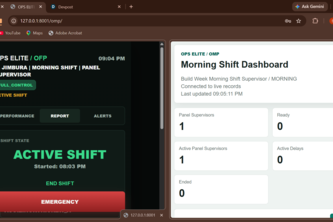
- OFP: Used by panel supervisors to start shifts, complete safety examinations, report delays, and record shift outcomes.
- OMP: Used by shift supervisors to monitor active workplaces, delays, and operational status.
The system is designed to extend visibility through mine overseers, section managers, and ultimately the general manager.
Inference: The author built this using AI tools like Codex and GPT-5.6 for development tasks such as code inspection, feature building, debugging, refactoring, and testing.
Positioning & Claim Evolution
The description states that OPS ELITE was inspired by the need to move critical operational information faster and accurately from underground to management. It aims to reduce delays in visibility, weaken accountability, and slow decision-making caused by fragmented reporting systems.
It positions itself as a solution for offline-first mining operations, where connectivity is unreliable. The author claims that it allows critical information to be captured locally, prioritized, and synchronized when connectivity returns.
The system is described as being designed around real underground roles, reporting structures, and operating conditions, suggesting an attempt at user-centric design.
Inference: The product evolved from a hackathon prototype into a conceptual platform for operational visibility in mining. It claims to bridge the gap between field-level data capture and management decision-making.
Target Customer & ICP
The description identifies underground miners and supervisors as primary users:
- Panel supervisors (using OFP)
- Shift supervisors (using OMP)
It also mentions that the system is designed to extend visibility to:
- Mine overseers
- Section managers
- General manager
There is no mention of external partners, end-users beyond mining personnel, or B2B customers.
Inference: The ICP appears to be mining operations with underground workflows, particularly those needing offline data capture and management visibility. No evidence of segmentation or targeting other industries.
Business Model & Pricing Evidence
The description does not state anything about pricing, monetization, or business model.
There is no mention of:
- Revenue streams
- Subscription tiers
- Licensing models
- Customer acquisition costs
- Unit economics
Not evidenced
Technical & Delivery Signals
The system was built using:
- Frontend: HTML5, CSS3, JavaScript
- Backend: Flask, REST API
- Database: PostgreSQL
- AI tools: Codex, GPT-5.6
- Other: Supabase, GitHub, Python
The author notes that the system follows an offline-first principle, allowing local data capture and synchronization when connectivity returns.
Inference: The technical stack suggests a modern web application with backend API support and database integration. Use of AI tools implies a developer-centric approach to rapid prototyping and debugging.
Traction & Maturity Signals
The description states that the system is a prototype, built during a hackathon (OpenAI 2026). It includes:
- A working connected workflow
- Role-based separation of tasks
- Offline-first design
- Integration of real-world workflows
However, there is no evidence of:
- Real user testing
- Production deployment
- Customer feedback
- Revenue or usage metrics
- Product-market fit validation
Not evidenced
Competitive Context
The description does not mention any competitors or existing solutions in the underground mining operational visibility space.
There is no reference to:
- Existing platforms for mining operations
- Similar offline-first systems
- Market size or competitive dynamics
Not evidenced
Open Questions & Risks
- Unverified claims: All statements are self-reported and unverified.
- Prototype only: No evidence of real-world deployment or user testing.
- Single-founder project: The team is listed as one person, raising questions about execution capacity.
- No commercial traction: No revenue, customers, or adoption data.
- AI dependency: Heavy reliance on AI tools (Codex, GPT-5.6) may not scale or be replicable in production.
- Offline-first assumption: May not reflect real-world connectivity challenges or user behavior.
Questions the description leaves open
- Has the system been tested with actual underground miners or supervisors?
- What specific mining operations or structures was it designed for, and how configurable is it?
- How does it handle data integrity and synchronization in low-connectivity environments?
- Are there any existing partnerships or pilot programs with mining companies?
- What are the key assumptions about user behavior and workflow adoption?
- How will the system evolve beyond the prototype stage?
Overall Assessment
Not evidenced
The project is described as a hackathon prototype, built by one person, without any evidence of traction, revenue, or customer validation. It is positioned as a solution for underground mining but lacks commercial due-diligence signals.
Confidence level: Low
Next steps: If this were a real opportunity, further due diligence would require:
- Real user feedback
- Pilot testing in actual operations
- Evidence of scalability and configurability
- Commercial model validation
Until then, the description remains a self-reported idea, not a product with demonstrated market or technical viability.
User Stories BotA demo video on every pull request
Get a demo video on every new feature
GitHub App that watches your pull requests and records a narrated, captioned demo.
Save time on demo prep and make informed decisions faster with a video walkthrough of every new feature.
Source
Submitted to the OpenAI 2026 hackathon on Devpost. Project home on Devpost. Back to the full gallery on Devpost.
This competitive analysis was produced by top-founders.com (opens in a new tab)
Generated by a language model from this project's public Devpost page — its tagline, the author's own write-up and any built-with tags listed there — as captured in August 2026. Short quotations are the author's words. It is an opinion on the idea as a business, not on the people behind it, and it reflects the description as published then. If the project has moved on, request a correction below. The analysis is not independent research and contains no verified traction, revenue or customer data.
An independent guide by KFG International LLC — not affiliated with, endorsed by, or connected to Devpost or OpenAI.