

Archive position — measured, not model output
0 likes on Devpost
2,263 of the 7,850 archived projects have more likes, and 5,587 share exactly 0 — so this project's #7,686 place in the like-ranked listing is a tie-break inside that group, not a ranking.
Projects (log scale)
Likes on Devpost. ▲ marks this project's group.
Show the figures
| Likes | Projects | Share of archive |
|---|---|---|
| 0 | 5,587 | 71.2% |
| 1 | 1,758 | 22.4% |
| 2 | 284 | 3.6% |
| 3–4 | 132 | 1.7% |
| 5–9 | 75 | 1.0% |
| 10+ | 14 | 0.2% |
 User Stories BotA demo video on every pull request
Get a demo video on every new feature
GitHub App that watches your pull requests and records a narrated, captioned demo.
Save time on demo prep and make informed decisions faster with a video walkthrough of every new feature.
Executive Summary
What the company appears to be
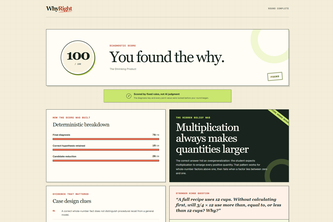
WhyRight is a synthetic educational simulation tool built for educators to practice diagnostic questioning. It presents a fixed scenario (e.g., fraction multiplication or seasons across hemispheres) and simulates a learner who holds a correct answer but an incorrect mental model. The educator asks up to three open-ended questions in 90 seconds, with GPT-5.6 responding as that learner while remaining constrained to the fixed misconception. The system evaluates the educator’s reasoning path using deterministic scoring logic.
What changed
The project is a self-contained prototype submitted to the OpenAI 2026 hackathon. It does not appear to have moved beyond this stage, nor does it show evidence of product-market fit, customer traction or commercial deployment.
Single most important open question
Is there any evidence that WhyRight has been used by educators in real-world settings, or whether it will be adapted into a scalable educational tool?
What The Product Actually Is
The description states:
- WhyRight is a responsive Next.js application with three server routes for session creation, live turns, and diagnosis.
- It uses GPT-5.6 via the OpenAI Responses API with Structured Outputs to simulate a learner holding a fixed misconception.
- The hidden belief, answer key, candidate labels, and scoring rules are fixed application data co-designed with Codex.
- Session state is sealed in an authenticated AES-256-GCM token, preventing tampering or access to the hidden belief.
Inference The product simulates a learner’s response using GPT-5.6 under strict constraints, but does not collect or store real user data beyond session tokens.
Positioning & Claim Evolution
The description states:
- The goal is not to evaluate real students, but to give educators a safe synthetic space to practice identifying the model behind an answer.
- It turns diagnostic questioning into a short, replayable investigation.
- It focuses on helping teachers ask questions that make competing explanations predict different answers.
Inference The positioning is educational and training-oriented, not for assessment or classroom deployment. The tool is framed as a practice environment for educators.
Target Customer & ICP
The description states:
- The target audience is educators who want to practice diagnostic questioning.
- It simulates learners with correct answers but incorrect mental models.
- It does not collect student records, grades, or login details.
Inference The ICP appears to be teachers or instructional designers working in education, particularly those focused on improving diagnostic teaching practices.
Business Model & Pricing Evidence
Not evidenced.
Explanation
There is no mention of pricing, monetization, or business model in the description. The project is presented as a hackathon submission with no indication of commercial intent or revenue streams.
Technical & Delivery Signals
The description states:
- Built with Next.js, React, TypeScript, Node.js, OpenAI API (GPT-5.6), and Structured Outputs.
- Uses AES-256-GCM encryption for session tokens.
- Session state is short-lived and authenticated.
- Server-side validation ensures question length, turn count, candidate monotonicity, token integrity, diagnosis readiness, and model output correctness.
- The score path never calls GPT; it is deterministic.
Inference The technical stack is modern and secure, with clear separation between simulation and scoring logic. The use of structured outputs and server-side validation suggests a deliberate approach to control and reproducibility.
Traction & Maturity Signals
Not evidenced.
Explanation
There is no evidence of customer adoption, usage metrics, or product maturity beyond a hackathon prototype. No revenue, headcount, or user data are mentioned.
Competitive Context
Not evidenced.
Explanation
The description does not mention competitors or the broader market landscape for diagnostic teaching tools or educational AI simulations.
Open Questions & Risks
- No real-world usage or feedback: The product is described as a prototype with no classroom piloting or user testing.
- Limited scope: MVP is restricted to two fixed scenarios, no accounts, and no database.
- Unverified effectiveness: The tool does not claim to improve learning outcomes or has been validated in practice.
- No commercialization path: No evidence of a plan for scaling or monetizing the product.
Questions the description leaves open
- Has WhyRight been tested with real educators or teachers? If so, what were the results?
- What is the intended evolution from this prototype to a scalable educational tool?
- Are there plans to expand beyond the two current scenarios?
- How does the team plan to validate that the diagnostic questioning improves actual teaching practices?
- Is there any interest in partnering with schools or educational institutions?
Overall Assessment
Not evidenced.
Explanation
There is no evidence of traction, revenue, or a clear path to market. The project is described as a hackathon prototype and does not show signs of commercial viability or strategic fit for investment or partnership at this stage.
User Stories BotA demo video on every pull request
Get a demo video on every new feature
GitHub App that watches your pull requests and records a narrated, captioned demo.
Save time on demo prep and make informed decisions faster with a video walkthrough of every new feature.
Source
Submitted to the OpenAI 2026 hackathon on Devpost. Project home on Devpost. Back to the full gallery on Devpost.
This competitive analysis was produced by top-founders.com (opens in a new tab)
Generated by a language model from this project's public Devpost page — its tagline, the author's own write-up and any built-with tags listed there — as captured in August 2026. Short quotations are the author's words. It is an opinion on the idea as a business, not on the people behind it, and it reflects the description as published then. If the project has moved on, request a correction below. The analysis is not independent research and contains no verified traction, revenue or customer data.
An independent guide by KFG International LLC — not affiliated with, endorsed by, or connected to Devpost or OpenAI.