

Archive position — measured, not model output
0 likes on Devpost
2,263 of the 7,850 archived projects have more likes, and 5,587 share exactly 0 — so this project's #7,684 place in the like-ranked listing is a tie-break inside that group, not a ranking.
Projects (log scale)
Likes on Devpost. ▲ marks this project's group.
Show the figures
| Likes | Projects | Share of archive |
|---|---|---|
| 0 | 5,587 | 71.2% |
| 1 | 1,758 | 22.4% |
| 2 | 284 | 3.6% |
| 3–4 | 132 | 1.7% |
| 5–9 | 75 | 1.0% |
| 10+ | 14 | 0.2% |
 User Stories BotA demo video on every pull request
Get a demo video on every new feature
GitHub App that watches your pull requests and records a narrated, captioned demo.
Save time on demo prep and make informed decisions faster with a video walkthrough of every new feature.
Executive Summary
What the company appears to be
WhyNotNow is a self-reported Codex plugin that enables users to defer tasks with contextual reasoning, storing why a task was postponed so it can return with context. The product is described as a local, privacy-first tool built for developers or AI users who want to reflect on decisions without losing information.
What changed
The project was submitted to the OpenAI 2026 hackathon and is presented as a proof-of-concept for a workflow that treats “not now” as an intentional pause rather than a forgotten item. It uses Codex, Node.js, and local structured storage to build a three-state task dashboard.
Single most important open question
Is there any evidence of user adoption or feedback beyond the author’s own description? The project is described as a hackathon submission with no revenue, customers, or traction data.
What The Product Actually Is
The description states:
- WhyNotNow is a Codex skill (plugin) that remembers why not now.
- It allows users to capture tasks, discuss why they should wait using Codex, and later resume them with context.
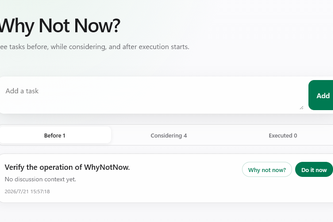
- It includes a dashboard with three states: Before, Considering, and Executed.
- The tool is built as a Node.js MCP server, uses local structured storage, and has a lightweight local dashboard.
- It is described as a privacy-first workflow, keeping all data on the device.
Inference: The product appears to be a developer-focused AI assistant extension that supports reflection over execution, with no external dependencies or cloud services.
Positioning & Claim Evolution
The description states:
- The project aims to make “not now” an intentional decision rather than a forgotten item.
- It is positioned as a tool that helps users capture context around deferred tasks.
- It emphasizes privacy, locality, and simplicity.
- The authors claim it respects intentional delay instead of pushing toward immediate action.
Inference: The positioning is centered on intentional AI interaction and user control over task execution, not on automation or productivity gains.
Target Customer & ICP
The description states:
- The tool is built with Codex, suggesting a target audience of developers or AI users.
- It uses Node.js MCP server, which implies technical users.
- The dashboard and plugin are described as lightweight, local, and privacy-first.
Inference: The ICP appears to be technical users (e.g., developers, AI researchers) who use Codex and value local data control and reflection-based workflows.
Business Model & Pricing Evidence
The description states:
- No pricing or monetization model is described.
- It is a local tool, with no mention of subscriptions, fees, or paid features.
- The tool is built for personal use or developer experimentation.
Inference: There is no evidence of a business model or pricing structure beyond the author’s own description.
Technical & Delivery Signals
The description states:
- Built with Codex, CSS, esbuild, HTML, JavaScript, MCP, Node.js, and npm.
- Uses a Node.js MCP server for integration.
- Employs local structured storage.
- Has a lightweight local dashboard.
- Separates “Why not now?” conversations from execution sessions.
Inference: The tool is built with modern developer tools, and the architecture suggests a lightweight, local-first approach, with clear separation of concerns between reflection and execution.
Traction & Maturity Signals
The description states:
- It was submitted to the OpenAI 2026 hackathon.
- It is described as a proof-of-concept.
- No user feedback, adoption metrics, or usage data are provided.
- The team size is listed as 1.
Inference: There is no evidence of traction, customers, or maturity beyond the hackathon submission.
Competitive Context
The description states:
- No mention of competitors or similar tools.
- It is positioned as a novel approach to task management and AI interaction.
Inference: The project does not appear to have a clearly defined competitive landscape, nor does it reference existing tools in the space.
Open Questions & Risks
The description states:
- It is a single-person hackathon project.
- No revenue, customers, or traction data are provided.
- It is described as a proof-of-concept, not a product.
- The tool is local-only, which may limit scalability or appeal.
Inference:
- Risk of limited commercial viability due to lack of traction and user feedback.
- Risk of low adoption due to its niche, local-first approach.
- Risk of no clear path to monetization or growth.
Questions the description leaves open
- What is the intended user base beyond developers?
- Have you tested this with real users or gathered feedback beyond your own use case?
- How do you plan to scale beyond a single-person hackathon project?
- Is there any intention to move away from local-only storage or expand into cloud-based features?
- What is the long-term vision for monetization, if any?
Overall Assessment
The description states:
- This is a hackathon submission with no evidence of revenue, customers, or traction.
- The tool is described as local, privacy-first, and simple.
- It is built by a single person.
Inference:
- Not evidenced as a viable investment or partnership opportunity at this stage.
- The project lacks commercial signals, user feedback, or scalability indicators.
- It may be an early-stage idea with potential for further development, but no evidence supports current viability.
User Stories BotA demo video on every pull request
Get a demo video on every new feature
GitHub App that watches your pull requests and records a narrated, captioned demo.
Save time on demo prep and make informed decisions faster with a video walkthrough of every new feature.
Source
Submitted to the OpenAI 2026 hackathon on Devpost. Project home on Devpost. Back to the full gallery on Devpost.
This competitive analysis was produced by top-founders.com (opens in a new tab)
Generated by a language model from this project's public Devpost page — its tagline, the author's own write-up and any built-with tags listed there — as captured in August 2026. Short quotations are the author's words. It is an opinion on the idea as a business, not on the people behind it, and it reflects the description as published then. If the project has moved on, request a correction below. The analysis is not independent research and contains no verified traction, revenue or customer data.
An independent guide by KFG International LLC — not affiliated with, endorsed by, or connected to Devpost or OpenAI.