

Archive position — measured, not model output
0 likes on Devpost
2,263 of the 7,850 archived projects have more likes, and 5,587 share exactly 0 — so this project's #7,682 place in the like-ranked listing is a tie-break inside that group, not a ranking.
Projects (log scale)
Likes on Devpost. ▲ marks this project's group.
Show the figures
| Likes | Projects | Share of archive |
|---|---|---|
| 0 | 5,587 | 71.2% |
| 1 | 1,758 | 22.4% |
| 2 | 284 | 3.6% |
| 3–4 | 132 | 1.7% |
| 5–9 | 75 | 1.0% |
| 10+ | 14 | 0.2% |
 User Stories BotA demo video on every pull request
Get a demo video on every new feature
GitHub App that watches your pull requests and records a narrated, captioned demo.
Save time on demo prep and make informed decisions faster with a video walkthrough of every new feature.
Executive Summary
What the company appears to be:
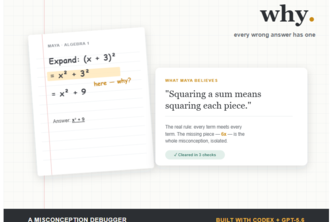
The author describes a product named Why, which uses AI to diagnose student misconceptions in math and science by analyzing wrong answers. It claims to go beyond simple correction by identifying the belief behind an error, visualizing it, and helping students fix it permanently.
What changed:
This is a self-reported project submitted for the OpenAI 2026 hackathon. The author states they built it end-to-end using Codex and GPT-5.6, with no external funding or traction evidence provided.
Single most important open question:
Is Why capable of reliably diagnosing student misconceptions at scale, or is this a prototype that works in limited contexts?
What The Product Actually Is
The description states that Why takes photos or typed transcriptions of student work and processes them through the following steps:
- Transcription: Uses GPT-5.6 vision to transcribe the work accurately.
- Diagnosis: Identifies where a student’s reasoning diverged from correct logic, inferring the belief that caused the mistake.
- Visualization: Shows an interactive visualization (e.g., area model, number line) based on the student's actual numbers.
- Verification: Presents three new problems to test if the misconception has been fixed.
- Memory: Maintains a private map of all misconceptions per student, with spaced rechecks.
The system is described as generalizable across subjects like geometry, fractions, exponents, statistics, physics, and chemistry, using both curated taxonomy and live GPT-5.6 reasoning.
Evidence:
- The author describes the full pipeline from input to output.
- It uses React/TypeScript frontend, Node/Express backend, SQLite, and GPT-5.6.
- The product includes interactive widgets and adaptive question generation.
Inference:
This is a diagnostic tool for education that attempts to move beyond correction toward conceptual understanding.
Positioning & Claim Evolution
The author positions Why as an alternative to traditional AI homework tools that simply mark answers wrong. Instead, it aims to:
- Diagnose the root belief behind a mistake.
- Fix it visually and interactively.
- Prevent recurrence through spaced repetition.
Evidence:
- The tagline: “An AI that doesn't grade wrong answers — it diagnoses the belief that caused them, then fixes it for good.”
- The author’s own write-up emphasizes that the product is not just about showing the right answer but understanding why a student went wrong.
- The claim of “no amount of ‘here’s the right answer’ fixes a belief that’s still there” frames a shift in pedagogical approach.
Inference:
The positioning suggests a move toward personalized, belief-based learning — a niche within edtech focused on conceptual mastery rather than rote memorization or practice.
Target Customer & ICP
The author states that Why is designed for students working through math and science problems. It targets learners who make systematic errors due to misconceptions, not random mistakes.
Evidence:
- The focus is on students who write wrong answers because of a belief (e.g., “freshman’s dream”) rather than carelessness.
- The product supports multiple subjects including algebra, geometry, fractions, exponents, basic statistics, physics, and chemistry.
Inference:
The target customer is likely K–12 students or early college learners in STEM fields. The ICP (Ideal Customer Profile) appears to be a student with recurring conceptual errors needing deeper intervention than standard feedback.
Business Model & Pricing Evidence
No information about pricing, monetization, or business model is provided in the description.
Evidence:
- No mention of subscription plans, usage fees, or institutional licensing.
- No indication of whether this will be sold to schools, parents, or directly to students.
- No reference to teacher accounts, class dashboards, or multi-user functionality beyond “Class view.”
Inference:
The project is currently a prototype submitted for a hackathon. There is no evidence of any commercialization strategy.
Technical & Delivery Signals
The author built the entire system using Codex and GPT-5.6 in one continuous session. Key technical components include:
- Frontend: React/TypeScript
- Backend: Node/Express
- Database: SQLite
- AI: GPT-5.6 for transcription, classification, visualization, and question generation
- Tools used: Zod validation, Vitest, Tailwind, Framer Motion, Vercel
Evidence:
- The stack is listed in detail.
- The author claims to have used Codex extensively across all layers — UI, logic, tests, schema.
- Specific decisions are noted (e.g., enforcing live model calls, strict data isolation).
Inference:
The product is built with a strong emphasis on AI integration and rapid prototyping. However, there’s no evidence of scalability or production-grade infrastructure.
Traction & Maturity Signals
There is no evidence of any traction, revenue, customers, or adoption beyond the author’s own development.
Evidence:
- The project was submitted to a hackathon.
- No mention of users, usage metrics, or feedback from real students or teachers.
- No indication of product-market fit or market validation.
Inference:
This is an early-stage prototype with no demonstrated traction. It has not yet reached a user base or proven commercial viability.
Competitive Context
The description does not provide any information about competitors or how Why compares to existing tools in the edtech space.
Evidence:
- No mention of competing platforms, AI tutoring systems, or educational software.
- No reference to market size, segment analysis, or competitive positioning.
Inference:
Without context, it’s unclear whether Why addresses a gap in the market or replicates existing offerings. It may compete with tools like Khan Academy, Photomath, or AI-powered tutoring platforms, but this is speculative.
Open Questions & Risks
Several risks and open questions are evident from the self-reported description:
- Unproven AI reliability: The system relies heavily on GPT-5.6 for diagnosis and reasoning — no evidence of accuracy or consistency in real-world use.
- Limited scope: While described as generalizable, the author only demonstrates depth in algebra.
- No production infrastructure: Built with SQLite and a single developer; no mention of scalability or robustness.
- Unverified claims: The author states that “the same diagnostic engine generalizes” — but provides no data to support this.
- Design vs. functionality tension: The emphasis on avoiding an “AI aesthetic” may hinder usability or perceived value.
Evidence:
- The author admits to catching bugs during development (e.g., mocked responses, data leaks).
- No mention of testing with real students or educators.
- No evidence of performance benchmarks or accuracy metrics.
Inference:
This is a prototype that has not been validated in practice. It may fail at scale or in real-world settings due to over-reliance on AI and lack of user feedback loops.
Questions the description leaves open
- What specific data or metrics do you have on the accuracy of your misconception classification?
- How do you plan to expand the taxonomy beyond algebra into other subjects?
- Have you tested Why with real students or teachers? If so, what were the results?
- Is there a path toward monetization or institutional adoption?
- What are the technical limitations of relying on GPT-5.6 for diagnosis and interaction?
- How do you ensure privacy and data security for student profiles?
Overall Assessment
Not evidenced:
There is no evidence of revenue, customers, traction, or financials to support an investment or partnership decision.
Confidence level:
Very low — this is a self-reported hackathon project with no external validation or commercial evidence.
Assessment:
This is an early-stage idea with strong conceptual appeal but no demonstrated product-market fit, traction, or scalability. It would require significant further development and testing before any serious consideration for investment or partnership.
User Stories BotA demo video on every pull request
Get a demo video on every new feature
GitHub App that watches your pull requests and records a narrated, captioned demo.
Save time on demo prep and make informed decisions faster with a video walkthrough of every new feature.
Source
Submitted to the OpenAI 2026 hackathon on Devpost. Project home on Devpost. Back to the full gallery on Devpost.
This competitive analysis was produced by top-founders.com (opens in a new tab)
Generated by a language model from this project's public Devpost page — its tagline, the author's own write-up and any built-with tags listed there — as captured in August 2026. Short quotations are the author's words. It is an opinion on the idea as a business, not on the people behind it, and it reflects the description as published then. If the project has moved on, request a correction below. The analysis is not independent research and contains no verified traction, revenue or customer data.
An independent guide by KFG International LLC — not affiliated with, endorsed by, or connected to Devpost or OpenAI.