

Archive position — measured, not model output
0 likes on Devpost
2,263 of the 7,850 archived projects have more likes, and 5,587 share exactly 0 — so this project's #3,758 place in the like-ranked listing is a tie-break inside that group, not a ranking.
Projects (log scale)
Likes on Devpost. ▲ marks this project's group.
Show the figures
| Likes | Projects | Share of archive |
|---|---|---|
| 0 | 5,587 | 71.2% |
| 1 | 1,758 | 22.4% |
| 2 | 284 | 3.6% |
| 3–4 | 132 | 1.7% |
| 5–9 | 75 | 1.0% |
| 10+ | 14 | 0.2% |
 User Stories BotA demo video on every pull request
Get a demo video on every new feature
GitHub App that watches your pull requests and records a narrated, captioned demo.
Save time on demo prep and make informed decisions faster with a video walkthrough of every new feature.
Executive Summary
Project: DispatchAI – AI Operations Agent for Chauffeur Dispatch
Author's self-description: A hackathon project that uses GPT-5.6 to extract booking details from natural-language messages and validate them with external services, before presenting structured drafts for human dispatcher approval.
Key technical stack: React, TypeScript, FastAPI, GPT-5.6, Supabase, OneMap, mock flight API.
Mode of operation: Two modes – Demo (deterministic) and Live (production-ready integrations).
Single most important open question: Is there a real-world market need for this type of AI-assisted booking workflow in chauffeur dispatch, or is this a proof-of-concept with no commercial traction?
What The Product Actually Is
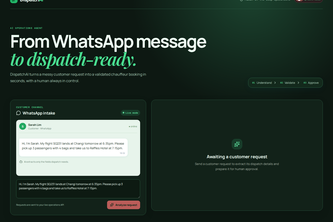
The description states that DispatchAI is an AI Operations Agent designed to transform natural-language customer messages into validated, human-approved chauffeur booking drafts. It uses GPT-5.6 for information extraction and integrates with external services like OneMap for address validation and a mock flight API for flight details.
It supports two modes:
- Demo Mode: End-to-end demonstration using deterministic logic and in-memory storage.
- Live Mode: Production-ready integrations with OpenAI, OneMap, and Supabase.
The system extracts booking details such as pickup location, destination, date/time, passenger count, luggage, and flight number. It presents a draft for dispatcher review before final approval or rejection.
Inference: The product is not a finished SaaS offering but a prototype built for a hackathon. It does not appear to have any live customers or revenue-generating features beyond the demo.
Positioning & Claim Evolution
The author claims that DispatchAI transforms natural-language messages into validated booking drafts, using GPT-5.6 and trusted data sources, while ensuring human oversight remains central.
It positions itself as an AI-powered automation tool for chauffeur dispatchers who currently spend time manually processing bookings from messaging apps like WhatsApp.
Inference: The positioning implies a solution to inefficiencies in manual booking workflows, but no evidence of prior customer feedback or market validation is provided. The claim is framed as a technological innovation rather than a product with traction.
Target Customer & ICP
The description states that the tool targets chauffeur companies that receive bookings through messaging apps like WhatsApp and require dispatchers to manually process messages, check addresses, and verify flight details.
It also implies a dispatcher role as the end user who reviews and approves booking drafts generated by AI.
Inference: The target customer segment is likely small to mid-sized chauffeur services in Singapore or similar markets where messaging-based bookings are common. However, no evidence of actual customers or market research exists.
Business Model & Pricing Evidence
There is no evidence of a business model or pricing structure in the description.
The project is presented as a hackathon submission and does not indicate any monetization strategy, subscription plans, or usage-based pricing.
Inference: The business model remains undefined. It could evolve into a SaaS offering for chauffeur companies, but no such indication exists in the provided text.
Technical & Delivery Signals
The project is built using:
- Frontend: React, TypeScript, Vite, Tailwind CSS, shadcn/ui
- Backend: FastAPI
- AI: OpenAI GPT-5.6
- Database: Supabase PostgreSQL
- External Services: OneMap API, mock flight service
It includes:
- Two operating modes (Demo and Live)
- Structured booking extraction from natural language
- Integration with trusted data sources for validation
- Human review step before booking approval
Inference: The architecture shows a modern full-stack approach with clear separation of AI logic, data validation, and human interaction. However, this is a prototype, not a production-ready system.
Traction & Maturity Signals
There is no evidence of traction or maturity beyond the hackathon submission.
The project has:
- No revenue
- No customers
- No product-market fit indicators
- No growth metrics or adoption data
It was built in a single day (as per hackathon context) and presented as a demonstration, not a functioning product.
Inference: The project is at the prototype stage with no signs of commercial traction or user engagement.
Competitive Context
The description does not mention any competitors. It does not reference existing tools for chauffeur dispatch automation or AI booking assistants.
It appears to be a novel concept within the hackathon space, but there is no evidence of prior market presence or competitive landscape analysis.
Inference: No competitive context is evident, and it's unclear whether similar solutions already exist in the market.
Open Questions & Risks
- No commercial traction: The project is a hackathon prototype with no real-world usage.
- Unproven demand: There is no evidence of actual customer need or feedback.
- Limited scope: The system only handles booking extraction and validation, not full dispatch operations.
- Dependency on external services: Reliance on OneMap and mock APIs may limit scalability or reliability in production.
- AI hallucination risk: While the system validates facts against external sources, GPT-5.6 could still misinterpret inputs or generate inaccurate outputs without proper safeguards.
Inference: The project lacks commercial viability indicators and is not yet a product with a clear path to market adoption.
Questions the description leaves open
- What specific pain points in chauffeur dispatch workflows are you trying to solve?
- Have you spoken to any actual dispatchers or chauffeur companies about this idea?
- Is there a plan to move beyond the demo mode into a production-ready system?
- How would you monetize this tool if it were to become a product?
- What is your long-term vision for DispatchAI — is it meant to be a standalone tool or part of a larger platform?
Overall Assessment
Not evidenced: There is no evidence that this project has reached a stage where investment or partnership decisions can be made.
The project is a hackathon prototype, not a product with traction, revenue, or clear market demand. It demonstrates technical capability but lacks commercial readiness.
Confidence level: Low — based entirely on self-reported description and no external validation.
Assessment: Not ready for investment or partnership consideration at this time. A follow-up evaluation would require evidence of customer feedback, early traction, or a defined go-to-market strategy.
User Stories BotA demo video on every pull request
Get a demo video on every new feature
GitHub App that watches your pull requests and records a narrated, captioned demo.
Save time on demo prep and make informed decisions faster with a video walkthrough of every new feature.
Source
Submitted to the OpenAI 2026 hackathon on Devpost. Project home on Devpost. Back to the full gallery on Devpost.
This competitive analysis was produced by top-founders.com (opens in a new tab)
Generated by a language model from this project's public Devpost page — its tagline, the author's own write-up and any built-with tags listed there — as captured in August 2026. Short quotations are the author's words. It is an opinion on the idea as a business, not on the people behind it, and it reflects the description as published then. If the project has moved on, request a correction below. The analysis is not independent research and contains no verified traction, revenue or customer data.
An independent guide by KFG International LLC — not affiliated with, endorsed by, or connected to Devpost or OpenAI.