

Archive position — measured, not model output
0 likes on Devpost
2,263 of the 7,850 archived projects have more likes, and 5,587 share exactly 0 — so this project's #7,677 place in the like-ranked listing is a tie-break inside that group, not a ranking.
Projects (log scale)
Likes on Devpost. ▲ marks this project's group.
Show the figures
| Likes | Projects | Share of archive |
|---|---|---|
| 0 | 5,587 | 71.2% |
| 1 | 1,758 | 22.4% |
| 2 | 284 | 3.6% |
| 3–4 | 132 | 1.7% |
| 5–9 | 75 | 1.0% |
| 10+ | 14 | 0.2% |
 User Stories BotA demo video on every pull request
Get a demo video on every new feature
GitHub App that watches your pull requests and records a narrated, captioned demo.
Save time on demo prep and make informed decisions faster with a video walkthrough of every new feature.
Executive Summary
What the company appears to be
Whetstone is a self-reported tool that uses language models to generate coding exercises and then verifies them via sandbox execution. The author states it aims to improve the reliability of generated problems by ensuring only those that pass tests are published.
What changed
The project evolved from an API-based generation system (which was not funded) to an in-Codex generation approach, while maintaining the same verification mechanism using a sandboxed environment.
Single most important open question
Is there evidence of actual use or traction beyond the author’s own development and testing?
What The Product Actually Is
The description states:
- Whetstone uses Codex to generate candidate coding exercises.
- Each exercise includes a problem statement, reference solution, and test suite.
- A sandbox executes the solution against the tests.
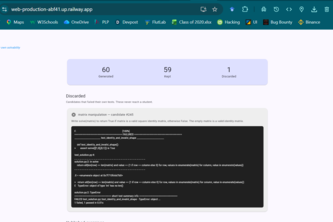
- If it passes, the exercise is published; if not, it goes into a discard log with failure details.
- The discard log serves as part of the product’s output.
Inference The system appears to be a proof-of-concept or prototype built during a hackathon. It does not appear to have any commercial revenue, customer base, or operational history beyond its author's development.
Positioning & Claim Evolution
The description states:
- The original inspiration was that language models often generate broken exercises without knowing it.
- The solution is to make the model "earn" the problem by running it through a sandbox.
- The author claims that this approach shifts the product from filtering out bad problems to guaranteeing good ones.
Inference The positioning evolved from an idea of “filtering” to one of “guaranteeing,” based on observed discard rates during development. This reflects a shift in narrative rather than a change in core functionality.
Target Customer & ICP
The description states:
- The primary user is an instructor who uses generated exercises.
- The product provides insight into why certain problems fail, via the discard log.
Inference The target customer is likely educators or curriculum designers working with coding instruction. However, no evidence of actual users or customers exists beyond the author’s own use case.
Business Model & Pricing Evidence
The description states:
- No pricing model is described.
- The product is presented as a tool for instructors to validate exercises.
- There is no mention of monetization, subscriptions, or sales channels.
Not evidenced No commercial business model or pricing information is provided. The project appears to be a prototype without any indication of how it would generate revenue.
Technical & Delivery Signals
The description states:
- Built with Django and PostgreSQL for the generation loop and storage.
- Flutter Web renders the UI showing counts, logs, and exercises.
- Docker sandbox enforces security constraints (no network, read-only FS, timeouts).
- Codex and GPT-5.6 are used for generating candidates.
- The core loop was built inside a single Codex thread.
Inference The technical stack suggests a minimal viable prototype with strong attention to sandboxing and execution safety. However, the lack of operational data or deployment details indicates no production-grade delivery.
Traction & Maturity Signals
The description states:
- The project was submitted to the OpenAI 2026 hackathon.
- It was built in a short timeframe (a hackathon).
- The author notes that discard rates were lower than expected, which changed the product’s framing.
- No mention of users, customers, or adoption.
Not evidenced There is no evidence of traction, revenue, or user engagement beyond the author's own development and testing. No data on usage, retention, or impact is available.
Competitive Context
The description states:
- The project addresses a gap in language model-generated coding exercises.
- It leverages Codex and GPT-5.6 for generation.
- It introduces sandboxing as a verification method.
Inference While the idea of verifying AI-generated content is not new, this approach uses sandboxed execution to validate code correctness. However, no comparison with existing tools or platforms in the coding education space is made.
Open Questions & Risks
The description states:
- The project was built as a hackathon submission.
- It relies on Codex credits rather than API access.
- There is no evidence of commercial viability or scalability.
- No data on real-world performance or adoption exists.
Inference Key risks include lack of funding, unclear monetization, and absence of real-world testing. The product may not be scalable beyond the author’s own use case.
Questions the description leaves open
- What is your plan for scaling beyond a single-person hackathon prototype?
- How do you intend to monetize this tool if it's only used by educators?
- Have you tested the system with actual students or teachers?
- Is there any evidence of interest from educational institutions or platforms?
- Can you describe how the discard log is intended to be used in practice?
Overall Assessment
The description states:
- This is a hackathon project.
- No revenue, customers, or traction are reported.
- The author has not yet demonstrated any commercial viability.
Not evidenced There is no evidence of a viable business model, product-market fit, or commercial readiness. The project remains in the prototype phase and lacks any indication of growth or investor interest.
User Stories BotA demo video on every pull request
Get a demo video on every new feature
GitHub App that watches your pull requests and records a narrated, captioned demo.
Save time on demo prep and make informed decisions faster with a video walkthrough of every new feature.
Source
Submitted to the OpenAI 2026 hackathon on Devpost. Project home on Devpost. Back to the full gallery on Devpost.
This competitive analysis was produced by top-founders.com (opens in a new tab)
Generated by a language model from this project's public Devpost page — its tagline, the author's own write-up and any built-with tags listed there — as captured in August 2026. Short quotations are the author's words. It is an opinion on the idea as a business, not on the people behind it, and it reflects the description as published then. If the project has moved on, request a correction below. The analysis is not independent research and contains no verified traction, revenue or customer data.
An independent guide by KFG International LLC — not affiliated with, endorsed by, or connected to Devpost or OpenAI.