

Archive position — measured, not model output
0 likes on Devpost
2,263 of the 7,850 archived projects have more likes, and 5,587 share exactly 0 — so this project's #3,753 place in the like-ranked listing is a tie-break inside that group, not a ranking.
Projects (log scale)
Likes on Devpost. ▲ marks this project's group.
Show the figures
| Likes | Projects | Share of archive |
|---|---|---|
| 0 | 5,587 | 71.2% |
| 1 | 1,758 | 22.4% |
| 2 | 284 | 3.6% |
| 3–4 | 132 | 1.7% |
| 5–9 | 75 | 1.0% |
| 10+ | 14 | 0.2% |
 User Stories BotA demo video on every pull request
Get a demo video on every new feature
GitHub App that watches your pull requests and records a narrated, captioned demo.
Save time on demo prep and make informed decisions faster with a video walkthrough of every new feature.
Executive Summary
What the company appears to be: DiscordBuilder, as described by its author, is a self-reported Discord integration that enables community members to request software tools in plain language, with an AI agent (Codex running GPT-5.6) building and iterating on those tools within a sandboxed environment. The product is positioned as a way to turn a Discord server into a development studio for community-driven tooling.
What changed: The author describes the project as a hackathon submission, suggesting it was built quickly in a short timeframe (likely under 48 hours). It is not described as a commercial product or platform with ongoing operations or users beyond a demo server.
The single most important open question: Is there any evidence of traction, revenue, or adoption beyond the author’s own demonstration and the demo Discord server?
Note: This analysis is based entirely on self-reported information from the project description. No independent verification, archived data, or third-party sources are available. All claims are attributed to the author's own account.
What The Product Actually Is
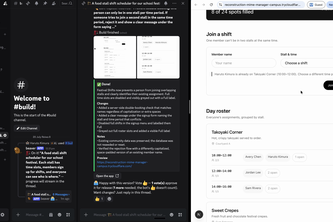
The description states that DiscordBuilder is a Discord integration that allows users to request software tools via /build <request> in plain language. It uses Codex (GPT-5.6 Sol) to generate full-stack applications inside a Docker sandbox, with outputs streamed live into the Discord thread.
Key technical elements:
- Uses Next.js + SQLite
- Built using Discord.js and Node.js
- Runs in Docker sandboxed environments
- Integrates with Codex (GPT-5.6) for code generation
- Outputs are validated through a BUILD_RESULT.json contract
- Screenshots and previews are uploaded to Discord
- Uses Playwright for UI testing and mobile responsiveness checks
The product is described as a real integration, not a standalone web app.
Positioning & Claim Evolution
The author positions DiscordBuilder as:
- A way to turn any Discord server into a development studio
- An answer to the problem of community tools that no one builds, because the people who feel the pain can’t code and coders don’t have time
- A tool that makes software creation collaborative and accessible by allowing non-developers to request apps in plain language
The claim evolution shows:
- From a personal frustration (lack of community tools) → to a technical solution (AI-powered app generation)
- The product is framed as both a tool for communities and a development workflow enhancement
This is a self-reported positioning, not verified traction or market validation.
Target Customer & ICP
The author states that the target is:
- Communities that need small software tools (e.g., shift tables, RSVP pages, voting systems)
- People who feel the pain of needing tools but can’t code
- Discord server members, especially those in book clubs, gaming servers, festival committees
The ICP appears to be:
- Non-developers who are part of a Discord community
- Community leaders or organizers who want to empower their members to build simple tools
- Small teams or groups that use Discord as their primary communication platform
No evidence of actual customers, user segments, or personas beyond the author’s own description.
Business Model & Pricing Evidence
The description does not mention:
- Any pricing model
- Revenue streams
- Monetization strategy
- Subscription plans or usage-based billing
It states that:
- The hosted bot is intentionally limited to a demo server
- The public repository includes instructions for running the integration with one’s own Discord bot and API key
- The project was submitted as a hackathon entry, not a commercial product
No evidence of business model, pricing, or monetization.
Technical & Delivery Signals
The author provides detailed technical implementation:
- Uses Codex (GPT-5.6 Sol) for code generation
- Runs inside Docker sandbox
- Enforces bounded authority via AGENTS.md contract
- Includes a design system (DESIGN.md) with Tailwind tokens
- Implements a quality loop: typecheck, build, DB migrations, Playwright screenshots
- Uses structured output validation through BUILD_RESULT.json
- Employs event-stream UX, where Codex reasoning is streamed live into Discord
- Includes security measures like O_NOFOLLOW file descriptors and stdin-based API key handling
These are self-reported technical details, not independently verified.
Traction & Maturity Signals
The description states:
- The project was submitted to the OpenAI 2026 hackathon
- It is a demo-only integration, not a live product
- The hosted bot is limited to a demo server
- No mention of users, customers, or usage beyond the author’s own testing and demo
No evidence of traction, adoption, or user base.
Competitive Context
The description does not reference:
- Competitors
- Similar tools in the market
- Market positioning relative to other no-code or low-code platforms
It is implied that DiscordBuilder is unique in its approach of using AI to build apps directly within a Discord thread, but this is not substantiated with competitive data.
No evidence of competitive landscape or differentiation from existing tools.
Open Questions & Risks
- No commercial traction: The product is described as a hackathon submission and demo-only
- Unverified technical claims: While detailed, the technical implementation is self-reported and unverified
- AI dependency: Heavy reliance on Codex (GPT-5.6) raises concerns about availability, cost, and control
- Security assumptions: Trust in AI-generated code without external audits or validation
- Limited scalability: The demo server approach suggests a prototype, not a scalable platform
These are inferred risks from the self-reported nature of the project.
Questions the description leaves open
- Is this product currently being used by any real communities or organizations?
- What is the current status of the demo server? Is it active or maintained?
- Has there been any feedback from users beyond the author’s own testing?
- How does the team plan to scale beyond the demo environment?
- Are there any plans for monetization or commercial use?
- What are the limitations of Codex (GPT-5.6) in terms of reliability and cost?
- Has the team considered how to handle edge cases or adversarial inputs?
Overall Assessment
Not evidenced
There is no evidence of:
- Revenue
- Customers
- Traction
- Market validation
- Commercial viability
The project is described as a hackathon submission, not a commercial product. It is unclear whether it has moved beyond prototype or demonstration stage.
This is a self-reported, unverified account of a demo-level product with no evidence of real-world usage or business model.
User Stories BotA demo video on every pull request
Get a demo video on every new feature
GitHub App that watches your pull requests and records a narrated, captioned demo.
Save time on demo prep and make informed decisions faster with a video walkthrough of every new feature.
Source
Submitted to the OpenAI 2026 hackathon on Devpost. Project home on Devpost. Back to the full gallery on Devpost.
This competitive analysis was produced by top-founders.com (opens in a new tab)
Generated by a language model from this project's public Devpost page — its tagline, the author's own write-up and any built-with tags listed there — as captured in August 2026. Short quotations are the author's words. It is an opinion on the idea as a business, not on the people behind it, and it reflects the description as published then. If the project has moved on, request a correction below. The analysis is not independent research and contains no verified traction, revenue or customer data.
An independent guide by KFG International LLC — not affiliated with, endorsed by, or connected to Devpost or OpenAI.