

Archive position — measured, not model output
0 likes on Devpost
2,263 of the 7,850 archived projects have more likes, and 5,587 share exactly 0 — so this project's #3,755 place in the like-ranked listing is a tie-break inside that group, not a ranking.
Projects (log scale)
Likes on Devpost. ▲ marks this project's group.
Show the figures
| Likes | Projects | Share of archive |
|---|---|---|
| 0 | 5,587 | 71.2% |
| 1 | 1,758 | 22.4% |
| 2 | 284 | 3.6% |
| 3–4 | 132 | 1.7% |
| 5–9 | 75 | 1.0% |
| 10+ | 14 | 0.2% |
 User Stories BotA demo video on every pull request
Get a demo video on every new feature
GitHub App that watches your pull requests and records a narrated, captioned demo.
Save time on demo prep and make informed decisions faster with a video walkthrough of every new feature.
Executive Summary
Company: Disha AI
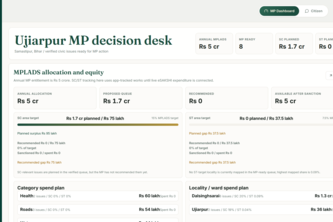
Self-reported purpose: An AI-powered constituency development co-pilot that converts citizen reports into verified, explainable and evidence-backed priorities for Members of Parliament (MPs) in India.
Key claim: To turn every citizen voice into smarter public investment for India through a multilingual platform using WhatsApp and web interfaces, with AI-assisted verification, prioritization and decision support.
What changed: The author describes building a prototype that integrates AI, civic tech and government data to help MPs make more informed decisions about local development issues.
Most important open question: Is there evidence of real-world use or adoption by citizens or MPs?
What The Product Actually Is
The description states that Disha AI is an AI-powered platform designed for citizens to report local development problems through a multilingual WhatsApp bot or web interface, using text, voice messages, photographs and location data.
It then analyzes submissions, checks relevance, detects duplicates, asks follow-up questions, groups related reports into themes, enriches them with evidence (e.g., maps, census data, satellite imagery), and prioritizes issues using an explainable framework based on Need × Reach × Gap.
The system includes:
- A citizen-facing platform built with React + Vite
- A backend using Node.js + Express
- Integration with Google Cloud Run, Firebase, Firestore, WhatsApp Cloud API
- AI workflows for multimodal input processing, verification, and decision support
Inference: The author describes a prototype system that uses generative AI (GPT-5.5/5.6) to assist in building the platform, but does not state whether this is production-ready or deployed.
Positioning & Claim Evolution
The author states that Disha AI is not designed to replace elected representatives, but rather to help MPs understand community needs and make more informed decisions while keeping humans in control.
It positions itself as:
- A civic tech tool for public development planning
- An AI co-pilot for MPs and their teams
- A system that makes public investment more transparent, inclusive and evidence-driven
The author emphasizes:
- Multilingual access via WhatsApp
- Evidence-based prioritization
- Human-in-the-loop AI
- Integration with public datasets and geospatial tools
Inference: The positioning reflects a strong emphasis on responsible AI, public accountability, and human oversight, but no evidence is provided that this has been tested or validated in practice.
Target Customer & ICP
The description states that the primary users are:
- Citizens reporting local development issues (e.g., roads, water, sanitation)
- Members of Parliament (MPs) and their constituency teams who use the dashboard to prioritize and act on reports
It also mentions that the system is designed for underserved communities, where issues may otherwise go unnoticed.
The author notes that the platform supports multilingual inputs and uses WhatsApp as a primary access point, suggesting an intent to reach low-tech users in rural or remote areas.
Inference: The ICP appears to be MPs and their teams, with citizens as secondary actors. However, there is no evidence of actual customer engagement or feedback from either group.
Business Model & Pricing Evidence
The description does not contain any information about:
- Revenue streams
- Pricing models
- Monetization strategy
- Subscription plans or fees
Not evidenced
Technical & Delivery Signals
The author describes building the platform using:
- Frontend: React + Vite
- Backend: Node.js + Express
- Deployment: Firebase Hosting, Google Cloud Run, Firestore, cloud storage
- AI stack: Generative AI (GPT-5.5/5.6), Google Gemini, Vertex AI, multimodal processing, conversational AI, computer vision
- APIs & tools: WhatsApp Cloud API, Google Maps, OpenStreetMap, satellite imagery, public datasets
The system is described as supporting:
- Text, image, and voice input
- Follow-up question generation
- Duplicate detection
- Contextual evidence enrichment
- Explainable decision support
Inference: The technical architecture suggests a prototype or proof-of-concept, not a production-grade system. Use of GPTs for development implies that the author leveraged AI tools rather than built proprietary systems.
Traction & Maturity Signals
The description states:
- The project was submitted to the OpenAI 2026 hackathon
- It is a single-person effort (team size: 1)
- No mention of actual users, customers, or deployment in real-world settings
- No data on usage volume, engagement metrics, or impact
Not evidenced
Competitive Context
The description does not contain any information about:
- Competitors
- Market landscape
- Existing solutions in civic tech or AI for governance
- Differentiation from similar platforms
Not evidenced
Open Questions & Risks
- Single-person team: No evidence of scaling, product-market fit, or operational capacity.
- Prototype only: The system is described as a hackathon submission, not a deployed product.
- No real-world validation: No evidence of citizen adoption, MP engagement, or feedback.
- AI dependency: Heavy reliance on GPTs for development raises questions about ownership and control over the final product.
- Privacy & bias concerns: The author acknowledges these as important but does not describe how they are mitigated in practice.
Inference: This is a conceptual or experimental project, not a commercial or operational system. It lacks any evidence of traction, maturity or real-world impact.
Questions the description leaves open
- Has the platform been tested with actual citizens or MPs?
- What are the data privacy and governance mechanisms in place for citizen submissions?
- How is bias addressed in AI-driven prioritization and verification?
- Are there any partnerships or pilot programs with local governments or NGOs?
- What is the plan for scaling beyond a single developer?
- How does the system handle uncertainty or incomplete information from citizens?
Overall Assessment
Not evidenced
The description presents Disha AI as an experimental, self-developed prototype submitted to a hackathon. There is no evidence of:
- Revenue
- Customers
- Product-market fit
- Deployment
- Traction or adoption
It is described as a conceptual tool aimed at improving public investment planning in India through AI and civic tech.
Confidence level: Low — based entirely on self-reported claims with no external validation.
User Stories BotA demo video on every pull request
Get a demo video on every new feature
GitHub App that watches your pull requests and records a narrated, captioned demo.
Save time on demo prep and make informed decisions faster with a video walkthrough of every new feature.
Source
Submitted to the OpenAI 2026 hackathon on Devpost. Project home on Devpost. Back to the full gallery on Devpost.
This competitive analysis was produced by top-founders.com (opens in a new tab)
Generated by a language model from this project's public Devpost page — its tagline, the author's own write-up and any built-with tags listed there — as captured in August 2026. Short quotations are the author's words. It is an opinion on the idea as a business, not on the people behind it, and it reflects the description as published then. If the project has moved on, request a correction below. The analysis is not independent research and contains no verified traction, revenue or customer data.
An independent guide by KFG International LLC — not affiliated with, endorsed by, or connected to Devpost or OpenAI.