

Archive position — measured, not model output
0 likes on Devpost
2,263 of the 7,850 archived projects have more likes, and 5,587 share exactly 0 — so this project's #3,756 place in the like-ranked listing is a tie-break inside that group, not a ranking.
Projects (log scale)
Likes on Devpost. ▲ marks this project's group.
Show the figures
| Likes | Projects | Share of archive |
|---|---|---|
| 0 | 5,587 | 71.2% |
| 1 | 1,758 | 22.4% |
| 2 | 284 | 3.6% |
| 3–4 | 132 | 1.7% |
| 5–9 | 75 | 1.0% |
| 10+ | 14 | 0.2% |
 User Stories BotA demo video on every pull request
Get a demo video on every new feature
GitHub App that watches your pull requests and records a narrated, captioned demo.
Save time on demo prep and make informed decisions faster with a video walkthrough of every new feature.
Executive Summary
What the company appears to be
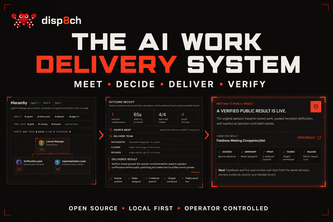
Disp8ch, as described by its author, is a local-first, open-source AI work delivery system built for teams using AI assistants. It aims to close the gap between AI-generated decisions and actual implementation by turning conversations or briefs into accountable workflows with defined roles, evidence, and outcomes.
What changed
The project evolved from an existing prototype (built over two months with GPT-5.5) into a more complete delivery system during a Build Week using Codex and GPT-5.6. This extension added end-to-end delivery capabilities including consent-gated sessions, role-based workflows, outcome receipts, and cross-tab work trails.
The single most important open question
Is there any evidence of real-world usage or adoption beyond the author’s own development and testing? The description provides no data on customers, revenue, or traction — only a self-reported narrative of what was built and how it works.
What The Product Actually Is
The description states that Disp8ch is an open-source, local-first AI work delivery system. It turns a conversation or brief into an accountable workflow with:
- Consent-gated live sessions
- Timestamp-cited decisions and requirements
- A supervised mission process involving planner, implementer, and reviewer roles
- Acceptance contracts, bounded repair, executable proof, and Outcome Receipts
- Source-grounded Files Projects with exact line highlighting
- Validation- and confirmation-gated publishing and feedback loops
- Cross-tab Work Trails that preserve the full chain of evidence
It uses technologies such as Next.js, React, TypeScript, Node.js, SQLite, Tailwind CSS, WebSockets, Electron, Playwright, and supports models like OpenAI/Codex, DeepSeek, OpenRouter, and local runtimes (e.g., Ollama, llama.cpp).
Inference The system appears to be designed for teams working in AI-assisted environments where accountability, traceability, and quality control are important. It is not a general-purpose AI tool but rather an orchestration layer for AI-driven work.
Positioning & Claim Evolution
The author positions Disp8ch as a solution to the problem of AI assistants producing answers but failing to deliver results. The core claim is that Disp8ch "closes that handoff" by ensuring decisions made in meetings or briefs are followed through with accountable execution and verification.
It builds on prior work (GPT-5.5 version) and extends it with a delivery loop using Codex and GPT-5.6 during Build Week.
Inference This is a self-described evolution from an experimental prototype to a more structured system. The positioning reflects a focus on AI workflow accountability, not just generative AI capabilities.
Target Customer & ICP
The description does not name specific customer types or personas. However, it implies the product targets:
- Teams using AI assistants in product development or engineering
- Organizations seeking to manage AI-assisted workflows with accountability and traceability
- Users who value local-first behavior and control over data
Inference Based on the narrative, the ICP likely includes technical teams, especially those working in AI-assisted software development, where decision-making, ownership, and verification matter.
Business Model & Pricing Evidence
There is no mention of pricing, monetization strategy, or business model. The product is described as open-source and local-first.
Not evidenced
Technical & Delivery Signals
The system uses:
- Frontend: Next.js, React, TypeScript, Tailwind CSS
- Backend: Node.js, SQLite
- AI Layer: OpenAI/Codex, DeepSeek, OpenRouter, local runtimes (Ollama, llama.cpp, etc.)
- Tools: Electron, WebSockets, Playwright, Three.js
- Deployment & Testing: Windows-native release process, npm/pnpm audits
It supports:
- Live sessions with consent gating
- Timestamp-cited delivery briefs
- Role-based workflow execution (planner, implementer, reviewer)
- Outcome receipts and cross-tab trails
- Source-grounded file projects with line-level highlighting
Inference The technical stack suggests a developer-focused tool, likely aimed at teams building software or digital products. The use of local-first principles and open-source implies a focus on privacy, control, and extensibility.
Traction & Maturity Signals
There is no evidence of traction, revenue, customers, or usage beyond the author’s own development and testing.
The project was submitted to the OpenAI 2026 hackathon. The author states that it was tested in a clean, isolated Windows database with real models (DeepSeek V4 Flash, GPT-5.6) and passed all test suites (71 of 71).
Not evidenced
Competitive Context
The description does not mention competitors or direct substitutes.
Not evidenced
Open Questions & Risks
- No external validation or adoption: The product exists only as a self-reported prototype.
- Single-person team: The project is built by one individual (Aaron Nathaniel), which raises questions about scalability and long-term maintenance.
- Limited maturity: While it was tested, there is no evidence of production use or real-world deployment.
- Open-source/local-first approach may limit commercial appeal: This could be a barrier to enterprise adoption unless further developed.
- AI model dependency: Heavy reliance on specific models (e.g., GPT-5.6) may create fragility if those models change or become unavailable.
Questions the description leaves open
- What is the actual use case or problem you're solving for real users?
- Have you tested this system with multiple users or teams?
- How does it handle edge cases, such as model failures or inconsistent inputs?
- Is there any plan to monetize or commercialize the product beyond its current open-source form?
- What are the long-term maintenance and scalability plans for a single-person team?
- Can you demonstrate how this system integrates with existing tools (e.g., Jira, Notion, Slack)?
- How do you ensure data privacy and security in local-first environments?
Overall Assessment
Not evidenced
The description provides no information on financials, traction, or market validation. It is a self-reported account of a prototype built during a hackathon.
This project shows potential for an AI workflow tool that addresses real pain points in AI-assisted work delivery, but lacks any evidence of commercial viability, customer adoption, or measurable impact.
It is not ready for investment or partnership without further demonstration of traction, user feedback, and product-market fit.
User Stories BotA demo video on every pull request
Get a demo video on every new feature
GitHub App that watches your pull requests and records a narrated, captioned demo.
Save time on demo prep and make informed decisions faster with a video walkthrough of every new feature.
Source
Submitted to the OpenAI 2026 hackathon on Devpost. Project home on Devpost. Back to the full gallery on Devpost.
This competitive analysis was produced by top-founders.com (opens in a new tab)
Generated by a language model from this project's public Devpost page — its tagline, the author's own write-up and any built-with tags listed there — as captured in August 2026. Short quotations are the author's words. It is an opinion on the idea as a business, not on the people behind it, and it reflects the description as published then. If the project has moved on, request a correction below. The analysis is not independent research and contains no verified traction, revenue or customer data.
An independent guide by KFG International LLC — not affiliated with, endorsed by, or connected to Devpost or OpenAI.