

Archive position — measured, not model output
0 likes on Devpost
2,263 of the 7,850 archived projects have more likes, and 5,587 share exactly 0 — so this project's #7,679 place in the like-ranked listing is a tie-break inside that group, not a ranking.
Projects (log scale)
Likes on Devpost. ▲ marks this project's group.
Show the figures
| Likes | Projects | Share of archive |
|---|---|---|
| 0 | 5,587 | 71.2% |
| 1 | 1,758 | 22.4% |
| 2 | 284 | 3.6% |
| 3–4 | 132 | 1.7% |
| 5–9 | 75 | 1.0% |
| 10+ | 14 | 0.2% |
 User Stories BotA demo video on every pull request
Get a demo video on every new feature
GitHub App that watches your pull requests and records a narrated, captioned demo.
Save time on demo prep and make informed decisions faster with a video walkthrough of every new feature.
Executive Summary
What the company appears to be
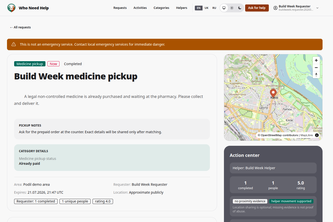
The description states that "Who Need Help" is a platform for connecting people who need urgent, non-emergency assistance with nearby volunteers willing to help — such as medicine delivery, fuel, or roadside support. It is described as a voluntary, local service where users can post requests and receive help from others in their vicinity.
What changed
The project was built as part of the OpenAI 2026 hackathon. The author reports that it includes a working requester-to-helper flow with features like real-time chat, location sharing (with consent), handover verification, and moderation tools. It uses Elixir/Phoenix for backend, Android for frontend, and integrates AI tools like Codex and GPT-5.6 in development.
The single most important open question
Is there any evidence of user adoption or traction beyond the hackathon prototype? The description does not indicate whether this has moved beyond a proof-of-concept or if it is being used by real people outside of the development team.
What The Product Actually Is
- The description states that "Who Need Help" allows requesters to publish categorized requests, with only approximate location exposed initially.
- A nearby volunteer can accept and coordinate through private real-time chat.
- Optional live location sharing occurs with user consent.
- The system supports pickup of legal medicine or other items (e.g., fuel, bicycle breakdown).
- Handover is confirmed via a one-time code, and both parties must confirm completion.
- Double-blind reviews, reputation systems, blocking/reporting, and privacy controls are included to reduce abuse.
Inference The product appears to be a marketplace-style platform for local, voluntary help — not a traditional delivery service or emergency response system. It is built around trust, consent, and minimal data exposure.
Positioning & Claim Evolution
- The tagline states: “Fast, local, voluntary help when every minute matters.”
- The inspiration behind the product was rooted in a real-life situation where a friend needed medicine but ordinary delivery services couldn’t assist.
- The author claims that the system is designed to be safe and non-emergency, with no payment processing or monetization.
- It emphasizes user privacy, consent-based location sharing, and moderation tools.
Inference The positioning has evolved from a personal need into a platform for community-driven assistance. The claim is that it fills a gap in local support services — particularly for urgent but non-emergency needs — without relying on commercial incentives or large-scale infrastructure.
Target Customer & ICP
- The description states that the product targets requesters who need urgent, non-emergency help (e.g., medicine, fuel, vehicle breakdown).
- Volunteers are described as nearby individuals willing to provide assistance.
- Users must be in close proximity to each other for the system to function.
Inference The ICP likely includes urban or suburban populations with access to smartphones and internet, who may face time-sensitive but non-medical emergencies. The platform is not intended for large-scale commercial use or emergency services.
Business Model & Pricing Evidence
- The description states that the platform is free.
- No payment processing is involved; optional thanks happen directly between users.
- There is no mention of monetization, subscriptions, or fees.
Inference There is no evidenced business model beyond a free, voluntary service. The system does not appear to generate revenue or charge users.
Technical & Delivery Signals
- Backend built with Elixir, Phoenix 1.8, LiveView, PostgreSQL/PostGIS, Oban, Phoenix PubSub and Presence.
- MapLibre is used for maps.
- Docker Compose supports single-server deployment; Helm and Kubernetes are mentioned as paths to scaling.
- Android client is a Java 17 WebView-based app with native foreground service for location sharing.
- Codex and GPT-5.6 were used in development, including code generation, testing, and security checks.
Inference The technical stack suggests a modern, scalable architecture with real-time capabilities and mobile integration. The use of AI tools during development indicates an emphasis on rapid prototyping and automation.
Traction & Maturity Signals
- The project was submitted to the OpenAI 2026 hackathon.
- It includes a working requester-to-helper flow with registration, matching, chat, tracking, handover, reviews, and moderation.
- The Phoenix suite passed 284 tests, and browser verification exercised core workflows.
- No evidence of user adoption or real-world usage beyond the prototype is provided.
Inference The product is a functional prototype built in a short timeframe. There is no indication of traction, customer base, or operational history beyond the hackathon.
Competitive Context
- Not evidenced.
Inference No information is given about competitors or similar platforms. The description does not reference existing solutions in this space.
Open Questions & Risks
- The platform is described as a hackathon prototype with no evidence of real-world usage.
- No revenue, customer, or traction data is provided.
- The system relies heavily on voluntary participation and trust — which may be difficult to scale or maintain.
- The use of AI tools like Codex and GPT-5.6 in development raises questions about long-term technical ownership and scalability.
Inference The lack of real-world testing, user feedback, or commercial viability makes it a high-risk investment or partnership opportunity at this stage.
Questions the description leaves open
- Has the platform been tested with actual users beyond the hackathon?
- What is the plan for scaling beyond a single developer and prototype?
- Are there any legal or regulatory considerations around voluntary assistance platforms in different jurisdictions?
- How will the platform handle abuse or misuse, especially if it becomes more widely used?
- Is there any intention to monetize or expand the service beyond its current scope?
Overall Assessment
- The description states that this is a hackathon project with no evidence of traction, revenue, or customer adoption.
- It is described as a prototype with a working flow but not yet operational in real-world conditions.
- No business model or monetization strategy beyond the free service is evident.
Inference At this stage, there is insufficient evidence to support an investment or partnership decision. The project appears to be a proof-of-concept with no demonstrated commercial viability or user engagement.
User Stories BotA demo video on every pull request
Get a demo video on every new feature
GitHub App that watches your pull requests and records a narrated, captioned demo.
Save time on demo prep and make informed decisions faster with a video walkthrough of every new feature.
Source
Submitted to the OpenAI 2026 hackathon on Devpost. Project home on Devpost. Back to the full gallery on Devpost.
This competitive analysis was produced by top-founders.com (opens in a new tab)
Generated by a language model from this project's public Devpost page — its tagline, the author's own write-up and any built-with tags listed there — as captured in August 2026. Short quotations are the author's words. It is an opinion on the idea as a business, not on the people behind it, and it reflects the description as published then. If the project has moved on, request a correction below. The analysis is not independent research and contains no verified traction, revenue or customer data.
An independent guide by KFG International LLC — not affiliated with, endorsed by, or connected to Devpost or OpenAI.