

Archive position — measured, not model output
1 like on Devpost
505 of the 7,850 archived projects have more likes, and 1,758 share exactly 1 — so this project's #1,790 place in the like-ranked listing is a tie-break inside that group, not a ranking.
Projects (log scale)
Likes on Devpost. ▲ marks this project's group.
Show the figures
| Likes | Projects | Share of archive |
|---|---|---|
| 0 | 5,587 | 71.2% |
| 1 | 1,758 | 22.4% |
| 2 | 284 | 3.6% |
| 3–4 | 132 | 1.7% |
| 5–9 | 75 | 1.0% |
| 10+ | 14 | 0.2% |
 User Stories BotA demo video on every pull request
Get a demo video on every new feature
GitHub App that watches your pull requests and records a narrated, captioned demo.
Save time on demo prep and make informed decisions faster with a video walkthrough of every new feature.
Executive Summary
What the company appears to be
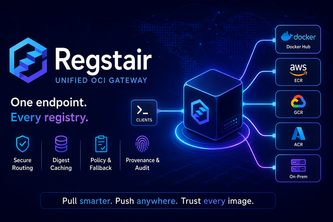
Regstair is an OCI (Open Container Initiative) routing fabric that presents a single logical endpoint for container image pull and push operations, abstracting physical registry locations through policy-based routing. It operates as an abstraction layer in front of existing registries like Harbor, Quay, ECR, GCR, ACR, Docker Hub, etc., enabling deterministic routing decisions based on namespace authority, fallback control, and logical-to-physical name mapping.
What changed
The project was developed over a short timeframe (Build Week) as part of an OpenAI hackathon submission. It is described as a vertical slice demonstrating core functionality including pull/push routing, digest caching, namespace authority, and provenance tracking — without replacement or full integration with existing registry infrastructure.
Single most important open question
Is there any evidence of real-world usage or adoption beyond the author’s own demonstration? The description states no revenue, customers, or traction data exist; all claims are self-reported and unverified.
What The Product Actually Is
The description states that Regstair is an OCI routing fabric designed to provide a single logical endpoint for container image operations (pull/push) across internal and external registries. It functions as an abstraction layer, separating the logical identity of images from their physical storage locations.
It includes components such as:
- An OCI Gateway handling client requests
- A Route Engine matching repository names against policy rules
- Registry Connectors isolating upstream-specific behavior
- A Content-Addressed Cache storing objects by digest
- Metadata and Provenance tracking
The system supports:
- Deterministic pull routing
- Push routing to defined destinations
- Namespace authority enforcement
- Fallback control (per namespace)
- Digest caching with reuse of shared layers
- Provenance logging for each operation
- Human-readable explanations of routing decisions
Not evidenced: actual deployment, usage metrics, or integration with real registries beyond the author’s test environment.
Positioning & Claim Evolution
The description frames Regstair as:
- A registry abstraction layer, not a replacement for existing registries.
- An OCI-compliant interface that allows clients to interact without knowing where images live.
- A tool for separating logical identity from physical registry location.
- A solution to brittle dependencies caused by registry leakage into workflows.
It positions itself as more than a pull-through cache, emphasizing:
- Policy-based routing
- Namespace authority
- Fallback control
- Logical naming
- Provenance tracking
Claims are self-reported and unverified. No external validation or market positioning data is provided.
Target Customer & ICP
The description implies Regstair targets organizations using multiple container registries, particularly those suffering from:
- Registry leakage in workflows (Dockerfiles, CI pipelines, Kubernetes manifests)
- Brittle dependencies due to registry changes
- Outages or rate limits affecting builds
- Dependency-confusion risks from unsafe fallback behavior
It appears aimed at enterprises managing complex multi-registry environments where:
- Internal and external registries coexist
- Developers need stable image names while storage locations change
- Security and governance require explicit namespace ownership
Not evidenced: specific customer segments, personas, or use cases beyond the author’s own scenario.
Business Model & Pricing Evidence
There is no evidence of a business model or pricing structure. The description only mentions:
- The project was built during a hackathon (Devpost submission)
- It is described as a vertical slice for demonstration purposes
- No revenue, funding rounds, or monetization strategy are stated
Not evidenced: any commercial offering, pricing tiers, or customer acquisition plans.
Technical & Delivery Signals
The description indicates:
- Built using Go, Docker, SQL, REST APIs, HTTP
- Deliberately separated components (Gateway, Route Engine, Connectors, Cache)
- Supports OCI Distribution protocol semantics
- Implements digest-based caching and reference-aware cleanup
- Includes an administrative web interface
- Uses AI tools (Codex, GPT-5.6) for development assistance but not live enforcement
It also notes:
- Challenges in handling mutable tags, multi-platform images, authentication
- Limitations in early version: no replication, signature verification, SBOMs, etc.
- Focus on proving core abstraction rather than full platform
Not evidenced: production-grade reliability, scalability, or performance benchmarks.
Traction & Maturity Signals
The description states:
- This is a Build Week hackathon project
- No revenue, customers, or traction data are available
- It was submitted to the OpenAI 2026 hackathon on Devpost
- The author describes it as a “vertical slice” demonstrating core functionality
No evidence of:
- User adoption
- Customer feedback
- Product-market fit
- Iteration history or roadmap beyond initial demo
Competitive Context
The description does not mention competitors directly. However, it implies Regstair operates in the space of:
- Container registry abstraction layers
- Pull-through caches (e.g., Harbor, Quay, Zot)
- OCI-compliant registries and proxy solutions
It distinguishes itself from existing pull-through caches by focusing on:
- Policy-based routing
- Namespace authority
- Provenance tracking
- Deterministic decision-making
Not evidenced: competitive landscape analysis, market share, or differentiation from similar tools.
Open Questions & Risks
Key risks and open questions based on the description:
- No real-world usage: The project is presented as a hackathon demo with no evidence of adoption.
- Unproven maturity: No production deployments, performance data, or long-term stability.
- Limited scope: Early version focused only on core abstraction; many advanced features (e.g., replication, vulnerability scanning) were not implemented.
- AI dependency: While AI is used for policy generation and explanation, enforcement remains deterministic — but this raises questions about how much of the system relies on human oversight.
- Self-reported nature: All claims are unverified and self-descriptive; no third-party validation or external feedback.
Questions the description leaves open
- What is the actual problem you're solving in practice? Is there a real-world organization using this?
- How does Regstair handle large-scale registry traffic or high availability requirements?
- Can you walk us through how a typical enterprise would integrate Regstair into their existing workflow?
- What are the key assumptions behind your routing policies, and how do they scale?
- Are there any known edge cases or failure modes in the current implementation?
- How do you plan to evolve beyond the current vertical slice?
- Do you have any plans for monetization or commercialization?
Overall Assessment
This is a self-reported, unverified demo project submitted as part of a hackathon. There is no evidence of traction, revenue, customers, or product-market fit beyond the author’s own account.
The description shows:
- A clear technical understanding of OCI protocols
- A well-defined architecture for routing and caching
- An emphasis on governance, security, and provenance
However, due to its nature as a hackathon submission, it lacks:
- Real-world deployment or usage
- Commercial viability indicators
- Scalability or performance data
- Market validation
Assessment Not ready for investment or partnership consideration at this stage. This is an idea with potential, but no evidence of execution or traction exists.
User Stories BotA demo video on every pull request
Get a demo video on every new feature
GitHub App that watches your pull requests and records a narrated, captioned demo.
Save time on demo prep and make informed decisions faster with a video walkthrough of every new feature.
Source
Submitted to the OpenAI 2026 hackathon on Devpost. Project home on Devpost. Back to the full gallery on Devpost.
This competitive analysis was produced by top-founders.com (opens in a new tab)
Generated by a language model from this project's public Devpost page — its tagline, the author's own write-up and any built-with tags listed there — as captured in August 2026. Short quotations are the author's words. It is an opinion on the idea as a business, not on the people behind it, and it reflects the description as published then. If the project has moved on, request a correction below. The analysis is not independent research and contains no verified traction, revenue or customer data.
An independent guide by KFG International LLC — not affiliated with, endorsed by, or connected to Devpost or OpenAI.