

Archive position — measured, not model output
1 like on Devpost
505 of the 7,850 archived projects have more likes, and 1,758 share exactly 1 — so this project's #1,791 place in the like-ranked listing is a tie-break inside that group, not a ranking.
Projects (log scale)
Likes on Devpost. ▲ marks this project's group.
Show the figures
| Likes | Projects | Share of archive |
|---|---|---|
| 0 | 5,587 | 71.2% |
| 1 | 1,758 | 22.4% |
| 2 | 284 | 3.6% |
| 3–4 | 132 | 1.7% |
| 5–9 | 75 | 1.0% |
| 10+ | 14 | 0.2% |
 User Stories BotA demo video on every pull request
Get a demo video on every new feature
GitHub App that watches your pull requests and records a narrated, captioned demo.
Save time on demo prep and make informed decisions faster with a video walkthrough of every new feature.
Executive Summary
What the company appears to be
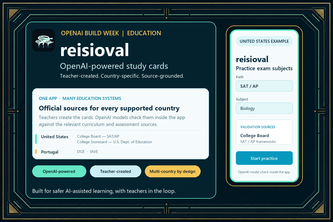
The description states that reisioval is an OpenAI-powered educational app designed for students and teachers, where AI tutors guide learning through short conversational study cards. The product supports country-specific curricula and connects academic content with real-world job roles. It allows teachers to create private cards and submit them for validation against official sources before they become public.
What changed
The project is described as the new identity of a prior system called livR, indicating a rebranding effort. The core functionality remains focused on AI-assisted study cards with curriculum alignment, but now includes more explicit validation mechanisms using OpenAI models and official educational sources.
Single most important open question — commercial due-diligence read
Is there sufficient evidence of traction or early adoption to suggest that the product has moved beyond a prototype or hackathon submission? The description does not include any data on users, revenue, customers, or institutional partnerships. Without such signals, it is unclear whether this represents a viable business model or an experimental idea.
What The Product Actually Is
The description states that reisioval is:
- A mobile-first educational app using conversational study cards.
- Powered by OpenAI models for tutoring and validation.
- Designed to align with official curriculum sources per country.
- Used in both student and teacher workflows, with separate access roles.
- Built using Capacitor, Firebase, HTML/CSS/JS, and Node.js.
The product is described as a "study game" that allows students to select educational context (country, subject, level) before beginning a session. It also includes:
- Teacher-created private cards.
- A public card gate based on official-source validation.
- Integration of real-world job roles into learning content.
- Support for multiple countries and their respective curricula.
Inference The product appears to be a hybrid between an AI-powered tutoring tool and a curriculum-aligned content platform, with emphasis on teacher involvement and institutional trust.
Positioning & Claim Evolution
The description states:
- reisioval is positioned as an AI-supported study tool that keeps learning focused and traceable.
- It aims to integrate teachers into the process rather than replace them.
- The app connects academic lessons to future career paths through company examples.
- It uses OpenAI models for validation, not certification or approval from OpenAI.
Inference The positioning evolved from a general-purpose AI tutor to one that emphasizes curriculum alignment, teacher control, and responsible use of AI in education. This shift suggests an awareness of ethical concerns around AI in learning environments.
Target Customer & ICP
The description states:
- Primary users are students who engage with study cards aligned to their curriculum.
- Teachers can create and test private cards.
- The system supports international expansion using local curricula.
Inference The target customer includes both students and educators, particularly those in formal education systems. The ICP likely centers around schools or institutions that value structured learning and curriculum compliance. However, no specific customer segments or user personas are defined.
Business Model & Pricing Evidence
The description states:
- There is a planned "responsible sponsorship model" where companies fund access to learning cards.
- No direct pricing information is provided.
- The app does not appear to charge students directly for use.
- Teachers may be involved in content creation, but no explicit monetization of teacher activity is mentioned.
Inference The business model seems to rely on third-party sponsorship or institutional funding rather than direct consumer payments. However, there is no evidence of pricing structures, revenue streams, or customer acquisition strategies.
Technical & Delivery Signals
The description states:
- Built with Capacitor for Android and iOS delivery.
- Uses Firebase Hosting, Cloud Functions v2, Firestore, and Firebase Authentication.
- OpenAI orchestration runs server-side to avoid exposing API keys.
- Mobile experience uses HTML/CSS/JS.
- Teacher workflows are separated from student workflows via role-based access.
Inference The technical stack suggests a mobile-first, cloud-hosted solution with strong separation between user roles. The use of Firebase and server-side OpenAI integration indicates a scalable architecture for handling AI workloads and data security.
Traction & Maturity Signals
The description states:
- The product is described as a working prototype built during a hackathon.
- No mention of users, revenue, or customer adoption.
- No evidence of institutional pilots, partnerships, or market traction.
- The founder notes he is not a programmer and studied nutrition.
Inference There is no evidence of traction, user growth, or commercial viability beyond the initial development phase. The product appears to be in early-stage experimentation rather than a mature offering.
Competitive Context
The description states:
- No explicit competitors are named.
- The app focuses on curriculum alignment and AI validation.
- It integrates real-world job connections into learning content.
- It supports multiple countries with localized curricula.
Inference While not directly competitive with known platforms, reisioval may overlap with AI-powered tutoring tools or curriculum-aligned edtech products. However, no comparative analysis or market positioning is provided.
Open Questions & Risks
The description states:
- The founder is not a programmer and has no technical background.
- The product is described as a hackathon submission.
- No evidence of user testing, institutional adoption, or revenue.
- Validation relies heavily on OpenAI models and official source retrieval — risks include data availability and model accuracy.
Inference
Key risks include:
- Lack of technical expertise among the founder.
- Prototype-level maturity with no proven traction.
- Dependence on external validation systems (OpenAI, official sources) that may not scale or remain stable.
- Unclear monetization strategy or path to profitability.
Questions the description leaves open
- What is the current status of the product — is it live in any schools or institutions?
- How many teachers have tested private card creation? Are there any feedback loops from educators?
- Can you provide examples of how the validation process works with real-world curriculum sources?
- What are your plans for scaling beyond a single country or language?
- How do you intend to monetize the platform, especially given the sponsorship model?
- What is the timeline for transitioning from prototype to full product launch?
Overall Assessment
The description states:
- The project was submitted to an OpenAI hackathon.
- No evidence of revenue, customers, or institutional adoption.
- The founder is not a technical expert and has limited experience in software development.
Inference At this stage, reisioval appears to be an experimental idea with strong conceptual foundations but no demonstrated traction. It lacks the commercial maturity required for investment or partnership consideration. While the concept shows promise in addressing AI ethics and curriculum alignment in education, further validation through user testing, pilot programs, and business model development is needed before any strategic move can be justified.
User Stories BotA demo video on every pull request
Get a demo video on every new feature
GitHub App that watches your pull requests and records a narrated, captioned demo.
Save time on demo prep and make informed decisions faster with a video walkthrough of every new feature.
Source
Submitted to the OpenAI 2026 hackathon on Devpost. Project home on Devpost. Back to the full gallery on Devpost.
This competitive analysis was produced by top-founders.com (opens in a new tab)
Generated by a language model from this project's public Devpost page — its tagline, the author's own write-up and any built-with tags listed there — as captured in August 2026. Short quotations are the author's words. It is an opinion on the idea as a business, not on the people behind it, and it reflects the description as published then. If the project has moved on, request a correction below. The analysis is not independent research and contains no verified traction, revenue or customer data.
An independent guide by KFG International LLC — not affiliated with, endorsed by, or connected to Devpost or OpenAI.