

Archive position — measured, not model output
1 like on Devpost
505 of the 7,850 archived projects have more likes, and 1,758 share exactly 1 — so this project's #1,793 place in the like-ranked listing is a tie-break inside that group, not a ranking.
Projects (log scale)
Likes on Devpost. ▲ marks this project's group.
Show the figures
| Likes | Projects | Share of archive |
|---|---|---|
| 0 | 5,587 | 71.2% |
| 1 | 1,758 | 22.4% |
| 2 | 284 | 3.6% |
| 3–4 | 132 | 1.7% |
| 5–9 | 75 | 1.0% |
| 10+ | 14 | 0.2% |
 User Stories BotA demo video on every pull request
Get a demo video on every new feature
GitHub App that watches your pull requests and records a narrated, captioned demo.
Save time on demo prep and make informed decisions faster with a video walkthrough of every new feature.
Executive Summary
What the company appears to be
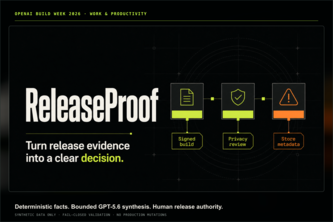
ReleaseProof, as described by its author, is a synthetic-data-only tool designed to help software portfolio leaders make defensible decisions about release readiness. It combines deterministic code checks with bounded GPT-5.6 synthesis to audit release candidates and flag contradictions or stale evidence. The system enforces fail-closed validation, ensuring that no model-generated output can override code-owned facts.
What changed
The author describes a shift from managing scattered evidence in software portfolios to building a tool that turns contradictory or aging data into actionable, traceable decisions using both deterministic logic and constrained AI.
Single most important open question
Is there any evidence of real-world adoption, customer feedback, or integration with actual systems beyond the synthetic demonstration?
Note: This analysis is based entirely on the self-reported project description provided by the author. No external verification, traction data, revenue figures, or third-party sources are available.
What The Product Actually Is
The description states that ReleaseProof:
- Audits a fully synthetic (dummy) portfolio of four release candidates.
- Uses deterministic code to check packet integrity, completeness, freshness, target alignment, approval ordering, and contradictions.
- Produces release status, findings, evidence, blocker counts, and prioritizes what needs attention first.
- Applies GPT-5.6 only after deterministic checks establish facts.
- Enforces fail-closed validation where invalid model output is rejected rather than repaired.
- Includes structured outputs, semantic guardrails, and independent browser verification of responses.
- Allows operators to test hypothetical resolutions in a sandbox without touching real systems.
Inference: The product appears to be a proof-of-concept or prototype built for a hackathon, focused on demonstrating how deterministic logic can be combined with AI synthesis in a controlled environment.
Positioning & Claim Evolution
The author claims:
- ReleaseProof helps “turn stale or contradictory evidence into defensible decisions.”
- It uses GPT-5.6 responsibly—“not allowing the model to decide whether a release is safe, but using it for bounded portfolio analysis after deterministic code establishes the facts.”
- The tool ensures that “ready always means ready for a human decision, never approved or shipped.”
Inference: The positioning evolves from a general problem (managing software portfolios) to a specific solution involving AI and deterministic validation. It positions itself as a responsible use of AI in high-stakes environments.
Target Customer & ICP
The description states:
- The tool is aimed at “software portfolio leaders.”
- It was inspired by the author’s experience managing growing software projects.
- It focuses on release readiness, not general development or deployment workflows.
Inference: The target customer likely includes technical product managers, engineering leads, or portfolio owners who oversee multiple software releases and need to make defensible decisions under pressure.
Business Model & Pricing Evidence
Not evidenced.
Note: There is no mention of pricing, licensing, monetization strategy, or business model in the description.
Technical & Delivery Signals
The author states:
- Built with: Cloudflare Workers, Codex, Express.js, GPT-5.6, Node.js, OpenAI APIs, React, Structured Outputs, Supertest, TypeScript, Vite, Vitest, Zod.
- Uses strict structured outputs and semantic guardrails to constrain model behavior.
- Implements independent verification at multiple layers (server-side checks, browser reparsing).
- Includes a sandboxed resolution testing feature.
- Demonstrated with six runs of synthetic data.
Inference: The technical stack suggests a modern web-based prototype using AI APIs and frontend frameworks. The architecture emphasizes safety through layered validation and deterministic logic.
Traction & Maturity Signals
Not evidenced.
Note: No evidence of customers, usage metrics, revenue, or product maturity beyond the hackathon submission is present in the description.
Competitive Context
Not evidenced.
Note: No mention of competitors, market positioning, or competitive landscape is included in the description.
Open Questions & Risks
- The system operates only on synthetic data and does not integrate with real systems.
- It is described as a hackathon prototype, not a production-ready tool.
- The use of GPT-5.6 is limited to bounded synthesis; there's no indication of how it scales or adapts beyond the current scope.
- The author notes that “no model claim reaches the interface until the independent guardrail proves its support,” which may limit practical utility if guardrails are too restrictive.
Inference: While the architecture is sound, the lack of real-world integration and scalability raises concerns about commercial viability or adoption beyond the demo phase.
Questions the description leaves open
- Has the system been tested with any actual customer data or integrated into live systems?
- How would you scale this approach to handle more complex release patterns or larger portfolios?
- What are your plans for integrating with existing tools (e.g., CI/CD pipelines, issue trackers)?
- Are there any known limitations in how GPT-5.6 behaves when applied to real-world data beyond the synthetic test cases?
- How do you plan to transition from a sandboxed prototype to a production-ready system?
Overall Assessment
Not evidenced.
Note: There is no evidence of funding, valuation, or investment interest in the project. The description does not indicate any commercial traction or strategic partnerships.
User Stories BotA demo video on every pull request
Get a demo video on every new feature
GitHub App that watches your pull requests and records a narrated, captioned demo.
Save time on demo prep and make informed decisions faster with a video walkthrough of every new feature.
Source
Submitted to the OpenAI 2026 hackathon on Devpost. Project home on Devpost. Back to the full gallery on Devpost.
This competitive analysis was produced by top-founders.com (opens in a new tab)
Generated by a language model from this project's public Devpost page — its tagline, the author's own write-up and any built-with tags listed there — as captured in August 2026. Short quotations are the author's words. It is an opinion on the idea as a business, not on the people behind it, and it reflects the description as published then. If the project has moved on, request a correction below. The analysis is not independent research and contains no verified traction, revenue or customer data.
An independent guide by KFG International LLC — not affiliated with, endorsed by, or connected to Devpost or OpenAI.