

Archive position — measured, not model output
1 like on Devpost
505 of the 7,850 archived projects have more likes, and 1,758 share exactly 1 — so this project's #1,794 place in the like-ranked listing is a tie-break inside that group, not a ranking.
Projects (log scale)
Likes on Devpost. ▲ marks this project's group.
Show the figures
| Likes | Projects | Share of archive |
|---|---|---|
| 0 | 5,587 | 71.2% |
| 1 | 1,758 | 22.4% |
| 2 | 284 | 3.6% |
| 3–4 | 132 | 1.7% |
| 5–9 | 75 | 1.0% |
| 10+ | 14 | 0.2% |
 User Stories BotA demo video on every pull request
Get a demo video on every new feature
GitHub App that watches your pull requests and records a narrated, captioned demo.
Save time on demo prep and make informed decisions faster with a video walkthrough of every new feature.
Executive Summary
What the company appears to be:
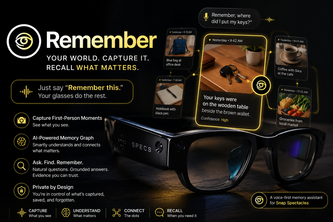
The project "Remember" is a self-reported voice-first memory assistant for Snap Spectacles, designed to capture first-person moments and convert them into structured, searchable memories using AI. It uses GPT-5.6 for visual understanding and grounded recall, with a local memory graph that evolves over time.
What changed:
The author states the project was built as part of an OpenAI 2026 hackathon submission. No indication of prior commercial activity or product evolution is evident in the description.
Single most important open question:
Is there any evidence of real-world usage, user feedback, or traction beyond the hackathon submission?
What The Product Actually Is
The description states that "Remember" is a voice-first memory assistant for Snap Spectacles, built using Lens Studio and TypeScript. It integrates:
- Spectacles’ first-person camera
- VoiceML and ASR for conversational input
- GPT-5.6 for visual understanding and grounded recall
- OpenAI text-to-speech for spoken responses
- Optional Supabase persistence
- A local memory graph for efficient retrieval
The system captures moments via voice command ("Remember this") and uses structured prompts to GPT-5.6 to extract relevant objects, actions, locations, spatial relationships, readable text, and uncertainty.
It then compresses this into a memory graph, which supports natural language queries such as:
- “Where did I put my keys?”
- “What happened this morning?”
The system retrieves evidence, generates grounded answers, and allows users to manage memories conversationally (correct, delete, summarize, undo).
Inference: The product is described as a wearable AI assistant focused on personal memory recall, not a general-purpose note-taking tool.
Positioning & Claim Evolution
The description states that the inspiration behind "Remember" was:
“What if your glasses could help you remember naturally, from your own point of view?”
This positions the product as an AI-powered personal memory assistant that operates in real-time and integrates seamlessly into daily life through wearable technology.
It claims to avoid traditional note-taking by capturing moments naturally and converting them into structured, searchable memories. The goal is not to remember everything, but to preserve details that become useful later.
The author also states:
“Remember does not treat every capture as an isolated note.”
This suggests a shift from raw data capture toward memory lifecycle management, where memories evolve over time through merging, corrections, and reinforcement.
Inference: The positioning evolved from a simple image-capturing tool to a more sophisticated memory graph system with conversational interaction and user control.
Target Customer & ICP
The description states that "Remember" is built for Snap Spectacles wearers, who are described as users of first-person wearable cameras.
It is implied that the target customer is someone who:
- Wears or uses Snap Spectacles
- Values personal memory recall and organization
- Needs to remember where things are, what happened, and what matters
There is no explicit mention of a specific persona beyond this. No segmentation by age, profession, or use case is provided.
Inference: The ICP appears to be first-person camera wearers, particularly those interested in AI-assisted memory management.
Business Model & Pricing Evidence
The description does not provide any information about:
- Revenue streams
- Pricing models
- Monetization strategy
- Customer acquisition costs
- Subscription or usage fees
Not evidenced
Technical & Delivery Signals
The project is built using:
- Lens Studio
- TypeScript
- GPT-5.6
- VoiceML and ASR
- OpenAI text-to-speech
- Snap’s Remote Service Gateway
- Supabase (optional)
- Local memory graph
Key technical elements include:
- Structured JSON output from GPT-5.6
- Deterministic local retrieval before generation
- Memory lifecycle states (canonical, superseded, stale, etc.)
- Conversational context handling
- Offline and speech-failure recovery
- Privacy controls including manual capture, private mode, undo, and thumbnail suppression
Inference: The system is designed with robustness in mind, supporting offline operation and user privacy.
Traction & Maturity Signals
The description states that this was a hackathon submission to the OpenAI 2026 hackathon, and no evidence of traction, revenue, or customer adoption beyond the project itself is provided.
There are no mentions of:
- Customers
- Users
- Revenue
- Product usage metrics
- Market validation
Not evidenced
Competitive Context
The description does not mention any competitors or existing solutions in the market for wearable memory assistants or AI-powered personal recall tools.
It also does not reference similar products or platforms, such as:
- Wearable AI devices
- Memory management apps
- First-person camera-based AI tools
Not evidenced
Open Questions & Risks
Several risks and open questions are implied by the description:
- Unproven commercial viability: The project is a hackathon submission with no evidence of traction or monetization.
- Dependency on proprietary APIs: Heavy reliance on GPT-5.6, Snap’s Remote Service Gateway, and Lens Studio may limit scalability or portability.
- Limited user feedback: No mention of real-world testing or user trials beyond the development phase.
- Privacy concerns with wearable AI: While privacy controls are mentioned, the system still collects and stores personal visual data.
- Technical complexity without validation: The described memory lifecycle management is complex but lacks evidence of successful implementation at scale.
Inference: The project may be technically impressive but lacks commercial maturity or real-world validation.
Questions the description leaves open
- What was the actual scope of the hackathon submission? Was it a prototype, proof-of-concept, or early-stage product?
- Have you conducted any user testing or feedback collection beyond the development team?
- How do you plan to scale this from a single-device experience to broader use cases?
- Are there any plans for monetization or revenue generation beyond the initial concept?
- What are the technical limitations of operating within the constraints of Lens Studio and Snap Spectacles?
- How do you intend to handle data privacy and compliance, especially with sensitive visual content?
Overall Assessment
The description states that this is a self-reported hackathon submission, and there is no evidence of traction, revenue, or customer adoption.
Assessment: Not ready for investment or partnership at this stage. The product shows technical sophistication but lacks commercial validation or market readiness.
Confidence level: Low — based entirely on self-reported information with no external corroboration or evidence of real-world usage.
User Stories BotA demo video on every pull request
Get a demo video on every new feature
GitHub App that watches your pull requests and records a narrated, captioned demo.
Save time on demo prep and make informed decisions faster with a video walkthrough of every new feature.
Source
Submitted to the OpenAI 2026 hackathon on Devpost. Project home on Devpost. Back to the full gallery on Devpost.
This competitive analysis was produced by top-founders.com (opens in a new tab)
Generated by a language model from this project's public Devpost page — its tagline, the author's own write-up and any built-with tags listed there — as captured in August 2026. Short quotations are the author's words. It is an opinion on the idea as a business, not on the people behind it, and it reflects the description as published then. If the project has moved on, request a correction below. The analysis is not independent research and contains no verified traction, revenue or customer data.
An independent guide by KFG International LLC — not affiliated with, endorsed by, or connected to Devpost or OpenAI.