

Archive position — measured, not model output
0 likes on Devpost
2,263 of the 7,850 archived projects have more likes, and 5,587 share exactly 0 — so this project's #7,675 place in the like-ranked listing is a tie-break inside that group, not a ranking.
Projects (log scale)
Likes on Devpost. ▲ marks this project's group.
Show the figures
| Likes | Projects | Share of archive |
|---|---|---|
| 0 | 5,587 | 71.2% |
| 1 | 1,758 | 22.4% |
| 2 | 284 | 3.6% |
| 3–4 | 132 | 1.7% |
| 5–9 | 75 | 1.0% |
| 10+ | 14 | 0.2% |
 User Stories BotA demo video on every pull request
Get a demo video on every new feature
GitHub App that watches your pull requests and records a narrated, captioned demo.
Save time on demo prep and make informed decisions faster with a video walkthrough of every new feature.
Executive Summary
What the company appears to be: WhenToWater? is a self-reported iOS application designed to provide plant-specific outdoor watering advice for California homeowners using an ordinary garden hose. The app uses scientific data (e.g., CIMIS ETo zones, UC crop coefficients) and user inputs (e.g., hose flow measurement, recent rain) to recommend when and how long to water plants.
What changed: The project was built during a single hackathon event (Build Week), with the author stating that prior to this effort, they had only gathered research and planning documents but no functional product or recommendation engine. This submission represents an initial implementation of their concept.
Single most important open question: Is there any evidence of traction, revenue, or user adoption beyond the single developer's own testing and demonstration?
Note: All claims are self-reported by the author and unverified. No third-party data, customer feedback, or financial metrics are provided in the description.
What The Product Actually Is
The description states that WhenToWater? is an iOS app that provides plant-specific outdoor watering advice based on:
- Seasonal evapotranspiration (CIMIS ETo)
- Plant demand (UC crop coefficients)
- Watered area
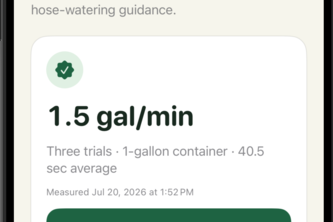
- Hose flow rate
- Recent conditions (rain, previous watering)
It uses these inputs to calculate a recommendation for how long and how often to water plants using an ordinary garden hose.
The app is described as:
- Built with Swift and SwiftUI
- Using GitHub and Codex for development workflow
- Running locally on iOS without requiring backend or network connectivity
- Designed for use by homeowners holding a hose in one hand and a phone in the other
Claim: The product is an iOS application that provides personalized watering guidance.
Evidence: Author's own write-up.
Inference: The app likely performs deterministic calculations based on input data.
Evidence: Author states "deterministic, provider-neutral engine" and describes calculation chain from ZIP code to hose duration.
Positioning & Claim Evolution
The author positions WhenToWater? as:
- A tool that brings irrigation intelligence to the person holding an ordinary hose
- An alternative to professional irrigation systems or controllers
- A way to avoid overwatering or under-watering without needing irrigation expertise
It is described as:
- Intended for "the ordinary hose in your hand and the human doing the watering"
- Not requiring accounts, APIs, or complex setup
- Focused on simplicity: “homeowners should not have to read six formulas”
The claim evolution appears to be:
- Initial idea: Bring scientific irrigation logic to homeowners using a simple hose.
- Development focus: Build a deterministic, local-first recommendation engine with traceable provenance.
- Current state: A working prototype demonstrating one path (tomato plant, hose delivery).
Claim: The product aims to simplify irrigation decision-making for everyday users.
Evidence: Author's own write-up.
Inference: The positioning reflects a shift from academic or technical tooling toward consumer usability.
Evidence: Emphasis on "simple answer", "trustworthy action", and avoiding complexity.
Target Customer & ICP
The description states that the target customer is:
- Homeowners in California
- Who do not have irrigation controllers or professional training
- Who use a garden hose to water plants outdoors
- Who are often in sun glare, trying to decide how much water a plant needs
The ICP (Ideal Customer Profile) seems to be:
- A homeowner with a vegetable garden or landscape
- Using an ordinary garden hose for watering
- Seeking reliable, science-backed guidance without technical knowledge
Claim: The target customer is California homeowners using a garden hose.
Evidence: Author's own write-up.
Inference: The app targets people who are not experts but want accurate irrigation advice.
Evidence: Mention of lack of irrigation training and desire to avoid overwatering.
Business Model & Pricing Evidence
There is no evidence in the description of:
- Revenue model
- Pricing structure
- Monetization strategy
- Subscription or one-time purchase plans
The app is described as:
- Not requiring an account
- Having no backend or API keys
- Being local-first and offline-capable
Claim: No business model or pricing information is provided.
Evidence: Author's own write-up.
Technical & Delivery Signals
Key technical elements mentioned:
- Built with Swift, SwiftUI, iOS Simulator
- Uses GitHub for version control and Codex for development workflow
- GPT-5.6 (via Codex) assisted in implementation
- Local-first architecture with no network dependency
- Deterministic recommendation engine
- Persistence of measurements across navigation and relaunch
- 29 deterministic tests covering accuracy, source integrity, etc.
- ZIP-to-CIMIS zone lookup, historical ETo data, UC crop coefficients
Claim: The app is technically implemented using local-first principles with AI-assisted development.
Evidence: Author's own write-up.
Inference: The architecture supports offline use and scientific traceability.
Evidence: Description of local data handling, deterministic engine, provenance tracking.
Traction & Maturity Signals
There is no evidence of:
- Revenue
- Customers or user base
- Product adoption or usage metrics
- Market traction beyond the author’s own testing
The project is described as:
- A single developer's hackathon submission
- Demonstrating one path (tomato plant, hose delivery)
- Not yet expanded to other plants or delivery methods
- In early alpha stage with planned future features
Claim: No traction or maturity data is available.
Evidence: Author's own write-up.
Competitive Context
The description does not mention:
- Direct competitors
- Market landscape
- Existing solutions in the irrigation space
It implies that current alternatives include:
- Professional irrigation controllers
- Irrigation certification or training programs
- General gardening apps (not specified)
Claim: No competitive context is provided.
Evidence: Author's own write-up.
Open Questions & Risks
Potential risks and open questions based on the description:
- Single developer team – Limited capacity for scaling or feature development
- No revenue or traction – No evidence of market validation or monetization
- Limited scope – Only one plant type (tomato) and delivery method (hose)
- Unverified scientific accuracy – App uses static data and deterministic logic, but no independent verification of its recommendations
- AI-assisted development dependency – Reliance on GPT-5.6 may not be scalable or reproducible outside the original developer's environment
Claim: Several operational and strategic risks are present due to lack of validation and limited scope.
Evidence: Author's own write-up.
Questions the description leaves open
- What is the source of the scientific data used (e.g., CIMIS, UC coefficients)? Is it publicly available or proprietary?
- How does the app handle missing or uncertain inputs? Are there fallbacks or warnings?
- Has the app been tested in real-world conditions beyond the author’s own testing?
- What are the plans for expanding to other plants, delivery methods, and regions beyond California?
- Is there any plan for monetization or commercial viability beyond personal use?
- How is the recommendation engine validated? Are there peer-reviewed sources or expert reviews?
- What is the long-term vision for the app’s architecture and data updates?
Note: These questions are based on the author's self-reported information and aim to probe deeper into unverified claims.
Overall Assessment
There is no evidence of:
- Revenue
- Customers or user adoption
- Product-market fit
- Scalable business model
- Financial performance or funding history
The project appears to be a single-developer hackathon prototype with limited scope and no demonstrated traction.
Claim: The project lacks commercial viability indicators.
Evidence: Author's own write-up.
Inference: It is not ready for investment or partnership at this stage.
Evidence: Lack of revenue, customers, or market validation.
User Stories BotA demo video on every pull request
Get a demo video on every new feature
GitHub App that watches your pull requests and records a narrated, captioned demo.
Save time on demo prep and make informed decisions faster with a video walkthrough of every new feature.
Source
Submitted to the OpenAI 2026 hackathon on Devpost. Project home on Devpost. Back to the full gallery on Devpost.
This competitive analysis was produced by top-founders.com (opens in a new tab)
Generated by a language model from this project's public Devpost page — its tagline, the author's own write-up and any built-with tags listed there — as captured in August 2026. Short quotations are the author's words. It is an opinion on the idea as a business, not on the people behind it, and it reflects the description as published then. If the project has moved on, request a correction below. The analysis is not independent research and contains no verified traction, revenue or customer data.
An independent guide by KFG International LLC — not affiliated with, endorsed by, or connected to Devpost or OpenAI.