

Archive position — measured, not model output
0 likes on Devpost
2,263 of the 7,850 archived projects have more likes, and 5,587 share exactly 0 — so this project's #3,751 place in the like-ranked listing is a tie-break inside that group, not a ranking.
Projects (log scale)
Likes on Devpost. ▲ marks this project's group.
Show the figures
| Likes | Projects | Share of archive |
|---|---|---|
| 0 | 5,587 | 71.2% |
| 1 | 1,758 | 22.4% |
| 2 | 284 | 3.6% |
| 3–4 | 132 | 1.7% |
| 5–9 | 75 | 1.0% |
| 10+ | 14 | 0.2% |
 User Stories BotA demo video on every pull request
Get a demo video on every new feature
GitHub App that watches your pull requests and records a narrated, captioned demo.
Save time on demo prep and make informed decisions faster with a video walkthrough of every new feature.
Executive Summary
Company: Diophantix ProofLab
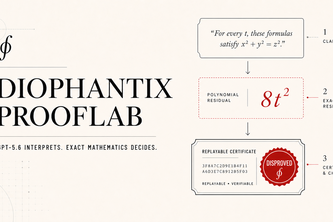
Self-reported purpose: A tool that verifies mathematical claims using GPT-5.6 and other AI tools, with a focus on solving difficult diophantine problems.
What changed: The project was submitted to the OpenAI 2026 hackathon by a single founder, Jamal Agbanwa. It is described as an experimental proof verification tool built with Cursor AI, Codex, and GPT-5.6.
Single most important open question: Does Diophantix ProofLab demonstrate any functional capability to verify mathematical claims beyond simple or well-known cases, and how does it differentiate from existing tools in the mathematical or AI space?
What The Product Actually Is
The description states that Diophantix ProofLab is a tool that verifies mathematical claims. It uses GPT-5.6 and other AI tools (Cursor AI, Codex) to interpret and evaluate mathematical statements. It is described as being able to determine whether a claim is correct or not, and to honestly admit when it cannot decide.
Evidence:
- The author states: “Diophantix ProofLab verifies proofs and mathematical statements.”
- It can take an input claim and determine its status.
- It uses GPT-5.6 for improving the tool and creating ProofLab.
Inference:
- The product is a proof verification system that leverages large language models (LLMs) to assess mathematical claims.
Positioning & Claim Evolution
The author positions Diophantix ProofLab as a tool that solves real mathematical problems, particularly difficult diophantine equations. It is described as being built with the intention of solving open problems and visualizing solutions. The project evolved from an initial idea to a working prototype using AI tools.
Evidence:
- “I was inspired by the idea of building a tool that solves a real mathematical problem.”
- “This tool was built with the initial intention of solving (and graphically visualising) very difficult diophantine problems which current AI assistants have difficulty getting past especially those related to open problems.”
- “One can simply put a mathematical claim and it quickly determines whether the statement is correct or not.”
Inference:
- The tool is positioned as a specialized verification system for mathematical claims, particularly in the domain of diophantine equations.
Target Customer & ICP
The description does not clearly identify a specific customer base or ideal customer profile (ICP). It is described as a tool built by one person to solve mathematical problems, with no mention of users, customers, or target industries.
Evidence:
- No explicit mention of who uses the product or how it would be monetized.
- The author states: “I was inspired by the idea of building a tool that solves a real mathematical problem.”
Inference:
- The ICP is not clearly defined; it may be academic researchers, mathematicians, or students working on complex problems.
Business Model & Pricing Evidence
There is no evidence in the description of any business model or pricing structure. The project is described as a hackathon submission with no indication of monetization or commercial use.
Evidence:
- No mention of revenue streams, pricing, or customer acquisition.
- The tool was built for a hackathon and is not described as a product for sale or licensing.
Inference:
- The business model is not evident; it may be experimental or non-commercial at this stage.
Technical & Delivery Signals
The project is built using Cursor AI, Codex, and GPT-5.6. It was submitted to the OpenAI 2026 hackathon. Challenges mentioned include issues with visualizing rational points and incorrect handling of known disproofs like Fermat's Last Theorem.
Evidence:
- “Built with (author-declared): codex, cursorai, gpt-5.6”
- “During the earlier phase of building Diophantix, when equations were run in it to be solved, even when it solves it correctly, the graphical illustration was either not working or sometimes even when it did, it was not properly visualising rational points as well as it did for integer points.”
- “When I tested its ability to identify correct proofs with Fermat's Last Theorem, i.e. $x^3 + y^3 = z^3$, it claimed it was undecided while it's known to be disproven (by Andrew Wiles).”
Inference:
- The tool is built on LLMs and AI tools but has limitations in visualization and accuracy for known mathematical facts.
Traction & Maturity Signals
There is no evidence of traction, adoption, or customer feedback. The project is described as a single-person hackathon submission with no indication of usage beyond the author’s testing.
Evidence:
- No mention of users, customers, or market traction.
- “This tool was built for a hackathon.”
- “I learned that there is always room for improvement.”
Inference:
- The product is at an early stage with no demonstrated adoption or usage.
Competitive Context
The description does not provide any information about competitors or how Diophantix ProofLab compares to existing tools in the mathematical or AI verification space. It is unclear whether similar tools already exist or what differentiates this one.
Evidence:
- No mention of competitors, existing tools, or market positioning.
- The author does not reference other proof-checking systems or AI tools for mathematics.
Inference:
- The competitive landscape is unknown; the project may be unique or overlap with existing tools in ways not described.
Open Questions & Risks
Key risks include:
- Accuracy issues: The tool reportedly misidentified Fermat’s Last Theorem as undecided, which suggests potential inaccuracies.
- Limited functionality: Visualizations are reported to be broken or incomplete.
- No commercial viability: No evidence of a business model or customer base.
- Unproven utility: The author states that the tool is experimental and has room for improvement.
Evidence:
- “It claimed it was undecided while it's known to be disproven (by Andrew Wiles).”
- “The graphical illustration was either not working or sometimes even when it did, it was not properly visualising rational points as well as it did for integer points.”
- “I learned that there is always room for improvement.”
Inference:
- The tool may be unreliable in its current form and lacks commercial viability.
Questions the description leaves open
- What specific mathematical claims or problems does the tool currently handle correctly?
- How does it validate or verify its own outputs, especially in cases where LLMs are uncertain?
- Are there any known limitations or edge cases where the system fails?
- Is there a plan to expand beyond diophantine equations or to integrate with existing mathematical software?
- What is the intended path to commercialization or product development?
Overall Assessment
Not evidenced: There is no evidence of revenue, customers, traction, or a clear business model. The project is described as a hackathon submission by one person and lacks any indication of commercial potential or scalability.
Confidence level: Low. The description is self-reported and unverified, with no data on performance, adoption, or market fit. Any potential for investment or partnership is speculative without further information.
Inference:
- At this stage, Diophantix ProofLab appears to be an experimental idea with limited demonstrated utility or commercial viability.
User Stories BotA demo video on every pull request
Get a demo video on every new feature
GitHub App that watches your pull requests and records a narrated, captioned demo.
Save time on demo prep and make informed decisions faster with a video walkthrough of every new feature.
Source
Submitted to the OpenAI 2026 hackathon on Devpost. Project home on Devpost. Back to the full gallery on Devpost.
This competitive analysis was produced by top-founders.com (opens in a new tab)
Generated by a language model from this project's public Devpost page — its tagline, the author's own write-up and any built-with tags listed there — as captured in August 2026. Short quotations are the author's words. It is an opinion on the idea as a business, not on the people behind it, and it reflects the description as published then. If the project has moved on, request a correction below. The analysis is not independent research and contains no verified traction, revenue or customer data.
An independent guide by KFG International LLC — not affiliated with, endorsed by, or connected to Devpost or OpenAI.