

Archive position — measured, not model output
0 likes on Devpost
2,263 of the 7,850 archived projects have more likes, and 5,587 share exactly 0 — so this project's #5,714 place in the like-ranked listing is a tie-break inside that group, not a ranking.
Projects (log scale)
Likes on Devpost. ▲ marks this project's group.
Show the figures
| Likes | Projects | Share of archive |
|---|---|---|
| 0 | 5,587 | 71.2% |
| 1 | 1,758 | 22.4% |
| 2 | 284 | 3.6% |
| 3–4 | 132 | 1.7% |
| 5–9 | 75 | 1.0% |
| 10+ | 14 | 0.2% |
 User Stories BotA demo video on every pull request
Get a demo video on every new feature
GitHub App that watches your pull requests and records a narrated, captioned demo.
Save time on demo prep and make informed decisions faster with a video walkthrough of every new feature.
Executive Summary
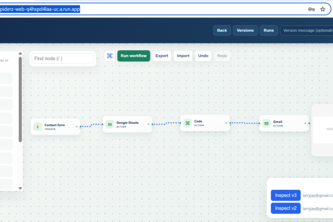
The company appears to be a single-developer project submitted to an OpenAI hackathon. The author states that OpenSpiderz is a visual automation platform built using AI tools like Codex and GPT-5.6 in three days. It claims to enable workflow automation by connecting nodes for various tools (e.g., Gmail, Slack) through a node-based interface. No revenue, customers or traction are evidenced.
What changed
The project was built over a few days as a hackathon submission using AI-assisted development tools. There is no evidence of prior development or commercial activity beyond this single submission.
The single most important open question
Is there any evidence that the author has continued development beyond the hackathon, or that the platform has moved past proof-of-concept into actual use by users?
What The Product Actually Is
- The description states that OpenSpiderz is a visual automation platform.
- It is described as a node-based workflow automation engine.
- It claims to act as the connective tissue for your entire tech stack.
- Users can connect tools (e.g., Gmail, Outlook, Slack, webhooks) via a visual interface.
- The system automates repetitive tasks and allows scaling without SaaS subscription bloat.
Inference The product appears to be an automation tool that allows users to build workflows by connecting nodes representing different software tools. It is self-described as code-extensible and customizable.
Positioning & Claim Evolution
- The author states the platform was built using Codex and GPT-5.6, with a focus on pushing boundaries of AI in enterprise application development.
- It is positioned as a tool that takes months for engineers to build but was completed in three days.
- The platform claims to enable users to automate thousands of repetitive tasks.
- The author states that the system "takes care of everything else" once tools are connected.
- The project is described as a large-scale automation platform, built in a hackathon setting.
Inference The positioning emphasizes rapid development using AI, ease-of-use for non-engineers, and broad tool integration. It frames itself as a solution to the complexity of building enterprise automation platforms.
Target Customer & ICP
- The description states that users can connect tools such as Gmail, Outlook, Slack, webhooks, etc.
- It is implied that the target includes individuals or teams who perform repetitive tasks and want to scale operations.
- The platform is described as "highly customizable, code-extensible and node-based workflow automation engine", suggesting a technical audience.
Inference The ICP likely includes technical users or developers who need to automate workflows involving multiple tools. It may also appeal to non-technical users looking for an easy-to-use interface for task automation.
Not evidenced No explicit customer segments, personas, or use cases are stated beyond general tool integration.
Business Model & Pricing Evidence
- The description states that the platform allows users to automate thousands of repetitive tasks, saving time and scaling operations.
- It is implied that the platform does not rely on SaaS subscription bloat.
- The author mentions plans to raise funding from investors and expand OpenSpiderz to serve millions of users.
Inference There is no clear business model or pricing structure evidenced. The description implies a potential freemium or enterprise SaaS model, but no details are provided.
Not evidenced No pricing, monetization strategy, or revenue model is described.
Technical & Delivery Signals
- Built using bullmq, codex, docker, fastify, git, gpt-5.6, kubernetes, postgresql, react, react-flow, redis, typescript, websockets.
- Development was done using Codex and GPT-5.6, with the author stating that these tools enabled rapid development.
- The platform is described as having a real-time UI for creating and running automations.
- Challenges included styling override issues and mobile UI design.
Inference The tech stack suggests a modern, scalable architecture using containerization, backend services, and frontend frameworks. The use of AI tools in development indicates a focus on rapid prototyping and code generation.
Traction & Maturity Signals
- The project was built in three days during a hackathon.
- It is described as an end-to-end large-scale automation platform.
- The author states that it successfully integrated multiple external tools.
- There are no evidence of users, customers, or adoption beyond the author’s own account.
Inference No traction or maturity signals are evident. The project is a hackathon prototype with no indication of ongoing development or user engagement.
Not evidenced No revenue, customer base, usage metrics, or product-market fit data.
Competitive Context
- The description does not mention any competitors.
- It positions itself as an alternative to enterprise infrastructure and security, orchestration engines, integrations, databases, workflow and execution engines, and AI integration.
- It is implied that it competes with platforms like Zapier, Make (Integromat), or Microsoft Power Automate.
Inference The platform likely aims to compete in the workflow automation space, but no direct comparison or competitive analysis is provided.
Not evidenced No mention of existing competitors or market positioning.
Open Questions & Risks
- The entire project was built by a single developer (John Ugbor) in a hackathon.
- It is self-reported and unverified, with no third-party validation.
- The platform is described as a hackathon prototype, not a commercial product.
- No evidence of ongoing development, funding, or user adoption.
- The use of AI tools like GPT-5.6 for building the system raises questions about scalability and maintainability.
Inference The project lacks commercial viability, traction, and long-term sustainability without further development or investment.
Questions the description leaves open
- Has the platform moved beyond the hackathon prototype stage?
- What is the current state of development and roadmap for future features?
- Are there any users or customers currently using the platform?
- How does OpenSpiderz plan to monetize its platform?
- What are the technical limitations of relying on AI tools like Codex and GPT-5.6 for development?
- Is there a plan to expand beyond the current tool integrations?
Overall Assessment
- The project is a single-developer hackathon submission, not a commercial product.
- No evidence of traction, revenue, or customer adoption.
- It is positioned as a proof-of-concept using AI tools for rapid development.
- There is no indication that the platform has moved beyond prototype status.
Inference At this stage, OpenSpiderz is not a viable investment or partnership opportunity. It lacks commercial viability and evidence of product-market fit.
Not evidenced No financials, customer data, or strategic partnerships are provided.
User Stories BotA demo video on every pull request
Get a demo video on every new feature
GitHub App that watches your pull requests and records a narrated, captioned demo.
Save time on demo prep and make informed decisions faster with a video walkthrough of every new feature.
Source
Submitted to the OpenAI 2026 hackathon on Devpost. Project home on Devpost. Back to the full gallery on Devpost.
This competitive analysis was produced by top-founders.com (opens in a new tab)
Generated by a language model from this project's public Devpost page — its tagline, the author's own write-up and any built-with tags listed there — as captured in August 2026. Short quotations are the author's words. It is an opinion on the idea as a business, not on the people behind it, and it reflects the description as published then. If the project has moved on, request a correction below. The analysis is not independent research and contains no verified traction, revenue or customer data.
An independent guide by KFG International LLC — not affiliated with, endorsed by, or connected to Devpost or OpenAI.