

Archive position — measured, not model output
1 like on Devpost
505 of the 7,850 archived projects have more likes, and 1,758 share exactly 1 — so this project's #1,788 place in the like-ranked listing is a tie-break inside that group, not a ranking.
Projects (log scale)
Likes on Devpost. ▲ marks this project's group.
Show the figures
| Likes | Projects | Share of archive |
|---|---|---|
| 0 | 5,587 | 71.2% |
| 1 | 1,758 | 22.4% |
| 2 | 284 | 3.6% |
| 3–4 | 132 | 1.7% |
| 5–9 | 75 | 1.0% |
| 10+ | 14 | 0.2% |
 User Stories BotA demo video on every pull request
Get a demo video on every new feature
GitHub App that watches your pull requests and records a narrated, captioned demo.
Save time on demo prep and make informed decisions faster with a video walkthrough of every new feature.
Executive Summary
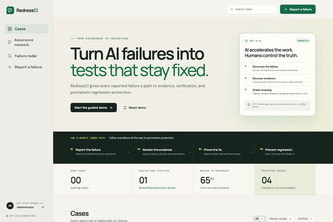
RedressCI is a self-reported platform that claims to turn reported AI failures into privacy-safe regression tests, verify fixes, and prevent recurrence in production environments. The description states it operates as a full-stack TypeScript application with React/Vite frontend, Express API, and integration with GitHub Actions for CI/CD workflows.
The project appears to be an early-stage prototype built by two team members, submitted to the OpenAI 2026 hackathon. It describes itself as a remediation loop that connects user-reported failures to engineering verification through structured processes involving human review, GPT-5.6 semantic grading, and deterministic assertions.
Key commercial due-diligence read: The author states RedressCI is a working platform with 37 automated tests covering various aspects of its functionality, but there is no evidence of revenue, customers, or production usage beyond the hackathon submission. The core business model remains undefined in the description — whether it's SaaS, a service, or a tool for internal use.
Single most important open question: Does RedressCI have any real-world adoption or pilot users who are paying for its functionality, or is this purely an experimental prototype?
What The Product Actually Is
The description states that RedressCI is:
- An AI remediation and continuous-assurance platform.
- A full-stack TypeScript application with React/Vite interface and Express API.
- Built using GPT-5.6 for semantic understanding tasks such as extracting interactions from text/screenshot, structuring incidents, discovering evidence candidates, and grading semantic requirements.
- Designed to guide reported failures through four stages: report, review, prove, and prevent.
- Capable of compiling approved cases into portable regression tests with deterministic checks and GPT-5.6 semantic grading.
- Integrated with GitHub Actions for CI/CD protection.
- Includes features like encrypted private artifact storage, role-enforced privacy boundaries, immutable grader-policy hashes, signed receipts, and allowlisted deployed-system adapters.
It is described as a working prototype that passes 37 automated tests covering privacy gates, evidence provenance, compiler behavior, comparative validation, proof integrity, and CI exports.
Inference: Based on the architecture and feature list, RedressCI appears to be a platform for managing AI-related incidents in development environments, with an emphasis on privacy and verification. However, this is not confirmed by any external data or usage metrics.
Positioning & Claim Evolution
The description states:
- RedressCI aims to connect "the missing middle" between traditional incident databases and evaluation platforms.
- It positions itself as a tool that turns user-reported AI failures into privacy-safe regression tests.
- The platform claims to guide users through four stages: report, review, prove, and prevent.
- It emphasizes that the original evidence remains private and separate from what developers can access.
- The goal is to ensure one person’s experience protects the next person.
There is no indication of prior positioning or evolution of claims beyond this single self-reported submission. No mention of previous versions, market feedback, or strategic pivots.
Inference: RedressCI appears to be a new product concept focused on responsible AI incident management and remediation. It does not appear to have evolved from earlier versions or prior products.
Target Customer & ICP
The description states:
- RedressCI is intended for organizations operating public-interest or high-impact AI systems.
- The platform targets engineering teams working with AI models where safety, accessibility, and reliability are critical.
- It includes a design-partner pilot plan with such organizations.
- Future enhancements include multilingual reporting, accessibility validation, and integration with Jira, Linear, Slack, and Teams.
No specific customer segments or personas beyond "organizations operating high-impact AI systems" are identified. No evidence of existing customers or use cases outside the hackathon context is provided.
Inference: The target ICP seems to be engineering teams in organizations using AI systems where failure can cause harm — particularly those concerned with accessibility, privacy, and compliance. However, no confirmed customer base exists.
Business Model & Pricing Evidence
The description does not state:
- Whether RedressCI is sold as a SaaS product.
- What pricing structure or licensing model it uses.
- If there are any paid features or tiers.
- How revenue would be generated (e.g., per user, per test, subscription, etc.).
There is no mention of monetization strategies, customer acquisition plans, or commercial partnerships.
Inference: No business model or pricing information is evident from the description. The platform appears to be a prototype with no clear indication of how it will generate revenue.
Technical & Delivery Signals
The description states:
- RedressCI is built as a full-stack TypeScript application using React/Vite, Express.js, Node.js, and Docker.
- It integrates with GitHub Actions for CI/CD workflows.
- Uses GPT-5.6 for semantic understanding tasks but not for final approvals or consent decisions.
- Includes role-enforced privacy boundaries, encrypted storage, immutable grader-policy hashes, signed receipts, and allowlisted adapters.
- Has a resettable synthetic demonstration workspace.
- Deployed on Render with continuous testing via GitHub Actions.
It also mentions that the application passes 37 automated tests covering various aspects of its functionality.
Inference: The technical stack suggests a modern, containerized, cloud-native platform. However, no evidence exists regarding scalability, performance, or production deployment beyond the prototype stage.
Traction & Maturity Signals
The description states:
- RedressCI is a working prototype with 37 automated tests.
- It demonstrates private failure reporting, human-approved redaction, portable evaluation compilation, broken-versus-corrected comparative proof, live deployed-target verification, signed receipts, and GitHub CI protection.
- The team plans to conduct a design-partner pilot with organizations operating public-interest or high-impact AI systems.
There is no evidence of:
- Revenue
- Customers
- Paid users
- Production usage
- Market traction
- Growth metrics
Inference: RedressCI shows early maturity in terms of prototype functionality, but lacks any signs of commercial traction or adoption beyond the hackathon submission.
Competitive Context
The description does not reference:
- Direct competitors
- Indirect substitutes
- Market size or growth trends
- Competitive advantages or differentiation strategies
It only mentions that traditional incident databases preserve what happened and evaluation platforms help test datasets they already own — implying a gap in the market between these two categories.
Inference: The competitive landscape is not described. RedressCI appears to be positioned at the intersection of AI incident management, privacy-preserving testing, and CI/CD integration, but no known competitors are named or analyzed.
Open Questions & Risks
Key risks and open questions based on the description:
- Unproven commercial viability: No evidence of revenue, customers, or monetization strategy.
- High technical complexity with limited validation: The system relies heavily on GPT-5.6 for semantic tasks but requires human approval for key decisions — this may create bottlenecks or inconsistencies.
- Privacy and trust assumptions: The platform claims to enforce privacy boundaries, but there is no independent verification of how effectively these are enforced.
- Unclear scalability and deployment readiness: While built with Docker and GitHub Actions, the description does not indicate whether it has been tested at scale or in production environments.
- Lack of market feedback or iteration history: The product appears to be a single submission without prior versions or customer input.
Inference: RedressCI is an experimental prototype with strong technical design but no evidence of real-world application, traction, or commercial viability.
Questions the description leaves open
- What specific organizations are you planning to partner with for the pilot program?
- How do you plan to monetize this platform — what pricing model or revenue streams are envisioned?
- Are there any existing users or customers who have provided feedback on the current functionality?
- What is the timeline for moving from prototype to production-ready deployment?
- How do you intend to scale the human review process as more incidents are reported?
- Can you provide details about how the GPT-5.6 integration handles uncertainty and edge cases?
- What are the key challenges in deploying this platform at scale, especially around privacy and compliance?
- Have you considered alternative approaches or tools that might achieve similar outcomes with less complexity?
Overall Assessment
RedressCI is a self-reported prototype submitted to a hackathon. The description indicates it is a working system with 37 automated tests and includes features such as privacy-preserving incident reporting, GPT-5.6 integration, CI/CD support, and deterministic assertions.
However, there is no evidence of revenue, customers, or production usage beyond the prototype stage. The business model, pricing strategy, and commercial traction are not described.
The platform shows promise in addressing a gap in responsible AI incident management, but its current status is that of an experimental tool with no demonstrated market validation or financial sustainability.
Assessment: Not ready for investment or partnership at this time. Requires further development, pilot testing, and evidence of customer demand before any serious consideration can be made.
User Stories BotA demo video on every pull request
Get a demo video on every new feature
GitHub App that watches your pull requests and records a narrated, captioned demo.
Save time on demo prep and make informed decisions faster with a video walkthrough of every new feature.
Source
Submitted to the OpenAI 2026 hackathon on Devpost. Project home on Devpost. Back to the full gallery on Devpost.
This competitive analysis was produced by top-founders.com (opens in a new tab)
Generated by a language model from this project's public Devpost page — its tagline, the author's own write-up and any built-with tags listed there — as captured in August 2026. Short quotations are the author's words. It is an opinion on the idea as a business, not on the people behind it, and it reflects the description as published then. If the project has moved on, request a correction below. The analysis is not independent research and contains no verified traction, revenue or customer data.
An independent guide by KFG International LLC — not affiliated with, endorsed by, or connected to Devpost or OpenAI.