

Archive position — measured, not model output
0 likes on Devpost
2,263 of the 7,850 archived projects have more likes, and 5,587 share exactly 0 — so this project's #7,624 place in the like-ranked listing is a tie-break inside that group, not a ranking.
Projects (log scale)
Likes on Devpost. ▲ marks this project's group.
Show the figures
| Likes | Projects | Share of archive |
|---|---|---|
| 0 | 5,587 | 71.2% |
| 1 | 1,758 | 22.4% |
| 2 | 284 | 3.6% |
| 3–4 | 132 | 1.7% |
| 5–9 | 75 | 1.0% |
| 10+ | 14 | 0.2% |
 User Stories BotA demo video on every pull request
Get a demo video on every new feature
GitHub App that watches your pull requests and records a narrated, captioned demo.
Save time on demo prep and make informed decisions faster with a video walkthrough of every new feature.
Executive Summary
Company: WanderQuest AI
Self-reported basis: The description is entirely from the project author’s own submission to a hackathon, with no external verification.
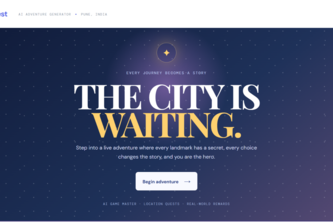
Commercial due-diligence read: WanderQuest AI appears to be an AI-powered travel companion that generates dynamic, RPG-style adventures for real-world exploration. It is positioned as a gamified travel tool that transforms destinations into interactive narratives using AI-generated quests, NPCs, and rewards. The product is in early-stage development (a hackathon project), with no evidence of revenue, customers or traction. The single most important open question is whether the AI storytelling engine can scale to generate diverse, engaging content without becoming repetitive or losing immersion at scale.
What The Product Actually Is
The description states that WanderQuest AI is an AI-powered travel companion that turns every journey into an RPG-style adventure. It allows users to input trip details (destination, budget, duration, interests) and generates a personalized storyline where the user becomes the main character. The AI creates quests, NPCs, riddles, rewards, and multiple endings based on the destination.
- Claimed functionality:
- Generates dynamic stories, quests, riddles, NPCs, and rewards tailored to a destination
- Uses GPT-5.6 for story generation, quest creation, NPC dialogue, hints, and adaptive storytelling
- Integrates with maps (Leaflet or Mapbox with OpenStreetMap)
- Includes photography challenges, exploration tasks, and collectibles
Inference: The product is a hybrid of travel planning, gamification, and AI storytelling. It is not a traditional travel app but rather an immersive narrative engine layered on top of real-world geography.
Positioning & Claim Evolution
The description states that WanderQuest AI was inspired by adventure games like Assassin's Creed, Pokémon GO, and Dungeons & Dragons, aiming to reimagine travel as an open-world RPG. It positions itself as a tool that makes exploration engaging and interactive, moving beyond standard travel recommendations.
- Claimed positioning:
- “Turn every journey into an RPG”
- “Reimagining travel by asking: What if every city became an open-world RPG?”
- “AI becomes a Game Master that creates personalized stories, quests, puzzles, characters, and rewards”
Inference: The product is positioned as a niche, immersive travel experience. It does not claim to be a mainstream travel app but rather a novelty or experimental tool for adventure-seeking travelers.
Target Customer & ICP
The description states that the project was inspired by the idea that traditional travel apps are not engaging enough and that most travelers follow the same routes. It aims to encourage exploration of lesser-known locations through interactive quests.
- Claimed target customer:
- Travelers who want immersive, interactive experiences
- Adventure seekers or those interested in gamified travel
- Users with a preference for storytelling and exploration over standard itineraries
Inference: The ICP is likely niche — early adopters of gamified or AI-driven tools, possibly younger or more tech-savvy travelers. No evidence of specific customer segments, personas, or market size.
Business Model & Pricing Evidence
The description does not state any pricing model, monetization strategy, or business model. It only describes the product’s functionality and future roadmap.
- Claimed business model:
- Not stated
Inference: No evidence of a monetization approach, subscription plans, freemium structure, or in-app purchases. The project is presented as a hackathon prototype with no commercial strategy described.
Technical & Delivery Signals
The description provides details on the tech stack and development approach:
- Frontend: React, Tailwind CSS, Framer Motion
- Backend: Node.js, Express
- Database: MongoDB / Firebase
- Authentication: Clerk or Firebase Auth
- Maps: Leaflet or Mapbox with OpenStreetMap
- AI: GPT-5.6 for storytelling, Codex for development workflow
Inference: The tech stack is standard for a full-stack web application with AI integration. It suggests a prototype built in a short timeframe (hackathon), not a production-grade system.
Traction & Maturity Signals
The description states that this was a hackathon project submitted to the OpenAI 2026 hackathon, and no evidence of revenue, customers, or adoption is provided.
- Claimed traction:
- Not evidenced
Inference: No data on user engagement, retention, monetization, or customer acquisition. The product is described as a prototype with a roadmap for future features, not a live product.
Competitive Context
The description does not mention any direct competitors. It references inspiration from games like Pokémon GO and Assassin's Creed but does not name similar travel or gamification tools.
- Claimed competitive context:
- Not stated
Inference: No evidence of existing players in the space, nor analysis of how WanderQuest AI differentiates from other travel or gamified platforms. The product is positioned as a novel concept, not a market leader.
Open Questions & Risks
- AI storytelling scalability: The description notes that one challenge was avoiding repetition in quest generation — this raises concerns about long-term content diversity and user fatigue
- Real-world integration complexity: Combining AI-generated narratives with real-world geography and landmarks may be difficult to execute consistently
- No monetization strategy: The project lacks a clear business model or revenue plan
- Prototype nature: The product is described as a hackathon prototype, not a mature product or platform
Questions the description leaves open
- What specific use cases or user personas are you targeting with this tool?
- How do you plan to scale the AI storytelling engine without repetition or loss of immersion?
- Do you have any data on how users interact with the generated quests and stories?
- Are there any partnerships or integrations planned with travel providers, tourism boards, or map services?
- What is your roadmap for monetization and user acquisition beyond the hackathon prototype?
- How do you plan to validate that the AI-generated content remains relevant and practical for real-world exploration?
Overall Assessment
Not evidenced.
The description does not provide any information on valuation, funding rounds, or investment interest. It is a self-reported hackathon project with no evidence of traction, revenue, or commercial viability. The product is in early-stage development and lacks a clear business model or customer base.
Confidence level: Low. The analysis is based entirely on the author’s own description, which is unverified and self-promotional. No third-party data or performance metrics are available to assess the project's potential or risks.
User Stories BotA demo video on every pull request
Get a demo video on every new feature
GitHub App that watches your pull requests and records a narrated, captioned demo.
Save time on demo prep and make informed decisions faster with a video walkthrough of every new feature.
Source
Submitted to the OpenAI 2026 hackathon on Devpost. Project home on Devpost. Back to the full gallery on Devpost.
This competitive analysis was produced by top-founders.com (opens in a new tab)
Generated by a language model from this project's public Devpost page — its tagline, the author's own write-up and any built-with tags listed there — as captured in August 2026. Short quotations are the author's words. It is an opinion on the idea as a business, not on the people behind it, and it reflects the description as published then. If the project has moved on, request a correction below. The analysis is not independent research and contains no verified traction, revenue or customer data.
An independent guide by KFG International LLC — not affiliated with, endorsed by, or connected to Devpost or OpenAI.