

Archive position — measured, not model output
0 likes on Devpost
2,263 of the 7,850 archived projects have more likes, and 5,587 share exactly 0 — so this project's #7,625 place in the like-ranked listing is a tie-break inside that group, not a ranking.
Projects (log scale)
Likes on Devpost. ▲ marks this project's group.
Show the figures
| Likes | Projects | Share of archive |
|---|---|---|
| 0 | 5,587 | 71.2% |
| 1 | 1,758 | 22.4% |
| 2 | 284 | 3.6% |
| 3–4 | 132 | 1.7% |
| 5–9 | 75 | 1.0% |
| 10+ | 14 | 0.2% |
 User Stories BotA demo video on every pull request
Get a demo video on every new feature
GitHub App that watches your pull requests and records a narrated, captioned demo.
Save time on demo prep and make informed decisions faster with a video walkthrough of every new feature.
Executive Summary
What the company appears to be
Wanderwonder is a self-reported local-first travel planning tool built by one developer (Seldon HE) for personal use and submitted as a hackathon project. The author describes it as an integrated platform combining itinerary planning, scheduling, mapping, budgeting, and preparation — all within a browser-based environment with no cloud storage or account requirements.
What changed
This is a single-person project submitted to the OpenAI 2026 hackathon. There is no evidence of prior existence, funding, customers, or product-market fit beyond the author’s own description.
The single most important open question
Is there any traction, revenue, or user adoption that validates the need for this tool beyond the author's personal experience?
Analysis basis: Self-reported and unverified. No third-party corroboration, no financials, no customers, no product usage data. The description is a narrative of intent and design, not proof of execution or market validation.
What The Product Actually Is
The description states that Wanderwonder is:
- A local-first travel planning companion.
- Designed around the entire travel lifecycle, from idea to departure.
- Combines planning, scheduling, mapping, budgeting, and preparation into one integrated experience.
- Built using React, TypeScript, JavaScript, CSS, Vite, and AI tools like ChatGPT and Codex.
- Operates without cloud storage or account requirements.
- Uses a browser-based local data model with explicit backup/recovery workflows.
It is described as a single-user tool that supports:
- Drag-and-drop itinerary editing
- Timeline views
- Route visualization
- Multi-currency budgeting
- Packing lists and readiness tracking
Inference: The product appears to be a prototype or MVP built in a short timeframe, likely for demonstration purposes. It is not described as having any monetization, distribution, or user base.
Positioning & Claim Evolution
The author positions Wanderwonder as:
- A single workspace that follows the journey from idea to departure.
- A local-first alternative to scattered tools (spreadsheets, maps, notes, calendars).
- A tool that answers core questions: What is happening each day? How do locations connect? How much will it cost?
The product is described as:
- Privacy-focused, with no cloud storage or account required.
- Designed around the entire travel lifecycle.
- Built using AI tools to accelerate development and iteration.
Claim vs. Fact: The positioning is self-described and not validated by any external data. It reflects the author’s intent, not market traction or competitive positioning.
Target Customer & ICP
The description states that Wanderwonder is designed for:
- Users who plan complex international trips.
- People who want to keep personal travel data private.
- Individuals who find existing tools fragmented or chaotic.
It is described as a tool for:
- Travelers who want to organize dozens of scattered pieces (flights, hotels, attractions, budgets).
- Users who value a calm, integrated workspace over fragmented apps.
Inference: The target customer seems to be individual travelers, particularly those with complex itineraries and a preference for privacy. No evidence of segmentation or persona development beyond the author’s own experience.
Business Model & Pricing Evidence
The description states:
- Wanderwonder is local-first.
- No account required.
- No cloud database storing personal itineraries.
- Explicit backup and recovery workflows.
There is no mention of pricing, monetization, or business model.
Not evidenced: No indication of how the product would generate revenue, if at all. The author does not describe any paid features, subscriptions, or commercial use cases.
Technical & Delivery Signals
The project was built using:
- React, TypeScript, JavaScript, CSS, Vite
- AI tools: ChatGPT, Codex, GPT-5.6
- Browser-based local-first architecture
- Progressive disclosure UX patterns
- Automated testing and validation logic
The author states that AI was used for:
- Exploring ideas
- Designing data models
- Generating implementation plans
- Refactoring components
- Debugging issues
Inference: The technical stack and development approach suggest a modern, lightweight, browser-based tool. The use of AI tools implies rapid iteration and prototyping, but no evidence of scalability or production-grade infrastructure.
Traction & Maturity Signals
The description states:
- Wanderwonder was built as a hackathon submission (OpenAI 2026).
- It is a single-person project.
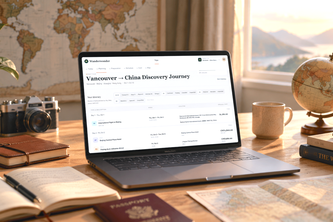
- The demo uses synthetic data (Vancouver → China journey).
- No personal travel data is included.
There is no evidence of users, customers, or adoption beyond the author’s own use case.
Not evidenced: No revenue, user base, or product usage metrics. The project appears to be a prototype with no commercial traction.
Competitive Context
The author states that:
- Current tools solve only one part of the travel planning problem (maps, spreadsheets, notes, calendars).
- Wanderwonder aims to integrate these functions into one experience.
- It is positioned as an alternative to fragmented tools.
No mention of direct competitors or market analysis is provided.
Not evidenced: No competitive landscape, no competitor names, no pricing comparison, no differentiation strategy beyond the author’s own claims.
Open Questions & Risks
Key risks and open questions based on the description:
- Single-person project with no team or external validation.
- No commercial traction, revenue, or user adoption.
- Local-first architecture may limit scalability or usability for shared planning.
- No monetization strategy or business model described.
- AI-driven development is not a scalable product feature — it’s a development method.
- Hackathon submission implies MVP-level maturity, not a production-ready tool.
Inference: The lack of any commercial evidence or user feedback raises concerns about market demand and viability beyond the author’s own use case.
Questions the description leaves open
- What is your actual travel planning experience? How many trips have you planned using Wanderwonder?
- Have you tested this with others, or is it purely a personal tool?
- What are your plans for monetization or commercial adoption?
- How do you plan to scale beyond the single-user, local-first model?
- What specific problems do users face with current tools that Wanderwonder solves?
- Do you have any feedback from early users or testers?
- What is your roadmap for product development beyond this MVP?
Overall Assessment
Not evidenced: No data on revenue, customers, traction, or commercial viability.
Assessment: This is a self-reported hackathon project with no evidence of market traction, user adoption, or business model. It is not ready for investment or partnership consideration at this stage. The author’s claims about product design and AI use are compelling but unvalidated by any external metrics or user feedback.
The project appears to be an early-stage prototype built for demonstration purposes, not a commercial product with market validation.
User Stories BotA demo video on every pull request
Get a demo video on every new feature
GitHub App that watches your pull requests and records a narrated, captioned demo.
Save time on demo prep and make informed decisions faster with a video walkthrough of every new feature.
Source
Submitted to the OpenAI 2026 hackathon on Devpost. Project home on Devpost. Back to the full gallery on Devpost.
This competitive analysis was produced by top-founders.com (opens in a new tab)
Generated by a language model from this project's public Devpost page — its tagline, the author's own write-up and any built-with tags listed there — as captured in August 2026. Short quotations are the author's words. It is an opinion on the idea as a business, not on the people behind it, and it reflects the description as published then. If the project has moved on, request a correction below. The analysis is not independent research and contains no verified traction, revenue or customer data.
An independent guide by KFG International LLC — not affiliated with, endorsed by, or connected to Devpost or OpenAI.