

Archive position — measured, not model output
0 likes on Devpost
2,263 of the 7,850 archived projects have more likes, and 5,587 share exactly 0 — so this project's #7,627 place in the like-ranked listing is a tie-break inside that group, not a ranking.
Projects (log scale)
Likes on Devpost. ▲ marks this project's group.
Show the figures
| Likes | Projects | Share of archive |
|---|---|---|
| 0 | 5,587 | 71.2% |
| 1 | 1,758 | 22.4% |
| 2 | 284 | 3.6% |
| 3–4 | 132 | 1.7% |
| 5–9 | 75 | 1.0% |
| 10+ | 14 | 0.2% |
 User Stories BotA demo video on every pull request
Get a demo video on every new feature
GitHub App that watches your pull requests and records a narrated, captioned demo.
Save time on demo prep and make informed decisions faster with a video walkthrough of every new feature.
Executive Summary
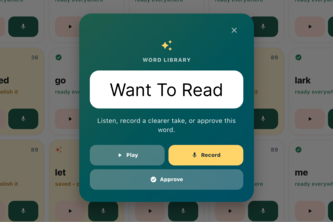
The description states that "Want To Read: Your Voice Inspires Young Readers" is a project built for an OpenAI hackathon by one developer, Evan Brammer. The author describes it as a tool that allows trusted adults to record audio for public-domain or user-provided text passages, enabling young readers to follow along with pronunciation and word tapping. It includes basic interactive features like a word-find game and plans for additional educational games.
The project appears to be an early-stage prototype built using AI tools (ChatGPT, Cursor) in a hackathon context. The author claims it addresses a real-world need in reading education but provides no evidence of revenue, customers, or adoption beyond the single developer's personal use case.
The single most important open question
Is there any evidence that this concept has traction or demand from actual educators or parents beyond the developer’s own experience?
What The Product Actually Is
The description states that Want To Read is a tool where:
- Trusted adults record audio for public-domain or user-provided text passages.
- Young readers can follow along while listening to the story or passage.
- Readers can pause and tap on any word to hear its pronunciation in a familiar voice and accent.
- The app includes basic games (e.g., word find) that reinforce sight reading and word memorization.
The author describes building it using Cursor, ChatGPT, and Flutter. It was submitted as a hackathon project to the OpenAI 2026 hackathon.
Inference Based on the description, this is an educational tool focused on reading development for young children, integrating audio narration with interactive word learning features.
Positioning & Claim Evolution
The author states that Want To Read helps young readers discover a love of reading through stories brought to life by someone they know and love. This positioning emphasizes emotional connection and personalization in early literacy.
The project was built during a hackathon, suggesting it is an experimental or proof-of-concept effort rather than a mature product. The author notes that the goal was to bridge the gap between fully independent practice and reading directly to children.
Inference The positioning reflects a niche focus on personalized reading support for young learners, likely targeting parents, teachers, or caregivers who want to engage children in reading.
Target Customer & ICP
The description states:
- The primary users are young readers.
- Trusted adults (parents, teachers) record audio for these passages.
- The tool is designed to help children develop reading skills through interactive storytelling and word recognition.
There is no explicit mention of specific age groups or educational levels targeted. However, the author implies a focus on early literacy development.
Inference The ICP likely includes caregivers and educators seeking tools to support children’s reading practice, particularly those who value personalization and familiarity in learning.
Business Model & Pricing Evidence
There is no evidence of pricing, monetization strategy, or business model in the description. The author does not describe how the product would be sold, licensed, or funded beyond the hackathon context.
Not evidenced No indication of revenue streams, subscription models, or commercial viability.
Technical & Delivery Signals
The author states:
- Built entirely in Cursor using the Codex extension.
- Used ChatGPT 5.6 and MacOS ChatGPT app with remote functionality.
- Worked with approximately 50 different AI agent sessions to build and refine the project.
- Started by scoping out phases, basic structure, and functionality.
- Focused on getting audio timing right before relying on AI-based timings.
Inference The development process relied heavily on AI-assisted coding and iterative refinement. The author emphasizes simplicity and focus over feature bloat.
Traction & Maturity Signals
The description states:
- This is a hackathon project submitted to the OpenAI 2026 hackathon.
- The team consists of one member (Evan Brammer).
- No mention of users, customers, or adoption beyond personal use cases.
- The author mentions future plans for additional games but does not indicate any current user engagement.
Not evidenced No evidence of traction, revenue, or customer base. The project is described as a prototype with no indication of market testing or real-world deployment.
Competitive Context
There is no mention of competitors in the description. The author does not reference existing tools for reading education or digital storytelling platforms.
Not evidenced No competitive analysis or positioning relative to other educational apps or services.
Open Questions & Risks
- Unproven market demand: The project is described as a hackathon prototype with no evidence of user traction or commercial viability.
- Single-person development: With only one developer, scalability and long-term maintenance are unclear.
- No monetization strategy: No indication of how the product would generate revenue or sustain itself.
- Limited scope: The author notes that the project was scoped to avoid "super apps" and rabbit holes — which may indicate a lack of ambition or strategic depth.
Inference The risk is high due to lack of evidence for market fit, scalability, or sustainable business model.
Questions the description leaves open
- What specific educational outcomes have you observed from using this tool?
- Have you tested the product with actual children and educators?
- Are there any existing partnerships or pilot programs with schools or libraries?
- How do you plan to scale beyond a single developer?
- What is your vision for monetization or commercialization?
- What are the key technical challenges that remain unresolved?
Overall Assessment
The description indicates this is an early-stage hackathon project with no evidence of traction, revenue, or customer engagement. It lacks any indication of a viable business model or strategic roadmap.
Assessment Not ready for investment or partnership at this stage. The concept may have potential, but there is insufficient evidence to assess commercial viability or market demand.
User Stories BotA demo video on every pull request
Get a demo video on every new feature
GitHub App that watches your pull requests and records a narrated, captioned demo.
Save time on demo prep and make informed decisions faster with a video walkthrough of every new feature.
Source
Submitted to the OpenAI 2026 hackathon on Devpost. Project home on Devpost. Back to the full gallery on Devpost.
This competitive analysis was produced by top-founders.com (opens in a new tab)
Generated by a language model from this project's public Devpost page — its tagline, the author's own write-up and any built-with tags listed there — as captured in August 2026. Short quotations are the author's words. It is an opinion on the idea as a business, not on the people behind it, and it reflects the description as published then. If the project has moved on, request a correction below. The analysis is not independent research and contains no verified traction, revenue or customer data.
An independent guide by KFG International LLC — not affiliated with, endorsed by, or connected to Devpost or OpenAI.