

Archive position — measured, not model output
0 likes on Devpost
2,263 of the 7,850 archived projects have more likes, and 5,587 share exactly 0 — so this project's #3,700 place in the like-ranked listing is a tie-break inside that group, not a ranking.
Projects (log scale)
Likes on Devpost. ▲ marks this project's group.
Show the figures
| Likes | Projects | Share of archive |
|---|---|---|
| 0 | 5,587 | 71.2% |
| 1 | 1,758 | 22.4% |
| 2 | 284 | 3.6% |
| 3–4 | 132 | 1.7% |
| 5–9 | 75 | 1.0% |
| 10+ | 14 | 0.2% |
 User Stories BotA demo video on every pull request
Get a demo video on every new feature
GitHub App that watches your pull requests and records a narrated, captioned demo.
Save time on demo prep and make informed decisions faster with a video walkthrough of every new feature.
Executive Summary
What the company appears to be
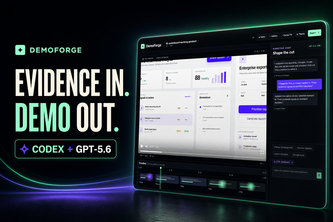
DemoForge, as described by its author, is a self-contained tool that converts raw product artifacts—such as screen recordings, screenshots, codebases, and voice input—into editable, motion-designed video demos. It uses AI (specifically GPT-5.6) to structure these inputs into a scene graph, allowing creators to make changes in plain language without needing video editing skills.
What changed
The author describes building this tool as an attempt to automate the laborious process of turning product evidence into a compelling demo. The system is designed to act like an AI director, taking input and generating a first-cut demo that remains editable throughout the process.
Single most important open question
Is there any evidence of real-world usage or traction beyond the author's own submission? The description contains no data on customers, revenue, adoption, or product-market fit beyond its own demonstration.
Note: This analysis is based entirely on the self-reported and unverified project description provided by the author. No external verification or historical data exists for this project.
What The Product Actually Is
The description states that DemoForge accepts:
- Screen recordings
- Screenshots
- Codebases (as a folder)
- Natural voice input
It then outputs:
- An editable, motion-designed video demo
- A validated scene graph containing title cards, real footage, uploaded-image beats, captions, camera moves, cursor treatment, music, and a narration outline
The tool is built using:
- Next.js and TypeScript
- Remotion for preview/export pipeline
- Three.js for interface
- GPT-5.6 via OpenAI API
- Vercel Blob store for storage
- Whisper for transcription
It supports two paths:
- A public prepared demo (no credentials required)
- A private live GPT-5.6 path where judges can upload their own inputs after entering an access code
Claim: The product is a video editing tool powered by AI, designed to turn raw product evidence into polished demos.
Evidence: Self-reported by the author.
Positioning & Claim Evolution
The author positions DemoForge as:
- A way to automate the creation of product demos
- An AI-powered "director" that structures content into a narrative
- A tool that allows creators to edit the output in plain language, not just through traditional video editing UIs
It is described as:
- Not starting from an empty editor but using real inputs (recordings, code, images)
- Making editing reversible and previewable
- Supporting natural voice narration with automatic alignment to scenes
Claim: DemoForge acts like an AI product-demo director.
Evidence: Self-reported by the author.
Target Customer & ICP
The description does not explicitly name target customers or define a specific Ideal Customer Profile (ICP). However, it implies:
- Founders and product teams who need to create compelling demos
- Users who have screen recordings, screenshots, codebases, and voice input but lack video editing skills or time
Claim: The tool is aimed at creators who want to turn product evidence into polished demos.
Evidence: Self-reported by the author.
Business Model & Pricing Evidence
There is no mention of pricing, monetization strategy, or business model in the description. The only reference to revenue is that the public demo path requires no credentials or API usage, while the private path uses a code-based access system.
Claim: No explicit business model or pricing information provided.
Evidence: Not evidenced.
Technical & Delivery Signals
The author describes:
- Use of Next.js and TypeScript
- Remotion for rendering pipeline
- Three.js for interactive UI
- GPT-5.6 via OpenAI API
- Vercel Blob store for storage
- Whisper for transcription
- JSON-based scene graph with RFC 6902 patches
- Zod-backed validation
- Serverless deployment constraints handled through durable blob storage
Claim: The product is technically robust, built on modern stacks and designed to handle multimodal inputs.
Evidence: Self-reported by the author.
Traction & Maturity Signals
There is no evidence of traction or maturity beyond the author’s own submission. No customers, revenue, usage metrics, or adoption data are mentioned. The project was submitted to a hackathon and includes only a public demo and a private judge path.
Claim: No traction or user engagement data.
Evidence: Not evidenced.
Competitive Context
The description does not reference any competitors or market context. It does not describe how DemoForge compares to existing tools for creating product demos, nor does it identify the competitive landscape.
Claim: No competitive analysis provided.
Evidence: Not evidenced.
Open Questions & Risks
- Lack of traction: The project is described only as a hackathon submission with no evidence of real-world usage or adoption.
- Unverified claims: The author states that GPT-5.6 is used, but there is no verification of its actual performance or integration.
- Limited scope: The tool is presented as a single-user demo generator, not scalable for teams or enterprise use.
- No monetization strategy: No indication of how the product would be monetized or whether it has commercial viability.
Inference: Without traction or revenue data, this appears to be an experimental prototype rather than a viable business.
Evidence: Self-reported by the author.
Questions the description leaves open
- What is the actual use case for DemoForge beyond the hackathon submission?
- How does it handle edge cases in input data (e.g., corrupted recordings, missing code)?
- Are there any plans to scale beyond a single-user experience?
- Has the tool been tested with real users or teams?
- What are the technical limitations of the current architecture that would prevent production deployment at scale?
Note: These questions aim to uncover whether the product has evolved past its initial prototype stage.
Overall Assessment
At this stage, DemoForge appears to be a hackathon-level prototype with no demonstrated traction or commercial viability. It is not evident whether it has moved beyond an experimental phase into a product that could attract investment or partnership interest.
Inference: The project lacks the signals of a mature, scalable business.
Evidence: Self-reported by the author.
User Stories BotA demo video on every pull request
Get a demo video on every new feature
GitHub App that watches your pull requests and records a narrated, captioned demo.
Save time on demo prep and make informed decisions faster with a video walkthrough of every new feature.
Source
Submitted to the OpenAI 2026 hackathon on Devpost. Project home on Devpost. Back to the full gallery on Devpost.
This competitive analysis was produced by top-founders.com (opens in a new tab)
Generated by a language model from this project's public Devpost page — its tagline, the author's own write-up and any built-with tags listed there — as captured in August 2026. Short quotations are the author's words. It is an opinion on the idea as a business, not on the people behind it, and it reflects the description as published then. If the project has moved on, request a correction below. The analysis is not independent research and contains no verified traction, revenue or customer data.
An independent guide by KFG International LLC — not affiliated with, endorsed by, or connected to Devpost or OpenAI.