

Archive position — measured, not model output
0 likes on Devpost
2,263 of the 7,850 archived projects have more likes, and 5,587 share exactly 0 — so this project's #3,702 place in the like-ranked listing is a tie-break inside that group, not a ranking.
Projects (log scale)
Likes on Devpost. ▲ marks this project's group.
Show the figures
| Likes | Projects | Share of archive |
|---|---|---|
| 0 | 5,587 | 71.2% |
| 1 | 1,758 | 22.4% |
| 2 | 284 | 3.6% |
| 3–4 | 132 | 1.7% |
| 5–9 | 75 | 1.0% |
| 10+ | 14 | 0.2% |
 User Stories BotA demo video on every pull request
Get a demo video on every new feature
GitHub App that watches your pull requests and records a narrated, captioned demo.
Save time on demo prep and make informed decisions faster with a video walkthrough of every new feature.
Executive Summary
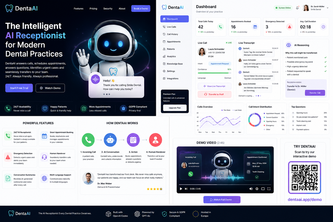
The company appears to be a single-person project submitted as a prototype for the OpenAI 2026 hackathon. The author describes DentaAI as a local-first AI receptionist for dental practices that handles incoming calls, triages urgent cases, and manages appointments through a privacy-focused dashboard. It is presented as a static web prototype built with HTML, CSS, JavaScript, and OpenAI Codex, using simulated data and interactions to demonstrate functionality.
What changed
The project was submitted to the OpenAI Challenge, indicating an intent to showcase a concept in a hackathon setting. No evidence of prior development or commercial activity is provided beyond this submission.
The single most important open question
Is there any evidence that this prototype will evolve into a product with real traction, revenue, or customer adoption? The description makes no claims about such outcomes, and the project is explicitly described as a "challenge prototype."
What The Product Actually Is
- The description states that DentaAI is a local-first AI receptionist prototype for dental practices.
- It includes:
- A product landing page
- An interactive call demo
- A practice dashboard
- A dedicated OpenAI Challenge Mode
- Simulated live transcription
- Explainable AI reasoning
- Urgency and confidence indicators
- Local audit-style events
- Privacy and safety notes
- The prototype is built using:
- HTML, CSS, JavaScript
- Canvas for charts
- OpenAI Codex for development assistance
- It is described as a static web prototype, not a production system.
Inference Based on the author's own description, this is a demonstration project, not a deployed product. The use of "simulated" and "scripted demo data" indicates it has no real-world functionality beyond showing how it might work.
Positioning & Claim Evolution
- The author states that DentaAI was inspired by the idea of giving dental teams a calm, privacy-aware AI receptionist.
- It is positioned to help with:
- Appointment requests
- Opening-hour questions
- Cancellations
- Urgent pain calls
- The product claims to:
- Understand patient intent
- Support appointment-related workflows
- Identify urgent cases
- Present everything in a clear dashboard
- It is described as privacy-focused, with an emphasis on keeping sensitive data local and only integrating external services when explicitly configured.
Inference The positioning is that of a conceptual tool for dental practices, aimed at reducing repetitive phone work while maintaining privacy. There is no evidence of prior market validation or product-market fit claims.
Target Customer & ICP
- The target customer is dental practices.
- The description states that dental practices lose time to:
- Appointment requests
- Opening-hour questions
- Cancellations
- Urgent pain calls
- The system is intended for use by dental teams, with a dashboard designed for practice management.
Inference The ICP appears to be small-to-medium-sized dental practices, but no evidence of customer segmentation or targeting beyond this general category is provided.
Business Model & Pricing Evidence
- No pricing information is provided.
- No evidence of revenue streams or monetization strategy is given.
- The description does not indicate whether the product will be sold, licensed, or offered as a service.
Inference There is no evidence of a defined business model or pricing structure. The project is described as a prototype, not a commercial offering.
Technical & Delivery Signals
- Built with:
- HTML, CSS, JavaScript
- Canvas for charts
- OpenAI Codex for development assistance
- Uses local-first architecture, meaning sensitive data stays under practice control.
- Includes simulated telephony, speech-to-text, text-to-speech, calendar integration, and AI outputs.
Inference The technical approach is consistent with a static prototype. No evidence of real-time integrations or production-grade infrastructure is provided.
Traction & Maturity Signals
- The project is described as a challenge prototype, not a production system.
- It includes:
- Simulated live transcription
- Scripted demo data
- Browser-based interactions
- No evidence of actual users, customers, or real-world deployment is provided.
Inference There is no traction or maturity beyond the prototype stage. The project has not moved past demonstration.
Competitive Context
- No competitive landscape or market analysis is provided.
- The description does not mention existing solutions in the dental practice automation or AI receptionist space.
Inference No evidence of competitive positioning or awareness of existing players is present. This is a standalone concept with no reference to prior art.
Open Questions & Risks
- The project is described as a prototype, not a product.
- No evidence of revenue, customers, or traction exists.
- The author states that the system is not a production medical, diagnostic, telephony, or scheduling system.
- The use of "simulated" and "scripted" data indicates no real-world functionality.
- The team size is listed as one person ("the vader").
- No evidence of product-market fit, scalability, or commercial viability.
Inference The biggest risk is that this remains a conceptual prototype, with no indication of future development or commercialization.
Questions the description leaves open
- What is the plan for evolving this prototype into a real product?
- Are there any existing dental practices interested in testing or piloting this system?
- How does the team intend to address privacy and compliance requirements in a real-world setting?
- Is there any interest from investors, partners, or customers beyond the hackathon context?
- What are the technical challenges expected in moving from prototype to production?
Overall Assessment
- The project is not evidenced as having traction, revenue, or customer adoption.
- It is a self-reported prototype submitted for a hackathon.
- No evidence of commercial viability, scalability, or product-market fit exists.
Inference At this stage, there is no basis to recommend investment or partnership. This is a conceptual demonstration, not a viable business opportunity.
User Stories BotA demo video on every pull request
Get a demo video on every new feature
GitHub App that watches your pull requests and records a narrated, captioned demo.
Save time on demo prep and make informed decisions faster with a video walkthrough of every new feature.
Source
Submitted to the OpenAI 2026 hackathon on Devpost. Project home on Devpost. Back to the full gallery on Devpost.
This competitive analysis was produced by top-founders.com (opens in a new tab)
Generated by a language model from this project's public Devpost page — its tagline, the author's own write-up and any built-with tags listed there — as captured in August 2026. Short quotations are the author's words. It is an opinion on the idea as a business, not on the people behind it, and it reflects the description as published then. If the project has moved on, request a correction below. The analysis is not independent research and contains no verified traction, revenue or customer data.
An independent guide by KFG International LLC — not affiliated with, endorsed by, or connected to Devpost or OpenAI.