

Archive position — measured, not model output
0 likes on Devpost
2,263 of the 7,850 archived projects have more likes, and 5,587 share exactly 0 — so this project's #3,704 place in the like-ranked listing is a tie-break inside that group, not a ranking.
Projects (log scale)
Likes on Devpost. ▲ marks this project's group.
Show the figures
| Likes | Projects | Share of archive |
|---|---|---|
| 0 | 5,587 | 71.2% |
| 1 | 1,758 | 22.4% |
| 2 | 284 | 3.6% |
| 3–4 | 132 | 1.7% |
| 5–9 | 75 | 1.0% |
| 10+ | 14 | 0.2% |
 User Stories BotA demo video on every pull request
Get a demo video on every new feature
GitHub App that watches your pull requests and records a narrated, captioned demo.
Save time on demo prep and make informed decisions faster with a video walkthrough of every new feature.
Executive Summary
What the company appears to be
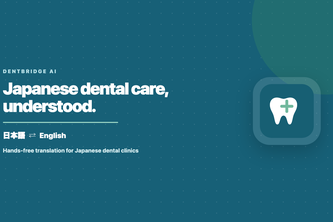
DentBridge AI is a self-reported Web/PWA application designed for use in Japanese dental clinics. The author states it is an AI-powered translation tool intended to improve communication between Japanese dentists and international patients, with a focus on safety and hands-free operation.
What changed
The project description reflects a shift from general-purpose translation tools to a specialized, safety-focused solution tailored for the unique constraints of dental environments—such as noise, physical limitations of patients, and critical medical terminology. The author emphasizes that this is not a diagnostic or decision-making tool but a communication bridge.
Single most important open question
Is there evidence of real-world testing or clinical validation in dental settings beyond the MVP stage?
Note
This analysis is based entirely on the self-reported project description provided by the author. No external verification, traction data, revenue figures, or customer feedback are available. All claims and assertions are stated by the author and not independently confirmed.
What The Product Actually Is
The description states that DentBridge AI is a responsive Web/PWA application designed for iPad, Android tablets, and desktop browsers. It uses local voice activity detection (VAD) via the Web Audio API and AudioWorklet, and integrates with GPT models (gpt-4o-transcribe and gpt-5.6) for transcription and translation.
Key features include:
- Automatic calibration to background noise.
- Detection of speech start/end using local VAD.
- Sentence-level upload only (not continuous audio).
- Transcription in Japanese or patient language.
- Translation direction detection.
- Structured output from GPT models with critical entity checks.
- Safety verification layer for medical terms like anatomy, direction, negation, dosage, etc.
- Playback of verified translations using native device speech synthesis.
- Two modes: Conversation Mode (hands-free bidirectional communication) and Treatment Mode (fixed dental phrases during treatment).
- No camera-based gesture detection; relies on visual confirmation by staff.
The author states this is an MVP and not a certified medical device. It is built using TypeScript, React, Next.js, and browser APIs like Speech API and AudioWorklet.
Positioning & Claim Evolution
The author positions DentBridge AI as a specialized translation tool for dental clinics, not a general-purpose app or interpreter replacement. The project evolved from a broad need for international patient communication to a hands-free, safety-focused solution tailored to the dental workflow.
Key claims:
- It addresses specific safety risks in dental translation (e.g., miscommunication of tooth locations, medications).
- It is designed around actual clinic workflows, not generic use cases.
- It avoids mobile app interaction that may be impractical in a dental setting.
- It does not diagnose or recommend treatment—only translates and displays information.
The positioning has shifted from a general translation tool to a medical communication safety tool for dentistry, with an emphasis on hands-free operation, local processing, and critical term verification.
Target Customer & ICP
The author states that the primary users are:
- Japanese dentists
- International patients visiting Japanese dental clinics
The app is designed for use in dental environments, where:
- Patients may be reclined or unable to touch a screen.
- Dentists wear gloves and work with both hands.
- Dental equipment creates loud, continuous noise.
The ICP appears to be Japanese dental clinics that serve international patients. No mention of other healthcare sectors or broader B2B use cases.
Business Model & Pricing Evidence
Not evidenced.
The description does not state anything about:
- Revenue model
- Pricing structure
- Monetization strategy
- Customer acquisition plans
- Subscription or licensing models
The author only describes the tool’s functionality and design, without indicating any business or pricing framework.
Technical & Delivery Signals
The app is built using:
- TypeScript
- React
- Next.js
- PWA technologies
- Web Audio API + AudioWorklet for local VAD
- Speech API for speech recognition and TTS
- GPT models (gpt-4o-transcribe, gpt-5.6) for transcription and translation
- Structured Outputs to extract critical entities
- Deterministic checks for safety verification
Key technical features:
- Local processing of audio to avoid uploading silence.
- Echo cancellation, noise suppression, automatic gain control.
- Two distinct modes: Conversation and Treatment.
- No camera-based gesture detection.
- Browser-memory-only conversation storage.
- Playback recovery, echo-loop prevention.
The author claims 119 passing automated tests, linting, type checking, and production builds. However, no evidence of scalability, performance metrics, or deployment details is provided.
Traction & Maturity Signals
Not evidenced.
The description states:
- It is an MVP.
- It has not been clinically certified.
- It is undergoing field testing in controlled dental environments.
- It is not yet deployed in production.
No evidence of customer adoption, usage data, or real-world deployment beyond the MVP stage.
Competitive Context
Not evidenced.
The description does not mention:
- Competitors
- Market size
- Existing solutions in the dental translation space
- Differentiation from other tools
The author does not provide any competitive analysis or positioning relative to existing tools or platforms.
Open Questions & Risks
Inferences based on self-reported claims:
- MVP-only status: The app is described as a field-test MVP, not yet clinically certified or in production use.
- No clinical validation: No evidence of real-world testing or medical review beyond mock scenarios.
- Limited language support: Only four patient languages (Chinese, English, Korean, Vietnamese) are supported.
- Safety vs. speed trade-off: The author notes that safety and speed compete, with deterministic checks increasing latency.
- No commercialization plan: No mention of monetization, distribution, or go-to-market strategy.
- Single-founder team: Only one team member is listed, raising questions about scalability and execution capacity.
These points are inferred from the self-reported description and not independently verified.
Questions the description leaves open
- What specific dental clinics have you tested with? Are there any clinical partners or feedback?
- How do you plan to scale beyond a single developer team?
- What is your strategy for regulatory compliance in Japan (e.g., medical device certification)?
- Have you conducted usability studies or safety trials with actual dentists and patients?
- What are the key performance metrics you're tracking during field testing?
- How do you plan to monetize this tool—will it be sold to clinics, or offered as a SaaS subscription?
- Are there any legal or liability concerns around using generative AI for medical translation?
- What is your roadmap for expanding language support and treatment modes?
Overall Assessment
Not evidenced.
The description does not include:
- Funding history
- Valuation
- Investor or partner interest
- Strategic fit for potential investors or partners
This project is described as a hackathon submission, not yet a commercial venture. No evidence of traction, revenue, or investment interest exists beyond the author’s own claims.
User Stories BotA demo video on every pull request
Get a demo video on every new feature
GitHub App that watches your pull requests and records a narrated, captioned demo.
Save time on demo prep and make informed decisions faster with a video walkthrough of every new feature.
Source
Submitted to the OpenAI 2026 hackathon on Devpost. Project home on Devpost. Back to the full gallery on Devpost.
This competitive analysis was produced by top-founders.com (opens in a new tab)
Generated by a language model from this project's public Devpost page — its tagline, the author's own write-up and any built-with tags listed there — as captured in August 2026. Short quotations are the author's words. It is an opinion on the idea as a business, not on the people behind it, and it reflects the description as published then. If the project has moved on, request a correction below. The analysis is not independent research and contains no verified traction, revenue or customer data.
An independent guide by KFG International LLC — not affiliated with, endorsed by, or connected to Devpost or OpenAI.