

Archive position — measured, not model output
0 likes on Devpost
2,263 of the 7,850 archived projects have more likes, and 5,587 share exactly 0 — so this project's #7,620 place in the like-ranked listing is a tie-break inside that group, not a ranking.
Projects (log scale)
Likes on Devpost. ▲ marks this project's group.
Show the figures
| Likes | Projects | Share of archive |
|---|---|---|
| 0 | 5,587 | 71.2% |
| 1 | 1,758 | 22.4% |
| 2 | 284 | 3.6% |
| 3–4 | 132 | 1.7% |
| 5–9 | 75 | 1.0% |
| 10+ | 14 | 0.2% |
 User Stories BotA demo video on every pull request
Get a demo video on every new feature
GitHub App that watches your pull requests and records a narrated, captioned demo.
Save time on demo prep and make informed decisions faster with a video walkthrough of every new feature.
Executive Summary
What the company appears to be
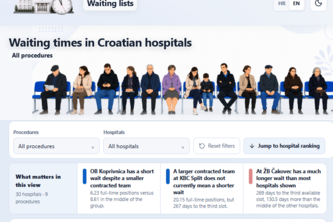
Waiting Lists is a self-reported public-data product that aggregates Croatian public hospital waiting-time information into an interactive web application. The author states it helps citizens find earlier appointments, compare hospitals, track trends and explore rankings.
What changed
The project was built as part of a hackathon submission and is described as a functional prototype with limited data collection and automation. It currently operates as a static website deployed via Cloudflare Pages, using Next.js and TypeScript.
Single most important open question
Is there any evidence of actual usage or traction beyond the author’s own development effort?
What The Product Actually Is
The description states that Waiting Lists is an interactive web application designed to help Croatian citizens navigate public hospital waiting times. It combines data from two main sources:
- Appointment availability published through the Croatian national health information system.
- Contracted medical-team data published by the Croatian Health Insurance Fund.
Key features include:
- An interactive map of Croatia with visual markers for hospitals (size = team size, color = waiting time).
- Trend charts showing how waiting times change over time.
- Sortable hospital rankings.
- Detailed hospital views including supported procedures and contact info.
- Support for both Croatian and English languages.
- Light/dark themes and responsive design.
The application uses Next.js, TypeScript, GitHub, Cloudflare Pages, and AI tools like ChatGPT Plus and Codex during development. It is currently deployed as a static site with no indication of backend infrastructure or user accounts.
Inference This appears to be a data visualization tool built for public access rather than a commercial SaaS product or marketplace.
Positioning & Claim Evolution
The author positions Waiting Lists as a citizen-facing tool that makes difficult-to-access public healthcare data understandable and actionable. The project is framed not just as a utility but also as a contribution to public discourse on healthcare reform.
Claims made:
- Citizens should be able to easily find appointments.
- Public data should be more accessible and interpretable.
- Transparency in waiting times supports informed debate about healthcare systems.
- The tool translates institutional data into insights for ordinary users.
Inference The positioning is rooted in civic engagement and open government data principles rather than commercial value creation or monetization.
Target Customer & ICP
The description states that the primary audience is ordinary citizens seeking medical appointments in Croatian public hospitals. These users are likely:
- Patients looking for earlier care.
- Individuals interested in comparing hospital performance.
- People engaged in discussions about healthcare reform.
There is no mention of healthcare providers, policymakers, or institutional buyers — suggesting a narrow focus on end-user citizen needs.
Inference The ICP (Ideal Customer Profile) centers around everyday users who want clarity and transparency from public health systems.
Business Model & Pricing Evidence
No evidence of pricing, monetization strategy, or business model is provided in the description. The project is described as a hackathon submission and deployed as a static website without any indication of paid features, subscriptions, or revenue streams.
Inference There is no commercial business model evident at this stage; it appears to be a non-commercial civic tool.
Technical & Delivery Signals
The application was built using:
- Next.js
- TypeScript
- GitHub
- Cloudflare Pages
- AI tools such as ChatGPT Plus and Codex (with 5.6 Sol)
Development process involved:
- Prompt engineering for AI tools.
- Manual data transformation and structuring.
- Local development with controls for updating source data and publishing updates.
Deployment is static, hosted on Cloudflare Pages, with no mention of databases, APIs, or server-side logic beyond the initial build.
Inference The technical stack suggests a lightweight frontend-only solution, possibly built quickly using AI assistance. No evidence of scalability or enterprise-grade infrastructure.
Traction & Maturity Signals
There is no evidence of:
- Users or customer base.
- Revenue or monetization.
- Product usage metrics.
- Customer feedback loops.
- Iteration history beyond the initial prototype.
The project is described as a one-off hackathon effort with limited automation and no ongoing data collection or updates. The author notes that historical data collection has only recently begun, and trend analysis will improve over time.
Inference This is an early-stage prototype with no demonstrated traction or maturity in terms of user engagement or operational scale.
Competitive Context
No direct competitors are mentioned in the description. However, the idea of aggregating public healthcare waiting data aligns with broader trends in open data and citizen-facing digital services.
The author references existing tools like liste.cezih.hr (a basic search interface) and Excel files from the Croatian Health Insurance Fund as prior art, but does not compare Waiting Lists to other similar platforms or products.
Inference There is no clear competitive landscape described. The tool may be unique in its approach to visualizing and presenting this specific dataset in a citizen-friendly way.
Open Questions & Risks
- Data quality issues: Source data are described as incomplete, inconsistent, or questionable.
- Limited automation: Data collection and updates are manual, with no evidence of automated pipelines.
- No commercial viability: No pricing, monetization, or revenue model is evident.
- Low scalability: Deployed as a static site; no indication of backend infrastructure for growth.
- Unclear long-term sustainability: The project was built during a single hackathon session and lacks ongoing development plans beyond automation.
Inference The risk profile leans toward technical limitations, lack of traction, and absence of a sustainable or scalable path forward.
Questions the description leaves open
- What is the current level of public interest in this tool? Are there any signs of usage or feedback from citizens?
- How is the data being collected and updated? Is there a plan to automate this process?
- Has the Croatian Health Insurance Fund or national health system expressed support for or collaboration with this project?
- What are the legal and ethical considerations around publishing public healthcare data in this format?
- Are there any plans to expand beyond Croatia or add more medical procedures?
- How does the team intend to validate the accuracy of the data presented?
Overall Assessment
Not evidenced.
The description provides no information on:
- Revenue, ARR, or funding.
- Customer acquisition or retention.
- Market size or TAM.
- Team traction or prior experience.
- Any commercial or strategic value proposition beyond its civic utility.
This is a self-reported hackathon prototype with no demonstrated business model or commercial potential. It may have social impact but does not appear to be a viable investment or partnership opportunity based on the information provided.
Confidence level Low — due to lack of evidence for traction, revenue, or scalability.
User Stories BotA demo video on every pull request
Get a demo video on every new feature
GitHub App that watches your pull requests and records a narrated, captioned demo.
Save time on demo prep and make informed decisions faster with a video walkthrough of every new feature.
Source
Submitted to the OpenAI 2026 hackathon on Devpost. Project home on Devpost. Back to the full gallery on Devpost.
This competitive analysis was produced by top-founders.com (opens in a new tab)
Generated by a language model from this project's public Devpost page — its tagline, the author's own write-up and any built-with tags listed there — as captured in August 2026. Short quotations are the author's words. It is an opinion on the idea as a business, not on the people behind it, and it reflects the description as published then. If the project has moved on, request a correction below. The analysis is not independent research and contains no verified traction, revenue or customer data.
An independent guide by KFG International LLC — not affiliated with, endorsed by, or connected to Devpost or OpenAI.