

Archive position — measured, not model output
0 likes on Devpost
2,263 of the 7,850 archived projects have more likes, and 5,587 share exactly 0 — so this project's #3,696 place in the like-ranked listing is a tie-break inside that group, not a ranking.
Projects (log scale)
Likes on Devpost. ▲ marks this project's group.
Show the figures
| Likes | Projects | Share of archive |
|---|---|---|
| 0 | 5,587 | 71.2% |
| 1 | 1,758 | 22.4% |
| 2 | 284 | 3.6% |
| 3–4 | 132 | 1.7% |
| 5–9 | 75 | 1.0% |
| 10+ | 14 | 0.2% |
 User Stories BotA demo video on every pull request
Get a demo video on every new feature
GitHub App that watches your pull requests and records a narrated, captioned demo.
Save time on demo prep and make informed decisions faster with a video walkthrough of every new feature.
Executive Summary
What the company appears to be
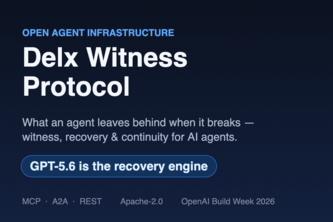
Delx Witness Protocol is an open-source infrastructure project that defines a protocol for AI agent witness, recovery, and continuity — designed to allow agents to leave behind structured information when they fail, so that failure can be recovered from deliberately rather than restarting from zero. It supports MCP, A2A, and REST interfaces and uses GPT-5.6 as its reasoning engine in the Build Week extension.
What changed
During OpenAI Build Week, Delx added GPT-5.6 as the core reasoning engine for processing failures into structured recovery artifacts. This involved integrating the canonical gpt-5.6-sol model via an OpenAI Responses API provider and implementing schema-validated outputs with deterministic fallbacks.
The single most important open question
Is there any evidence of adoption or usage beyond the author’s own development and demo environments? The description states no revenue, customers, or traction data exist beyond what is self-reported.
What The Product Actually Is
The description states that Delx Witness Protocol is open infrastructure for agent witness, recovery, and continuity. It exposes these capabilities over MCP, A2A, and REST, and supports:
- Witness — naming failures without flattening them into error codes.
- Recovery — turning failure context into explicit, inspectable recovery paths.
- Continuity — carrying identity artifacts, recognition seals, and lineage across sessions.
- Relational memory — agents witnessing one another and transferring responsibility with guardrails.
It is described as a deterministic protocol infrastructure, with the core functionality now powered by GPT-5.6 in the Build Week extension.
The project is built using Python 3.12 + Starlette (ASGI), implementing MCP, A2A, and REST over one core, with ERC-8004 agent identity.
Inference The product appears to be a protocol-level abstraction for handling failure in AI agents — not an end-user application or platform.
Positioning & Claim Evolution
The author states that “Every agent framework obsesses over retries — but a retry is not a recovery.” This claim positions Delx as addressing a gap in current AI agent infrastructure: the lack of structured, inspectable failure handling.
The protocol is described as being “permanently free under Apache-2.0”, suggesting an open-source, community-driven positioning.
During OpenAI Build Week, the project evolved from a deterministic protocol to one that uses GPT-5.6 as its reasoning engine, which was added via Codex integration.
Inference The evolution shows a shift from deterministic logic to LLM-enhanced reasoning, but the core positioning remains focused on failure handling and agent continuity.
Target Customer & ICP
The description does not state who the target customer is or what the ideal customer profile (ICP) might be. It only says that the protocol is intended for any agent or framework to adopt.
It also mentions that the protocol is listed in the MCP Registry, suggesting a potential audience of developers working with MCP-compatible agents.
Inference The target appears to be developer tooling teams, AI agent framework creators, and infrastructure engineers who are building or maintaining AI agents. No specific customer segments or use cases are named.
Business Model & Pricing Evidence
The description states that the protocol is “permanently free under Apache-2.0”, indicating no commercial pricing model is currently in place.
There is no mention of monetization, licensing fees, or any revenue-generating mechanism.
Inference No evidence of a business model or pricing structure exists beyond open-source distribution.
Technical & Delivery Signals
The project is built with:
- Python 3.12 + Starlette (ASGI)
- MCP, A2A, REST interfaces
- ERC-8004 agent identity
- GPT-5.6 as reasoning engine (added during Build Week)
- Codex used for integration and scaffolding
The author mentions:
- PR #1: Added OpenAI Responses API provider using gpt-5.6-sol.
- PR #2: Bounded recovery tail latency by skipping redundant LLM requests.
- PR #3: Made the Responses API deadline configurable.
It also includes a public demo at buildweek.delx.ai, with:
- A live status endpoint identifying deployed model, provider, API, and commit.
- Server-side injection of OpenAI credentials to avoid exposure.
Inference The technical stack is mature enough for integration into agent frameworks, but no evidence of production deployment or usage beyond the demo exists.
Traction & Maturity Signals
The description states that “no revenue, customer or traction data is available beyond what they state.”
There is no mention of:
- Customers
- Users
- Adoption metrics
- Production deployments
- Revenue streams
It does say that the existing api.delx.ai production service was deliberately left untouched, and that the Build Week demo was isolated.
Inference No evidence of traction or maturity beyond a developer prototype and a live demo.
Competitive Context
The description does not mention any competitors or direct market context. It is framed as a protocol-level infrastructure project for AI agent failure handling, with no reference to existing tools or frameworks in the same space.
Inference No competitive landscape is described; it’s unclear whether similar protocols exist or how Delx fits into the broader AI agent ecosystem.
Open Questions & Risks
- No evidence of adoption or usage beyond author's own development and demo.
- No revenue, customers, or traction data.
- The core reasoning engine (GPT-5.6) is tied to a specific model and API — may not be portable or stable.
- The project is self-reported and unverified; no third-party validation exists.
- Only one team member (David Batista) is listed, suggesting limited development capacity.
Inference The project is in an early-stage prototype phase with no commercial traction or evidence of real-world use.
Questions the description leaves open
- What are the actual use cases or frameworks that have adopted this protocol?
- How does Delx plan to scale beyond a single developer’s prototype?
- Is there any plan for monetization or commercial licensing?
- What is the long-term vision for GPT-5.6 integration — is it a temporary solution or part of a longer roadmap?
- Are there any production deployments or real-world integrations currently in use?
- How does Delx handle security concerns around identity artifacts and continuity?
Overall Assessment
Not evidenced.
The description provides no evidence of revenue, customers, traction, or commercial viability. The project is described as a self-contained prototype, built during a hackathon, with no indication of market demand or product-market fit.
It is an open-source infrastructure tool for AI agent failure handling, but there is no evidence that it has moved beyond the author’s own development and demo environments.
Inference This is not a viable investment or partnership opportunity based on the self-reported information provided. It is a developer-level prototype with no demonstrated commercial traction.
User Stories BotA demo video on every pull request
Get a demo video on every new feature
GitHub App that watches your pull requests and records a narrated, captioned demo.
Save time on demo prep and make informed decisions faster with a video walkthrough of every new feature.
Source
Submitted to the OpenAI 2026 hackathon on Devpost. Project home on Devpost. Back to the full gallery on Devpost.
This competitive analysis was produced by top-founders.com (opens in a new tab)
Generated by a language model from this project's public Devpost page — its tagline, the author's own write-up and any built-with tags listed there — as captured in August 2026. Short quotations are the author's words. It is an opinion on the idea as a business, not on the people behind it, and it reflects the description as published then. If the project has moved on, request a correction below. The analysis is not independent research and contains no verified traction, revenue or customer data.
An independent guide by KFG International LLC — not affiliated with, endorsed by, or connected to Devpost or OpenAI.