

Archive position — measured, not model output
0 likes on Devpost
2,263 of the 7,850 archived projects have more likes, and 5,587 share exactly 0 — so this project's #5,659 place in the like-ranked listing is a tie-break inside that group, not a ranking.
Projects (log scale)
Likes on Devpost. ▲ marks this project's group.
Show the figures
| Likes | Projects | Share of archive |
|---|---|---|
| 0 | 5,587 | 71.2% |
| 1 | 1,758 | 22.4% |
| 2 | 284 | 3.6% |
| 3–4 | 132 | 1.7% |
| 5–9 | 75 | 1.0% |
| 10+ | 14 | 0.2% |
 User Stories BotA demo video on every pull request
Get a demo video on every new feature
GitHub App that watches your pull requests and records a narrated, captioned demo.
Save time on demo prep and make informed decisions faster with a video walkthrough of every new feature.
Executive Summary
What the company appears to be
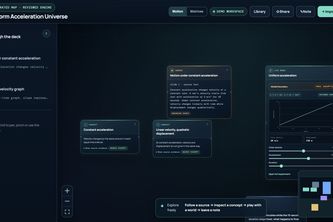
OmniCanvas is a self-reported educational tool that transforms STEM slide decks into interactive, source-grounded learning environments. The author states it allows students to upload various formats (PDF, PPTX, Markdown), explore content on an interactive canvas, answer retrieval questions, and interact with deterministic simulations for specific concepts.
What changed
The project description indicates a pivot from a basic slide summarizer or note-taking tool into a more structured, spatially organized learning universe that includes embedded simulations. It also reflects a shift toward a product focused on “spatial study maps” and “predict → change → test → explain” workflows.
Single most important open question
Is there evidence of real-world usage or adoption by students or educators? The description lacks any mention of users, customers, revenue, or traction beyond the author’s own demonstration and repository code.
What The Product Actually Is
The description states that OmniCanvas is a tool for turning STEM slides into “Learning Universes” with questions, notes, and simulations. It allows users to upload content in multiple formats (PDF, PPTX, Markdown, text), explore it on an interactive canvas, and engage in a Study Sprint process involving answering retrieval questions and reviewing material.
It includes:
- A pannable, zoomable canvas with source rail.
- Retrieval-based question answering.
- Self-rating of recall difficulty (Again, Hard, Got it).
- Learner-authored connections that are marked as unverified.
- Embedded deterministic simulations for eight reviewed families of concepts.
- Browser-local storage and no account requirement.
The author claims the product does not claim visual bounding boxes, OCR, handwriting recognition, real-time collaboration, or adaptive learning.
Inference The tool appears to be a prototype or MVP built for a hackathon, with an emphasis on educational interactivity and source traceability. It is not described as a commercial product or platform with users beyond the author’s own testing.
Positioning & Claim Evolution
The description states that OmniCanvas is not another slide summarizer and does not pretend every concept has a custom simulation. Instead, it positions itself on two layers:
- Broad coverage: readable material becomes a useful spatial study map.
- Trusted depth: supported concepts also become interactive, reviewed worlds.
The author emphasizes that grounding means:
- Every learning object retains page or slide traceability.
- Every displayed evidence excerpt is checked against the source text.
- Learner-authored connections are deliberately marked as unverified.
This suggests a positioning shift from generic summarization to a more structured, validated, and interactive educational experience. The product is described as not claiming scientific correctness guarantees or AI grading.
Inference The positioning reflects an attempt to differentiate itself from generic AI tools by focusing on source fidelity and learner engagement through simulation. However, it remains unclear whether this is a strategic direction or just a feature set in the MVP.
Target Customer & ICP
The description states that OmniCanvas is for students who want to explore STEM content interactively. It is designed for use with materials like slides, PDFs, and text, and supports a “predict → change → test → explain” learning loop.
It does not mention:
- Teachers or instructors.
- Institutions or schools.
- Any specific demographic beyond students.
- Use cases outside of STEM education.
Inference The ICP appears to be individual students in STEM fields who are looking for interactive, source-grounded study tools. There is no evidence of institutional adoption or broader market targeting.
Business Model & Pricing Evidence
There is no evidence in the description of a business model or pricing strategy. The author states that no account is required, saved universes stay in the browser, and there are no paid features mentioned.
The product is described as:
- Free to use.
- Browser-local storage.
- No account needed.
Inference There is no indication of monetization or revenue model. It appears to be a prototype or open-source tool, not a commercial offering.
Technical & Delivery Signals
The author reports that the system is built with:
- FastAPI (backend ingestion layer)
- React + React Flow (frontend UI)
- GPT-5.6 via OpenAI Responses API
- Pydantic and Zod for validation
- TypeScript, Vite, Vercel, Render
- Deterministic simulation engines
It includes:
- Bounded AI concurrency.
- Rate limiting.
- Schema-validated local persistence.
- Extractive fallback when AI is unavailable.
- Literal-evidence filters to reject excerpts not in the source.
The repository has:
- 98 frontend tests
- 78 API tests
- Deployment checks on GitHub Actions and Vercel
Inference The technical stack suggests a well-structured prototype with validation layers, but there is no evidence of production deployment or scalability beyond the MVP. The use of deterministic engines for simulations indicates an attempt to maintain accuracy.
Traction & Maturity Signals
There is no evidence of traction or adoption. The author states:
- No account required.
- Saved universes stay in browser.
- No mention of users, customers, or usage metrics.
- No revenue or monetization data.
- No institutional or educational use cases.
The product was submitted to a hackathon and is described as an MVP.
Inference This is a prototype with no demonstrated traction. It has not been validated in real-world settings or by users beyond the author.
Competitive Context
The description does not mention any competitors. However, based on the stated functionality (interactive learning, simulations, source-grounded content), it may compete with:
- Slide summarizers.
- Interactive learning platforms.
- AI-powered educational tools.
- Simulation-based learning environments.
There is no evidence of competitive positioning or market analysis in the description.
Inference The product’s competitive landscape is unknown. It appears to be a new idea or prototype, not an established player in any category.
Open Questions & Risks
- No traction or user validation: The tool is described as a hackathon MVP with no real-world usage.
- Unproven educational impact: There is no evidence of effectiveness or adoption by students or educators.
- Limited scope: It only supports eight simulation families, and the author explicitly states it does not claim scientific correctness guarantees.
- Self-reported tooling: All technical claims are self-reported; no third-party validation or audits are mentioned.
- No monetization model: The lack of pricing or business model raises questions about long-term viability.
Inference The project is a prototype with limited commercial potential unless it gains traction and evolves into a scalable, validated product.
Questions the description leaves open
- What is the intended user base beyond the author’s own testing?
- Have you conducted any usability studies or feedback sessions with students or educators?
- How do you plan to scale beyond the current simulation families?
- What are your plans for monetization, if any?
- Are there any partnerships or institutional trials planned?
- How do you ensure that the deterministic simulations remain accurate and up-to-date?
- What is the long-term vision for the product beyond a hackathon prototype?
Overall Assessment
The description indicates that OmniCanvas is a self-reported hackathon project with no evidence of traction, revenue, or user adoption. It is described as an MVP built for educational interactivity and source traceability, but there is no indication it has moved beyond the prototype stage.
Confidence Low
Assessment Not ready for investment or partnership at this time. The product lacks commercial validation, user data, or a clear path to monetization. It may be a promising idea with potential, but it is not yet a viable business.
User Stories BotA demo video on every pull request
Get a demo video on every new feature
GitHub App that watches your pull requests and records a narrated, captioned demo.
Save time on demo prep and make informed decisions faster with a video walkthrough of every new feature.
Source
Submitted to the OpenAI 2026 hackathon on Devpost. Project home on Devpost. Back to the full gallery on Devpost.
This competitive analysis was produced by top-founders.com (opens in a new tab)
Generated by a language model from this project's public Devpost page — its tagline, the author's own write-up and any built-with tags listed there — as captured in August 2026. Short quotations are the author's words. It is an opinion on the idea as a business, not on the people behind it, and it reflects the description as published then. If the project has moved on, request a correction below. The analysis is not independent research and contains no verified traction, revenue or customer data.
An independent guide by KFG International LLC — not affiliated with, endorsed by, or connected to Devpost or OpenAI.