

Archive position — measured, not model output
0 likes on Devpost
2,263 of the 7,850 archived projects have more likes, and 5,587 share exactly 0 — so this project's #5,661 place in the like-ranked listing is a tie-break inside that group, not a ranking.
Projects (log scale)
Likes on Devpost. ▲ marks this project's group.
Show the figures
| Likes | Projects | Share of archive |
|---|---|---|
| 0 | 5,587 | 71.2% |
| 1 | 1,758 | 22.4% |
| 2 | 284 | 3.6% |
| 3–4 | 132 | 1.7% |
| 5–9 | 75 | 1.0% |
| 10+ | 14 | 0.2% |
 User Stories BotA demo video on every pull request
Get a demo video on every new feature
GitHub App that watches your pull requests and records a narrated, captioned demo.
Save time on demo prep and make informed decisions faster with a video walkthrough of every new feature.
Executive Summary
What the company appears to be
OMNIX Translator – Photoshop is described as an AI-powered UXP plugin for Adobe Photoshop that translates design content into multiple languages while preserving layout, formatting, and editable text layers. The author states it was built for global brands, e-commerce businesses, marketing agencies, and design teams seeking multilingual localization workflows.
What changed
The project description indicates a shift from traditional manual translation methods to an AI-assisted workflow within Adobe Photoshop, using UXP plugin architecture. It introduces structured JSON-based translation pipelines with integrations for ChatGPT, DeepL, and Ollama.
Single most important open question
Is there any evidence of actual usage or adoption by target customers beyond the author's self-reporting?
What The Product Actually Is
The description states that OMNIX Translator is an AI-powered Adobe Photoshop UXP plugin. It enables users to:
- Build language groups from existing text layers.
- Export documents into a structured JSON format for translation.
- Translate content using ChatGPT, DeepL, or Ollama.
- Review and edit translations before applying them.
- Inject translated text back into Photoshop while preserving editable text layers.
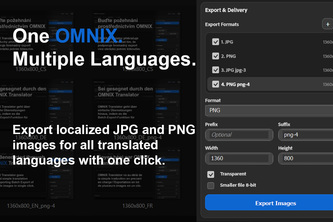
- Batch export localized assets in multiple languages.
It is described as a native Adobe UXP plugin built with JavaScript, supporting Windows and macOS platforms. The tool integrates with translation APIs and includes secure license activation.
Evidence
- Built as an Adobe UXP plugin using JavaScript.
- Supports ChatGPT, DeepL, Ollama integrations.
- Preserves editable text layers post-translation.
- Includes batch export functionality.
- Uses structured JSON pipeline for translation.
Inference The product appears to be a desktop application tool, not a web-based SaaS offering. It targets design professionals working in Photoshop and aims to automate multilingual localization within that environment.
Positioning & Claim Evolution
The author positions OMNIX Translator as an AI-powered solution for multilingual localization workflows within Adobe Photoshop. The tagline emphasizes its ability to translate designs into multiple languages while preserving layout, formatting, and editable text layers.
Key claims include:
- Enables global brands, e-commerce businesses, marketing agencies, and design teams to prepare creative assets once and localize them efficiently.
- Provides a streamlined workflow for creating multilingual creative content from a single Photoshop document.
- Offers support for multiple AI providers through a unified user experience.
Evidence
- Tagline: “AI-powered UXP plugin for Adobe Photoshop that translates one design into multiple languages while preserving layout, formatting, and editable text layers.”
- Claimed use cases: global brands, e-commerce businesses, marketing agencies, design teams.
- Integration with ChatGPT, DeepL, Ollama.
Inference The positioning suggests a niche tool for creative professionals, targeting the intersection of design automation and localization, rather than general-purpose AI tools or enterprise software.
Target Customer & ICP
The description states that OMNIX Translator is intended for:
- Global brands
- E-commerce businesses
- Marketing agencies
- Design teams
These are described as users who need to prepare creative assets once and then translate them into multiple languages while maintaining layout integrity.
Evidence
- Explicitly named customer segments: global brands, e-commerce businesses, marketing agencies, design teams.
- Use case: preparing creative assets once, translating into multiple languages, preserving layout.
Inference The ICP likely includes creative professionals or agencies using Adobe Photoshop for localized marketing materials, product visuals, or UI/UX designs. The tool may appeal to those with high-volume localization needs, but no evidence of actual customer base is provided.
Business Model & Pricing Evidence
There is no explicit mention of pricing models or business model in the description. However, the author notes that the plugin uses FastSpring for licensing and Hostinger for hosting — suggesting some form of monetization via software licenses or subscriptions.
Evidence
- Mention of FastSpring (licensing) and Hostinger (hosting).
- No stated pricing tiers, subscription models, or revenue streams.
- The tool is described as part of a larger platform called Benedict OMNIX.
Inference It is possible the product could be sold via software licensing, possibly with tiered access or usage-based pricing. However, no concrete details are available.
Technical & Delivery Signals
The project was built as a native Adobe UXP plugin using JavaScript, supporting both Windows and macOS platforms. It includes:
- Native Adobe UXP integration.
- Custom Translation Editor.
- Structured JSON translation pipeline.
- OpenAI ChatGPT integration.
- DeepL API integration.
- Ollama integration for offline AI translation.
- Secure license activation and validation.
- Batch export workflow.
Evidence
- Built with JavaScript, native UXP support.
- Integrates with multiple AI providers (ChatGPT, DeepL, Ollama).
- Supports cross-platform deployment.
- Includes secure licensing and batch export features.
Inference The technical stack suggests a lightweight, desktop-focused tool, likely aimed at professional creative users. The inclusion of offline capabilities (Ollama) indicates flexibility in deployment environments.
Traction & Maturity Signals
There is no evidence of traction, revenue, customer adoption, or user engagement beyond the author’s own description.
Evidence
- No mention of active users, customers, or sales.
- No data on usage frequency, retention, or feedback.
- No indication of product maturity beyond initial development.
Inference This is a pre-release or early-stage tool, likely submitted to a hackathon. There is no evidence of market validation or commercial traction.
Competitive Context
The description does not provide any information about competitors or competitive positioning. It also lacks references to existing tools in the localization or design automation space.
Evidence
- No mention of competitor products.
- No discussion of differentiation from other tools.
- No reference to similar offerings in Adobe ecosystem or localization market.
Inference It is unclear whether OMNIX Translator competes directly with other localization tools, AI plugins for Photoshop, or broader creative automation platforms. The lack of competitive context makes it difficult to assess its positioning.
Open Questions & Risks
Several key risks and open questions are evident from the self-reported description:
- No traction or revenue: No evidence of customers, usage, or monetization.
- Single founder team: Only one member listed (Balari Shabong), which may limit execution capacity.
- Limited product scope: Currently only supports Photoshop; future products are planned but not launched.
- Unverified claims: All statements are self-reported without external validation.
- Unclear monetization strategy: While FastSpring is mentioned, no pricing or business model details are provided.
Evidence
- Team size: 1 person.
- No revenue, customer data, or usage metrics.
- Mention of future products but no current product launch.
- No mention of partnerships, distribution channels, or go-to-market plans.
Inference This is a pre-product or early-stage idea, not yet validated in the market. The lack of traction and limited team size raise concerns about scalability and execution risk.
Questions the description leaves open
- What specific problems are you solving for your target customers, and how do you know they exist?
- Have you conducted any user research or interviews with potential customers?
- How do you plan to monetize this tool? Is there a pricing model in place?
- Are there any existing users or pilot programs?
- What is the timeline for launching additional products (e.g., InDesign, automation tools)?
- Do you have experience building and shipping desktop applications or plugins?
- How do you plan to scale beyond a single developer?
- What are your key assumptions about demand for this type of tool in the market?
Overall Assessment
Not evidenced.
The description provides no information on financials, traction, customer base, or commercial viability. The project appears to be an early-stage prototype or hackathon submission, with no evidence of product-market fit, revenue generation, or adoption.
Confidence Level Very low — based entirely on self-reported claims and unverified assertions.
Conclusion
OMNIX Translator – Photoshop is a conceptually interesting tool that addresses a potential gap in creative localization workflows. However, without any evidence of traction, customers, or monetization, it cannot be evaluated as a viable investment or partnership opportunity at this time. It remains an idea in its early stages, with no demonstrated commercial readiness.
User Stories BotA demo video on every pull request
Get a demo video on every new feature
GitHub App that watches your pull requests and records a narrated, captioned demo.
Save time on demo prep and make informed decisions faster with a video walkthrough of every new feature.
Source
Submitted to the OpenAI 2026 hackathon on Devpost. Project home on Devpost. Back to the full gallery on Devpost.
This competitive analysis was produced by top-founders.com (opens in a new tab)
Generated by a language model from this project's public Devpost page — its tagline, the author's own write-up and any built-with tags listed there — as captured in August 2026. Short quotations are the author's words. It is an opinion on the idea as a business, not on the people behind it, and it reflects the description as published then. If the project has moved on, request a correction below. The analysis is not independent research and contains no verified traction, revenue or customer data.
An independent guide by KFG International LLC — not affiliated with, endorsed by, or connected to Devpost or OpenAI.