

Archive position — measured, not model output
0 likes on Devpost
2,263 of the 7,850 archived projects have more likes, and 5,587 share exactly 0 — so this project's #5,660 place in the like-ranked listing is a tie-break inside that group, not a ranking.
Projects (log scale)
Likes on Devpost. ▲ marks this project's group.
Show the figures
| Likes | Projects | Share of archive |
|---|---|---|
| 0 | 5,587 | 71.2% |
| 1 | 1,758 | 22.4% |
| 2 | 284 | 3.6% |
| 3–4 | 132 | 1.7% |
| 5–9 | 75 | 1.0% |
| 10+ | 14 | 0.2% |
 User Stories BotA demo video on every pull request
Get a demo video on every new feature
GitHub App that watches your pull requests and records a narrated, captioned demo.
Save time on demo prep and make informed decisions faster with a video walkthrough of every new feature.
Executive Summary
What the company appears to be
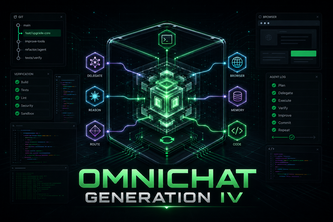
OmniChat is a self-modifying AI agent built as a desktop application, described by its author as a sandboxed multi-model desktop agent that plans, delegates tasks, uses tools, verifies work, remembers failures, and improves its own code. It was developed through an experimental process where no human-written code was used in the implementation — instead, an AI agent was instructed to build it using various APIs and tools.
What changed
The project evolved from a simple bash script into a complex desktop application with multiple generations (IV being the latest), incorporating advanced features like task queues, Git checkpointing, browser automation, and self-modification capabilities. The author emphasizes that this is not just a prototype but an evolving system designed to perform real-world tasks autonomously.
Single most important open question
Is there any evidence of actual usage or adoption beyond the author's own testing? The description contains no data on revenue, customers, or traction — only claims and self-reported development history.
Note: This analysis is based entirely on the self-reported project description provided by the caller. It has not been independently verified, and no archived records, third-party sources, or external validation are available. All statements reflect the author’s own account and should be treated as unverified claims.
What The Product Actually Is
The description states that OmniChat is a sandboxed multi-model desktop agent built for completing outcomes rather than answering questions. It operates in Task Mode, which involves planning, selecting models, delegating bounded investigations, editing files, running isolated commands, researching the web, operating a visible browser, verifying work, and returning self-contained answers.
It can modify its own source code when necessary, with changes tested, checked against architectural boundaries, and committed to Git. It includes features such as:
- Bounded persistent history
- Failure diagnostics
- Task queues
- Temporary file-aware chat
- Cost tracking
- Speculative architecture generation
- Lineage-aware instances and snapshots
- Specialization merging
- An independently isolated custom dashboard
The system is built using Qt 6, Python, JavaScript, CSS, HTML, Git, SQLite, and various AI APIs including OpenAI, Anthropic, and Google Gemini.
Claim: The product is a desktop agent that performs autonomous tasks.
Evidence: Described in the write-up under "What it does".
Inference: This appears to be an experimental AI-driven development tool or autonomous task executor.
Label: Inferred from description.
Positioning & Claim Evolution
The author describes OmniChat as a self-improving AI agent that was initially started as a “fragile Bash experiment” and evolved into a coherent desktop environment. The project is presented as an exploration of how far AI can go in software development without human-written code.
Key claims include:
- No manual implementation code was written.
- The system modifies itself, tests changes, and commits them to Git.
- It supports multiple models from different providers (OpenAI, Anthropic, Google).
- It handles complex workflows including browsing, file editing, command execution, and verification.
- It maintains lineage awareness and allows merging of specialized descendants.
The project evolved from a hackathon submission into a more mature system with a focus on autonomy, safety, and continuous improvement.
Claim: The product is self-improving and autonomous.
Evidence: Described in the write-up under "What it does", "Challenges we ran into", and "Accomplishments that we're proud of".
Inference: The positioning suggests a future-oriented tool for AI-assisted development or task execution.
Label: Inferred from description.
Target Customer & ICP
Not evidenced.
There is no mention in the description of specific customer segments, personas, or ideal customer profiles (ICPs). No indication of who would use this product or what their needs are beyond the author’s personal experimentation.
Claim: Not stated.
Evidence: None provided.
Business Model & Pricing Evidence
Not evidenced.
There is no information about pricing models, monetization strategies, or business structure. The project is described as a hackathon submission and experimental tool with no indication of commercial viability or revenue streams.
Claim: Not stated.
Evidence: None provided.
Technical & Delivery Signals
The system uses:
- Qt 6 for interface
- Python, JavaScript, HTML/CSS
- Git for version control
- Sandboxing via bubblewrap, seccomp, slirp4netns
- Browser automation through Qt WebEngine
- Integration with multiple AI APIs (OpenAI, Anthropic, Google Gemini)
- JSON Schema for structured data handling
- LSP for language server protocol support
It supports:
- Multi-model routing
- Bounded history
- Task queues
- Capability registry
- Failure diagnostics
- Snapshotting and lineage tracking
Claim: The system is technically sophisticated.
Evidence: Described in the write-up under "How we built it" and "What it does".
Inference: This suggests a high degree of technical maturity for an experimental project.
Label: Inferred from description.
Traction & Maturity Signals
Not evidenced.
There is no mention of users, customers, or adoption metrics. The project is described as being in alpha and developed by one person (the author). No data on usage, performance, or real-world impact is provided.
Claim: Not stated.
Evidence: None provided.
Competitive Context
Not evidenced.
There is no reference to competitors or market positioning beyond the general idea of AI agents or autonomous systems. No comparison with existing tools or platforms is made.
Claim: Not stated.
Evidence: None provided.
Open Questions & Risks
Several potential risks and open questions are implied by the description:
- The project is experimental, with no known users or customers.
- It relies heavily on AI agents for implementation — which may introduce instability or unpredictability.
- Self-modification introduces risk of breaking functionality without proper safeguards.
- The system uses sandboxing techniques but lacks clarity on how robustly it enforces boundaries.
- The author notes that the project consumed $200–$300 in Codex tokens, suggesting high cost for development and operation.
Claim: Risk of instability due to AI-driven implementation.
Evidence: Described in "Challenges we ran into" and "What's next for OmniChat".
Inference: The lack of user feedback or real-world testing raises concerns about reliability.
Label: Inferred from description.
Questions the description leaves open
- What is the current state of the product? Is it stable enough to be used in any practical way?
- Have you tested OmniChat on real-world tasks beyond your own experimentation?
- How do you ensure safety and prevent unintended behavior during self-modification?
- Are there plans for user-facing interfaces or APIs beyond the current desktop version?
- What are the long-term goals for this project? Is it intended to become a commercial product or remain experimental?
Note: These questions are based on the limited information provided in the description.
Overall Assessment
Not evidenced.
There is no indication of investment interest, partnership opportunities, or strategic value beyond the author’s personal curiosity and experimentation. No financials, traction data, or market opportunity are described.
Claim: Not stated.
Evidence: None provided.
User Stories BotA demo video on every pull request
Get a demo video on every new feature
GitHub App that watches your pull requests and records a narrated, captioned demo.
Save time on demo prep and make informed decisions faster with a video walkthrough of every new feature.
Source
Submitted to the OpenAI 2026 hackathon on Devpost. Project home on Devpost. Back to the full gallery on Devpost.
This competitive analysis was produced by top-founders.com (opens in a new tab)
Generated by a language model from this project's public Devpost page — its tagline, the author's own write-up and any built-with tags listed there — as captured in August 2026. Short quotations are the author's words. It is an opinion on the idea as a business, not on the people behind it, and it reflects the description as published then. If the project has moved on, request a correction below. The analysis is not independent research and contains no verified traction, revenue or customer data.
An independent guide by KFG International LLC — not affiliated with, endorsed by, or connected to Devpost or OpenAI.