

Archive position — measured, not model output
1 like on Devpost
505 of the 7,850 archived projects have more likes, and 1,758 share exactly 1 — so this project's #1,733 place in the like-ranked listing is a tie-break inside that group, not a ranking.
Projects (log scale)
Likes on Devpost. ▲ marks this project's group.
Show the figures
| Likes | Projects | Share of archive |
|---|---|---|
| 0 | 5,587 | 71.2% |
| 1 | 1,758 | 22.4% |
| 2 | 284 | 3.6% |
| 3–4 | 132 | 1.7% |
| 5–9 | 75 | 1.0% |
| 10+ | 14 | 0.2% |
 User Stories BotA demo video on every pull request
Get a demo video on every new feature
GitHub App that watches your pull requests and records a narrated, captioned demo.
Save time on demo prep and make informed decisions faster with a video walkthrough of every new feature.
Executive Summary
What the company appears to be
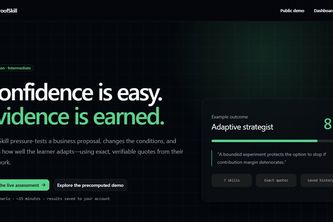
ProofSkill, as described by its author, is a product that delivers an interactive, AI-assisted learning journey for users to build and test strategic decisions in a structured, evidence-based way. It uses GPT-5.6 Sol to generate adaptive constraints and evaluations, while deterministic code ensures verifiable outcomes.
What changed
The project was submitted as part of the OpenAI 2026 hackathon. The author describes an MVP that includes guided decision cards, AI-generated adaptive constraints, and structured evaluation outputs — all within a private dashboard with evidence trails.
Single most important open question
Is there any evidence of traction or commercial adoption beyond the hackathon submission?
Note: This analysis is based entirely on the self-reported description provided by the author. No external verification or historical data are available. All claims are stated by the author and not independently confirmed.
What The Product Actually Is
The description states that ProofSkill delivers an “eight-part strategy” through guided decision cards, where a learner builds a plan and then adapts it in response to AI-generated constraints. GPT-5.6 Sol is used for constraint generation and evaluation. The system produces a structured seven-competency evaluation, which is verified by deterministic code that checks quotes against saved work.
It also includes:
- A private dashboard with evidence trails.
- Reopenable sessions.
- Supabase Auth and Row Level Security (RLS) to isolate user data.
- Structured Outputs using Zod for constraints and evaluations.
- Deterministic validation of evidence, versioned scoring, and visible caps.
Inference: The product appears to be a decision-making simulation tool with an emphasis on transparency and verifiability. It is not described as a general-purpose AI assistant or platform but rather a specific educational or coaching tool.
Positioning & Claim Evolution
The author states that ProofSkill “pressure-tests product judgment” and turns every score into “verifiable evidence.” The tagline supports this: “Pressure-test product judgment and turn every score into verifiable evidence.”
It is positioned as a way to move beyond quiz scores toward actionable learning, where users can see contradictions in their own thinking and get clear next steps.
Inference: The positioning suggests a shift from passive learning or testing to active judgment development. It implies that the tool is intended for skill-building, particularly around strategic decision-making.
Target Customer & ICP
The description does not name specific customer types or personas. However, it mentions that the same pattern could later support:
- Product management education
- Hiring simulations
- Cohort coaching
This suggests a potential target of professionals or learners in roles requiring strategic judgment and decision-making.
Inference: The initial use case seems to be for individuals undergoing structured learning or coaching, but the author implies broader applicability. No evidence of actual customers or user segments is provided.
Business Model & Pricing Evidence
There is no mention of pricing, monetization, or business model in the description. The system requires a login and uses Supabase Auth, suggesting it may be subscription-based or freemium, but this is not stated.
Not evidenced: No information on how ProofSkill intends to generate revenue or charge users.
Technical & Delivery Signals
The project was built using:
- GPT-5.6 Sol via OpenAI Responses API
- Structured Outputs with Zod
- Next.js 16, React 19.2, TypeScript
- Supabase Auth and PostgreSQL with Row Level Security
- Vercel for deployment
- Tailwind CSS 4, shadcn/ui, Vitest, Playwright
The author notes that Codex was used extensively during development, including:
- Converting briefs into vertical slices
- Implementing architecture
- Designing state machines and least-privilege policies
- Writing tests and debugging deployments
Inference: The technical stack indicates a modern, full-stack SaaS approach with strong emphasis on security (RLS), deterministic validation, and structured AI integration. The use of Codex suggests rapid prototyping and tool-assisted development.
Traction & Maturity Signals
The project is described as an MVP built for the OpenAI 2026 hackathon. It includes a precomputed public demo labeled as such, and live assessments require an account. There is no mention of:
- Users
- Revenue
- Customers
- Product usage metrics
- Live deployment or production data
Not evidenced: No evidence of traction, adoption, or product maturity beyond the hackathon submission.
Competitive Context
The description does not reference direct competitors. However, it implies a space that includes:
- AI-powered learning platforms
- Decision simulation tools
- Product management training systems
- Hiring assessment platforms
Inference: The tool may compete with or complement existing platforms in education, coaching, and hiring simulations, but no competitive landscape is described.
Open Questions & Risks
- No traction or revenue evidence: The product exists only as a hackathon submission.
- Unproven commercial viability: No pricing, monetization, or customer base are mentioned.
- Limited team size: Only one member (Daniel Zuluaga) is listed.
- Self-reported nature: All claims are unverified and based on the author’s own description.
- Unclear scalability: The MVP is described as a single journey; no indication of how it might scale or evolve.
Inference: This is a very early-stage idea, likely not yet ready for market. It lacks any commercial validation or user feedback.
Questions the description leaves open
- What specific use cases are you targeting beyond the hackathon MVP?
- How do you plan to monetize this product?
- Are there any existing users or pilot programs?
- What is your roadmap for moving from MVP to a scalable product?
- How do you intend to differentiate from other decision simulation or learning tools?
- What are the key assumptions behind the AI-generated constraints and evaluations?
Overall Assessment
Not evidenced: There is no evidence of revenue, customers, traction, or commercial viability beyond the hackathon submission.
Confidence level: Low — this is a self-reported MVP with no external validation. The author’s claims are not substantiated by any third-party data or user behavior.
The project appears to be an early-stage idea with strong technical execution but no demonstrated market fit or business model. It may be worth exploring further if there is interest in the underlying concept, but it does not yet meet criteria for investment or partnership at this stage.
User Stories BotA demo video on every pull request
Get a demo video on every new feature
GitHub App that watches your pull requests and records a narrated, captioned demo.
Save time on demo prep and make informed decisions faster with a video walkthrough of every new feature.
Source
Submitted to the OpenAI 2026 hackathon on Devpost. Project home on Devpost. Back to the full gallery on Devpost.
This competitive analysis was produced by top-founders.com (opens in a new tab)
Generated by a language model from this project's public Devpost page — its tagline, the author's own write-up and any built-with tags listed there — as captured in August 2026. Short quotations are the author's words. It is an opinion on the idea as a business, not on the people behind it, and it reflects the description as published then. If the project has moved on, request a correction below. The analysis is not independent research and contains no verified traction, revenue or customer data.
An independent guide by KFG International LLC — not affiliated with, endorsed by, or connected to Devpost or OpenAI.