

Archive position — measured, not model output
1 like on Devpost
505 of the 7,850 archived projects have more likes, and 1,758 share exactly 1 — so this project's #1,734 place in the like-ranked listing is a tie-break inside that group, not a ranking.
Projects (log scale)
Likes on Devpost. ▲ marks this project's group.
Show the figures
| Likes | Projects | Share of archive |
|---|---|---|
| 0 | 5,587 | 71.2% |
| 1 | 1,758 | 22.4% |
| 2 | 284 | 3.6% |
| 3–4 | 132 | 1.7% |
| 5–9 | 75 | 1.0% |
| 10+ | 14 | 0.2% |
 User Stories BotA demo video on every pull request
Get a demo video on every new feature
GitHub App that watches your pull requests and records a narrated, captioned demo.
Save time on demo prep and make informed decisions faster with a video walkthrough of every new feature.
Executive Summary
What the company appears to be:
Properly — AI Phonics Tutor is a self-reported web application designed as an AI-powered phonics tutor for children aged 4–7. It uses AI services (OpenAI) for content generation, coaching feedback, and speech transcription, while maintaining deterministic logic for core learning behaviors like phoneme validation and reward systems.
What changed:
The project was built from a Markdown product plan using Codex as the main engineering collaborator. It includes a full-stack prototype with React + Node.js frontend/backend, real-time audio via WebSockets, SQLite storage, and integration of OpenAI services for personalized reading experiences.
Single most important open question:
Is there any evidence that this product has been used by children or parents beyond the demo/prototype stage? The description states it is a working demo suitable for hackathon judging but does not indicate adoption or usage outside of that context.
What The Product Actually Is
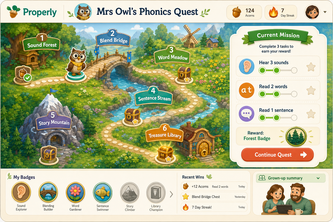
The description states that Properly is an AI phonics tutor for children aged 4–7. It listens as children read aloud, checks pronunciation and word coverage, and provides coaching through a virtual character named Mrs Owl. The system generates or selects reading material based on the child’s phonics phase and interests.
It includes:
- Child profile setup with age/phase and interests
- Interactive grapheme and phoneme highlighting
- Read-aloud recording and assessment using speech transcription (Whisper) and phonics validation
- Feedback from Mrs Owl via GPT-5.6
- Rewards system (acorns, badges, streaks)
- Printable A4 PDF storybooks with illustrations
The product is described as a full-stack web application built using React, Node.js, Express, and various OpenAI services.
Evidence:
- The author describes the core functionality of the app.
- It uses specific technologies like Whisper for transcription, GPT-5.6 for coaching, and TTS for voice feedback.
- Features are listed in detail including story generation, progress tracking, and reward mechanics.
Inference:
- The architecture is described as a full-stack web application with React frontend and Node.js backend.
- It integrates AI services selectively rather than relying entirely on LLMs.
Positioning & Claim Evolution
The description positions Properly as an accessible, low-pressure phonics practice tool for young children. It aims to address the lack of affordable, consistent early phonics support that parents often struggle to provide at home.
Key claims:
- Early phonics support is expensive and inconsistent.
- The app makes this practice available through a web application.
- It focuses on encouraging feedback rather than harsh correction.
- It uses AI to personalize reading content and coaching.
Evidence:
- The problem statement explicitly mentions cost, inconsistency, and parental difficulty in providing practice.
- The solution emphasizes child-friendly features like Mrs Owl, reward systems, and printable storybooks.
- The positioning is framed around accessibility and ease-of-use for parents and children.
Inference:
- The product is positioned as a supplement to traditional phonics instruction or private tutoring.
- It targets parents seeking affordable, scalable solutions for early literacy development.
Target Customer & ICP
The description states that Properly serves children aged 4–7, with a focus on those needing phonics practice between school sessions. The target user is likely a parent or caregiver who wants to support their child's reading journey at home.
Evidence:
- The age range (4–7) is clearly defined.
- It mentions that the challenge is not only reading words but also phase-appropriate vocabulary and repeated exposure.
- The app includes features like progress tracking, rewards, and printable storybooks aimed at young learners and caregivers.
Inference:
- Parents or educators who are looking for low-pressure, interactive phonics practice tools.
- Likely a subset of early childhood education stakeholders, possibly including teachers in informal settings.
Business Model & Pricing Evidence
There is no evidence provided about pricing, monetization strategies, or business model. The description focuses on the technical implementation and features but does not mention how the product would be sold or whether it has any revenue streams.
Evidence:
- No mention of subscription plans, one-time purchases, freemium models, or B2B sales.
- No indication of target customers beyond parents or caregivers.
Inference:
- The project is described as a prototype/demo for hackathon judging — suggesting no commercial model has been implemented yet.
Technical & Delivery Signals
The product is built as a full-stack web application using:
- Frontend: React 18 + Vite
- Backend: Node.js + Express
- Real-time audio: WebSockets
- Data storage: SQLite with WAL mode
- AI services: OpenAI chat, Whisper, TTS, image generation
It uses Codex for development and includes mock mode functionality to avoid API costs during demos.
Evidence:
- Detailed tech stack is listed.
- The app integrates OpenAI services selectively (e.g., GPT-5.6 for stories, Whisper for transcription).
- Deterministic logic is used in core learning behaviors.
- Caching strategies are implemented to reduce AI usage and improve performance.
Inference:
- The architecture supports both local and cloud deployment via Docker and Render.
- The use of mock mode suggests a cautious approach to API costs and scalability concerns.
Traction & Maturity Signals
The description states that Properly is a working demo/prototype suitable for hackathon judging. It includes the core learning journey, AI integration points, deterministic phonics logic, deployment setup, documentation, and publishable architecture visuals.
There is no evidence of actual user adoption, customer base, or revenue generation beyond the prototype stage.
Evidence:
- The product is described as a demo/prototype.
- No mention of users, customers, or usage metrics.
- No indication of production readiness or market traction.
Inference:
- This is likely a proof-of-concept or early-stage product.
- It may not yet be ready for commercial launch or widespread use.
Competitive Context
There is no evidence provided about competitors or competitive landscape. The description does not reference existing phonics apps, AI tutoring platforms, or educational tools in the market.
Evidence:
- No mention of competing products or market positioning.
- No indication of differentiation from other early literacy tools.
Inference:
- The competitive environment is unknown — whether there are similar offerings in the market or if this is a novel approach.
Open Questions & Risks
Key risks include:
- No commercial traction or revenue model: The product is described only as a demo/prototype.
- Limited scope of AI usage: While AI is used for content and feedback, core phonics logic remains deterministic — this may limit scalability or adaptability.
- Dependency on OpenAI services: Heavy reliance on external APIs introduces cost and availability risks.
- Unproven user engagement: No evidence of actual child or parent usage beyond the prototype.
Evidence:
- The product is explicitly labeled as a demo/prototype.
- No mention of real-world testing, feedback loops, or user retention.
Inference:
- The risk of failure in transitioning from prototype to scalable product is high without further validation.
- Lack of data on user behavior or engagement metrics raises concerns about long-term viability.
Questions the description leaves open
- Has the product been tested with real children and parents? What were the results?
- Are there any plans for monetization or business model development beyond the prototype?
- How does the team plan to scale the AI usage without incurring high costs?
- What are the key assumptions about user behavior that have not yet been validated?
- Is there a roadmap for moving from prototype to production-ready product?
Overall Assessment
Confidence Level: Low
This is a self-reported, unverified prototype built for a hackathon. There is no evidence of revenue, customers, or traction beyond the demo stage.
Assessment Summary:
The project shows technical capability and thoughtful design but lacks commercial validation or market readiness. It represents an early-stage idea with potential, but further due diligence is needed to assess its viability as a product or investment opportunity.
Next Steps:
If pursuing this further, seek evidence of:
- Real-world usage or testing
- Revenue projections or monetization strategy
- Market research or competitive analysis
- Team experience in education or SaaS product development
User Stories BotA demo video on every pull request
Get a demo video on every new feature
GitHub App that watches your pull requests and records a narrated, captioned demo.
Save time on demo prep and make informed decisions faster with a video walkthrough of every new feature.
Source
Submitted to the OpenAI 2026 hackathon on Devpost. Project home on Devpost. Back to the full gallery on Devpost.
This competitive analysis was produced by top-founders.com (opens in a new tab)
Generated by a language model from this project's public Devpost page — its tagline, the author's own write-up and any built-with tags listed there — as captured in August 2026. Short quotations are the author's words. It is an opinion on the idea as a business, not on the people behind it, and it reflects the description as published then. If the project has moved on, request a correction below. The analysis is not independent research and contains no verified traction, revenue or customer data.
An independent guide by KFG International LLC — not affiliated with, endorsed by, or connected to Devpost or OpenAI.