

Archive position — measured, not model output
0 likes on Devpost
2,263 of the 7,850 archived projects have more likes, and 5,587 share exactly 0 — so this project's #7,587 place in the like-ranked listing is a tie-break inside that group, not a ranking.
Projects (log scale)
Likes on Devpost. ▲ marks this project's group.
Show the figures
| Likes | Projects | Share of archive |
|---|---|---|
| 0 | 5,587 | 71.2% |
| 1 | 1,758 | 22.4% |
| 2 | 284 | 3.6% |
| 3–4 | 132 | 1.7% |
| 5–9 | 75 | 1.0% |
| 10+ | 14 | 0.2% |
 User Stories BotA demo video on every pull request
Get a demo video on every new feature
GitHub App that watches your pull requests and records a narrated, captioned demo.
Save time on demo prep and make informed decisions faster with a video walkthrough of every new feature.
Executive Summary
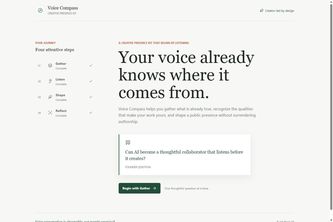
What the company appears to be: Voice Compass is a self-reported AI collaboration tool designed for independent creators (writers, artists) that emphasizes listening before generating public-facing content. It uses GPT-5.6 and Codex to interpret a creator's writing with evidence-based readings, requiring explicit human approval before shaping public material.
What changed: The author states this is not another writing assistant but a "listening-first creative companion" that separates interpretation from generation and makes AI evidence visible through exact excerpt matching.
Single most important open question: Does the described system actually function as claimed — specifically, can it reliably validate every interpretive claim with verbatim excerpts from submitted text?
Analysis basis: This is entirely self-reported by the author. No third-party verification, revenue data, customer traction or independent testing is available. The description contains no numbers, pricing, headcount, funding, customers or product usage metrics.
What The Product Actually Is
The description states that Voice Compass is:
- A "listening-first creative companion"
- Not another writing assistant
- An AI collaboration system for creators
- Built with GPT-5.6 and Codex during a hackathon
- Designed to help creators recognize, preserve, and express their voice with clarity
It is described as an application that:
- Begins by asking what the AI should notice before it writes
- Uses GPT-5.6 to produce structured readings of submitted writing
- Requires exact evidence for each interpretive claim
- Separates "Original Compass", "Working Compass", and "Approved Compass" states
- Shapes a "Creative Presence Kit" after approval
- Includes a "Companion Perspective" that shows AI observations without presenting them as public language
- Exports editable Markdown
Evidence strength: Self-reported. No functional demonstration, screenshots or user testing data provided.
Positioning & Claim Evolution
The author claims:
- Voice Compass is not another writing assistant
- It is a "listening-first creative companion"
- Its purpose is to help creators recognize, preserve and express their voice with clarity
- The system makes AI evidence visible through exact excerpt matching
- It separates interpretation from generation
- The AI listens before it creates, and the creator retains final authorship
The positioning evolves from:
- A question: "Can AI become a thoughtful collaborator that listens before it creates?"
- To a methodology: "Creative Presence Kit" human-led approach
- To a product: V1 built with Codex and GPT-5.6 during Build Week
Evidence strength: Claims are self-reported, not substantiated by external validation or performance data.
Target Customer & ICP
The description states:
- Independent authors, artists, and thoughtful creators
- People who have meaningful writing scattered across notes, drafts, biographies, project descriptions, and unfinished ideas
- Individuals who know what they care about but struggle to shape those materials into a coherent public presence
Evidence strength: Self-reported. No segmentation data, personas or customer interviews are provided.
Business Model & Pricing Evidence
The description states:
- No pricing information is given
- The V1 is intentionally narrow: one creator, one uninterrupted journey, one approved Creative Presence Kit, and one editable Markdown export
- Future work will build on this foundation while preserving its central promise
- The AI listens before it creates, the creator retains final authorship, and voice preservation remains visible
Evidence strength: Not evidenced. No business model, pricing structure or monetization strategy described.
Technical & Delivery Signals
The description states:
- Built with React, TypeScript, Vite, Node.js, OpenAI Responses API, GPT-5.6, Zod
- Server-side OpenAI API key (never reaches browser)
- GPT-5.6 responses are accepted only when they satisfy fixed schemas
- Server rejects malformed output, unsupported references, and evidence excerpts that cannot be matched exactly to the submitted source
- Uses browser-tab session storage rather than accounts or a database
- Markdown export is created locally without an API request
- Verification included 24 automated tests, strict schema and evidence rejection tests, production builds, desktop/mobile checks, keyboard navigation, browser-log inspection, export inspection, credential-boundary scans
Evidence strength: Self-reported. No live system access, performance benchmarks or technical architecture diagrams provided.
Traction & Maturity Signals
The description states:
- V1 was built during a hackathon (OpenAI 2026)
- The first live API attempt encountered an account-limit response before billing became active
- Only one live GPT-5.6 verification was performed after billing became available
- No mention of users, usage metrics, or adoption data
Evidence strength: Not evidenced. No traction, customer base, or product maturity indicators are provided.
Competitive Context
The description states:
- Most AI writing workflows begin by asking what should be generated (biography, tagline, homepage, social post)
- Most AI tools move quickly toward polished public language without showing what the AI understood
- Voice Compass asks a different first question: "What should the AI notice before it writes?"
- It is not another writing assistant
Evidence strength: Self-reported. No competitive analysis or market positioning data provided.
Open Questions & Risks
Inferences based on self-reporting:
- Trust in AI interpretation: The system requires exact evidence for every interpretive claim, but the author does not demonstrate whether this actually works reliably
- Single-user scope: V1 uses session storage instead of accounts or databases — may limit scalability or usability for creators who want to save progress
- Limited functionality: No mention of multi-user support, export formats beyond Markdown, or integration capabilities
- Unproven validation mechanism: The claim that "every interpretive claim must include an exact excerpt" is stated but not verified in practice
- No monetization path: No indication of how the product would generate revenue or scale
Evidence strength: Inferences from self-reporting. No independent verification.
Questions the description leaves open
- How does the system verify that every interpretive claim includes an exact excerpt? Can you show a working example?
- What happens if the submitted text is too short or vague for the AI to produce valid evidence-based readings?
- Is there any mechanism to handle cases where the creator disagrees with the AI's interpretation and wants to override it?
- How does the system prevent false positives or misleading matches between AI output and source material?
- What are the technical limitations of using session storage instead of a database for user progress tracking?
- Are there plans to support multiple users, team collaboration, or integrations with existing tools?
- How would you scale this product beyond a single-user journey?
Overall Assessment
Not evidenced.
The description is entirely self-reported and unverified. No evidence of:
- Revenue
- Customers
- Product usage
- Market traction
- Financials
- Team size or structure beyond one person
- Product performance or user feedback
- Technical validation or testing results
This is a conceptual prototype submitted to a hackathon, not a functioning product with demonstrated value or market demand. The author describes an ambitious vision but provides no evidence of execution or impact.
Confidence level: Very low. The description contains strong claims about AI behavior and trust mechanisms, but none are substantiated by data or demonstration.
User Stories BotA demo video on every pull request
Get a demo video on every new feature
GitHub App that watches your pull requests and records a narrated, captioned demo.
Save time on demo prep and make informed decisions faster with a video walkthrough of every new feature.
Source
Submitted to the OpenAI 2026 hackathon on Devpost. Project home on Devpost. Back to the full gallery on Devpost.
This competitive analysis was produced by top-founders.com (opens in a new tab)
Generated by a language model from this project's public Devpost page — its tagline, the author's own write-up and any built-with tags listed there — as captured in August 2026. Short quotations are the author's words. It is an opinion on the idea as a business, not on the people behind it, and it reflects the description as published then. If the project has moved on, request a correction below. The analysis is not independent research and contains no verified traction, revenue or customer data.
An independent guide by KFG International LLC — not affiliated with, endorsed by, or connected to Devpost or OpenAI.