

Archive position — measured, not model output
0 likes on Devpost
2,263 of the 7,850 archived projects have more likes, and 5,587 share exactly 0 — so this project's #7,588 place in the like-ranked listing is a tie-break inside that group, not a ranking.
Projects (log scale)
Likes on Devpost. ▲ marks this project's group.
Show the figures
| Likes | Projects | Share of archive |
|---|---|---|
| 0 | 5,587 | 71.2% |
| 1 | 1,758 | 22.4% |
| 2 | 284 | 3.6% |
| 3–4 | 132 | 1.7% |
| 5–9 | 75 | 1.0% |
| 10+ | 14 | 0.2% |
 User Stories BotA demo video on every pull request
Get a demo video on every new feature
GitHub App that watches your pull requests and records a narrated, captioned demo.
Save time on demo prep and make informed decisions faster with a video walkthrough of every new feature.
Executive Summary
What the company appears to be
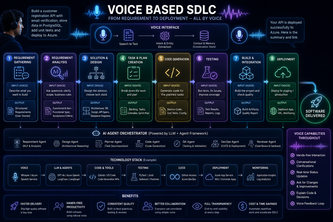
Voice Dev Loop is a self-reported tool that allows users to speak software requirements, which are then transcribed, structured, and converted into a tested draft pull request through Jira and GitHub. The system uses voice input, transcription, structured requirement generation, and controlled code generation via GitHub Actions and Copilot CLI.
What changed
The project is described as a hackathon submission (Devpost entry for OpenAI 2026) that demonstrates a proof-of-concept workflow from spoken requirement to draft pull request. It is not evidenced to be in production or used by any customers.
Single most important open question
Is there evidence of traction, revenue, or adoption beyond the hackathon demo? The description states no such data exists.
What The Product Actually Is
The description states that Voice Dev Loop:
- Accepts spoken English requirements via a push-to-talk interface.
- Transcribes the audio using Groq Whisper.
- Allows users to correct the transcript.
- Converts the corrected transcript into a structured requirement (title, description, acceptance criteria, constraints, open questions).
- Creates a Jira story upon user approval.
- Triggers a GitHub Actions workflow that generates code changes in a restricted environment.
- Runs validation checks (lint, TypeScript, tests, build) in an isolated container.
- Opens a draft pull request for human review.
- Does not auto-merge or deploy.
Inference The system is a prototype built to demonstrate a workflow from voice input to code generation, with strong emphasis on control and safety via manual approval and sandboxed execution.
Positioning & Claim Evolution
The description states:
- The product aims to reduce friction in software development by allowing spoken requirements.
- It seeks to improve context preservation and delivery speed compared to manual copying between tools like Jira and GitHub.
- It positions itself as a way to "speak a software requirement" and automate the rest of the process.
Inference The positioning is minimal, focused on solving inefficiencies in current workflows. No claims about market fit, scalability, or competitive advantage beyond the demo are made.
Target Customer & ICP
The description does not state:
- Who the target customer is.
- Whether it's aimed at developers, product managers, or teams.
- What size organizations or use cases it targets.
Not evidenced.
Business Model & Pricing Evidence
The description states:
- The project is a hackathon demo.
- No pricing model, monetization strategy, or business model is described.
Not evidenced.
Technical & Delivery Signals
The description states:
- Built with Next.js and TypeScript.
- Uses Groq Whisper for speech-to-text.
- GitHub Models to structure requirements.
- Jira Cloud for storing stories.
- GitHub Actions workflow for code generation.
- GitHub Copilot CLI for controlled code changes.
- Validation runs in an isolated container without network access or CI secrets.
Inference The system is built with modern, open-source tools and emphasizes sandboxing and safety. It is not described as a hosted service or scalable product.
Traction & Maturity Signals
The description states:
- This is a hackathon submission.
- The demo records speech, structures requirements, creates Jira stories, starts GitHub workflows, validates code, and opens draft pull requests.
- No revenue, customers, or adoption data are provided.
- The authors note that the current version stays intentionally small and ends at a tested draft pull request.
Not evidenced.
Competitive Context
The description does not state:
- Who the competitors are.
- Whether similar tools exist in the market.
- How Voice Dev Loop compares to existing voice-based or automation tools for software development.
Not evidenced.
Open Questions & Risks
- The system is described as a hackathon demo, with no evidence of production use or scalability.
- No revenue, customers, or traction are reported.
- The project is small (2-person team) and self-reported.
- The demo uses limited sandboxing and does not include features like durable state, trace identifiers, or GitHub App integration beyond the prototype stage.
Inference The risk of misalignment with real-world needs or lack of product-market fit is high without further evidence of traction or adoption.
Questions the description leaves open
- What is the actual use case you're solving for? Is there a customer who has asked for this?
- How does this differ from existing tools like GitHub Copilot, Jira, or voice-to-text integrations?
- Are you planning to move beyond the demo into production or beta usage?
- Do you have any early adopters or feedback from developers who might use this?
- What are the technical limitations of the current prototype that would need to be addressed for a production version?
Overall Assessment
The description states:
- This is a hackathon submission.
- No evidence of revenue, customers, or traction exists.
- The system is described as a proof-of-concept with no indication of commercial viability or scalability.
Inference There is no basis for investment or partnership at this stage. The project is not evidenced to be beyond the prototype phase and lacks any demonstration of market demand or product maturity.
User Stories BotA demo video on every pull request
Get a demo video on every new feature
GitHub App that watches your pull requests and records a narrated, captioned demo.
Save time on demo prep and make informed decisions faster with a video walkthrough of every new feature.
Source
Submitted to the OpenAI 2026 hackathon on Devpost. Project home on Devpost. Back to the full gallery on Devpost.
This competitive analysis was produced by top-founders.com (opens in a new tab)
Generated by a language model from this project's public Devpost page — its tagline, the author's own write-up and any built-with tags listed there — as captured in August 2026. Short quotations are the author's words. It is an opinion on the idea as a business, not on the people behind it, and it reflects the description as published then. If the project has moved on, request a correction below. The analysis is not independent research and contains no verified traction, revenue or customer data.
An independent guide by KFG International LLC — not affiliated with, endorsed by, or connected to Devpost or OpenAI.