

Archive position — measured, not model output
0 likes on Devpost
2,263 of the 7,850 archived projects have more likes, and 5,587 share exactly 0 — so this project's #7,590 place in the like-ranked listing is a tie-break inside that group, not a ranking.
Projects (log scale)
Likes on Devpost. ▲ marks this project's group.
Show the figures
| Likes | Projects | Share of archive |
|---|---|---|
| 0 | 5,587 | 71.2% |
| 1 | 1,758 | 22.4% |
| 2 | 284 | 3.6% |
| 3–4 | 132 | 1.7% |
| 5–9 | 75 | 1.0% |
| 10+ | 14 | 0.2% |
 User Stories BotA demo video on every pull request
Get a demo video on every new feature
GitHub App that watches your pull requests and records a narrated, captioned demo.
Save time on demo prep and make informed decisions faster with a video walkthrough of every new feature.
Executive Summary
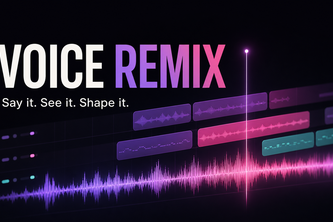
What the company appears to be: Voice Remix is a self-reported voice-first visual multitrack arranger built as a demo for the OpenAI 2026 hackathon. The author states it allows users to edit music by speaking or typing, with changes shown visually as a "Music Diff" that displays before-and-after values and allows selective application.
What changed: The project description is a single self-reported write-up from one developer (Mark Chen) submitted to a hackathon. No prior version or evolution is described.
Single most important open question: Is there any evidence of product-market fit, revenue, traction, or customer adoption beyond the author's own demonstration?
What The Product Actually Is
The description states that Voice Remix is a voice-first visual multitrack arranger. It allows users to input natural language requests like “Move the final chorus four bars earlier and make the drums harder, but keep the bass unchanged.” These are translated into a Music Diff, showing proposed operations with before-and-after values, assumptions, and protected tracks.
The app supports:
- Local full-song import
- Individual stem replacement
- Synchronized multi-stem import
- Source-derived waveforms
- Manual stem mute controls
- Guided judge mode
- Stereo WAV export
It uses React, TypeScript, Tone.js, Canvas waveform rendering, Zod, and integrates with OpenAI's GPT-5.6 Sol, OpenAI Responses API, and OpenAI Realtime API.
Inference: The product appears to be a prototype or demo, not a commercial offering. It is built for creative AI interaction in music editing, using structured outputs from an LLM to propose edits that are then validated and applied manually by the user.
Positioning & Claim Evolution
The author states:
- “Say the change. See the diff. Keep control.” — tagline
- The product explores the space between AI music generators (which create first versions) and traditional DAWs (which offer precise control but require production knowledge).
- It is positioned as a tool that allows natural language editing, with visual transparency and user control.
Inference: The positioning suggests an intent to bridge generative AI and manual editing, emphasizing non-destructive workflows and collaborative interaction. However, the description does not indicate any prior version or evolution of this positioning — it is a single self-reported narrative from one developer.
Target Customer & ICP
The description does not identify a specific customer segment or ideal customer profile (ICP). It describes an editor for music creation, but no explicit user persona, industry, or use case beyond the author’s own demo is stated.
Inference: The likely target is music creators or producers who want to experiment with AI-assisted editing while retaining control. However, this is inferred from the product's purpose and not explicitly stated.
Business Model & Pricing Evidence
There is no evidence of a business model or pricing structure in the description. It is presented as a hackathon demo.
Inference: The project has no commercialization evidence — no revenue streams, pricing tiers, or monetization strategy are described.
Technical & Delivery Signals
The author states:
- Built with React, TypeScript, Tone.js, Canvas waveform rendering, Zod
- Uses OpenAI’s GPT-5.6 Sol, Responses API, and Realtime API
- The model does not directly mutate audio or receive raw audio
- Server-side deterministic code validates edits and creates versioned transactions for UI review
- Voice transcription, conversational replies, and editor tools are handled via OpenAI Realtime API
- Audio decoding, playback, waveform analysis, and export run in the browser
Inference: The system is built with a clear separation between AI generation (structured outputs), validation (deterministic code), and UI (React + Tone.js). It uses modern web technologies and integrates with LLMs for natural language processing.
Traction & Maturity Signals
The description states:
- This is a demo submitted to the OpenAI 2026 hackathon
- The author built it alone
- No mention of users, customers, or adoption beyond the demo itself
Inference: There is no evidence of traction, revenue, or customer base. It is a single-person project with no external validation or usage data.
Competitive Context
The description does not reference any competitors or market positioning relative to existing tools. It only describes the product’s intent to bridge AI music generation and traditional DAWs.
Inference: The competitive landscape is unknown, but it likely overlaps with:
- AI music generators (e.g., AIVA, Amper, Udio)
- Traditional DAWs (e.g., Ableton, Logic, Pro Tools)
- Voice-controlled editing tools or AI-assisted audio tools
However, no direct comparison or differentiation is stated.
Open Questions & Risks
- Single developer: The project is built by one person (Mark Chen), with no team or organizational structure.
- No commercialization evidence: No revenue, pricing, or customer data.
- Hackathon demo: Not a product in development, but a prototype submitted for competition.
- Unverified claims: All descriptions are self-reported and unverified.
- No traction: No users, customers, or adoption metrics.
Inference: The project is not yet a commercial product. It may be an early-stage idea or proof-of-concept with no clear path to monetization or market fit.
Questions the description leaves open
- What is the intended user base for Voice Remix beyond the demo?
- Has there been any feedback from users or potential customers?
- Are there plans to commercialize this product, and if so, what is the business model?
- How does the current demo translate into a scalable product?
- What are the technical limitations of the current implementation that would need to be addressed for production use?
Overall Assessment
Not evidenced: There is no evidence of revenue, customers, or traction beyond the author’s own demo.
Inference: This project is a single-developer hackathon submission, not a commercial product. It lacks any indication of market demand, monetization strategy, or scalability. It may be an early-stage idea with potential, but it is not ready for investment or partnership consideration based on this description alone.
User Stories BotA demo video on every pull request
Get a demo video on every new feature
GitHub App that watches your pull requests and records a narrated, captioned demo.
Save time on demo prep and make informed decisions faster with a video walkthrough of every new feature.
Source
Submitted to the OpenAI 2026 hackathon on Devpost. Project home on Devpost. Back to the full gallery on Devpost.
This competitive analysis was produced by top-founders.com (opens in a new tab)
Generated by a language model from this project's public Devpost page — its tagline, the author's own write-up and any built-with tags listed there — as captured in August 2026. Short quotations are the author's words. It is an opinion on the idea as a business, not on the people behind it, and it reflects the description as published then. If the project has moved on, request a correction below. The analysis is not independent research and contains no verified traction, revenue or customer data.
An independent guide by KFG International LLC — not affiliated with, endorsed by, or connected to Devpost or OpenAI.