

Archive position — measured, not model output
1 like on Devpost
505 of the 7,850 archived projects have more likes, and 1,758 share exactly 1 — so this project's #1,703 place in the like-ranked listing is a tie-break inside that group, not a ranking.
Projects (log scale)
Likes on Devpost. ▲ marks this project's group.
Show the figures
| Likes | Projects | Share of archive |
|---|---|---|
| 0 | 5,587 | 71.2% |
| 1 | 1,758 | 22.4% |
| 2 | 284 | 3.6% |
| 3–4 | 132 | 1.7% |
| 5–9 | 75 | 1.0% |
| 10+ | 14 | 0.2% |
 User Stories BotA demo video on every pull request
Get a demo video on every new feature
GitHub App that watches your pull requests and records a narrated, captioned demo.
Save time on demo prep and make informed decisions faster with a video walkthrough of every new feature.
Executive Summary
What the company appears to be
Preuvance is a self-reported tool for AI governance that supports a three-step workflow: Prompt, Scan, Prove. It claims to help teams document AI systems by collecting and organizing evidence from dependency manifests, local scans, and AI-generated assessments. The system separates declared, detected, missing, and proven items in an evidence register, with human review required for "Proven" status.
What changed
The project description indicates this was built during a hackathon (OpenAI 2026 Build Week), focusing on an "instant dossier" workflow. It builds upon prior work, emphasizing new features like bounded scanning, explicit consent for local scans, and model tracking within the assessment pipeline.
The single most important open question
Does Preuvance have any commercial traction or adoption beyond its hackathon prototype? The description provides no evidence of revenue, customers, or usage beyond a demo environment.
What The Product Actually Is
The description states that Preuvance supports a three-step workflow: Prompt, Scan, Prove. It is described as an "evidence-by-evidence ledger" with explicit Declared, Detected, Missing, and Proven semantics.
- Prompt: A user describes an AI system and its context.
- Scan: Supported dependency manifests are parsed in the browser; optional local scan provides a redacted digest.
- Prove: Preuvance assembles a living evidence register that separates Declared, Detected, Missing, and Proven items.
The system uses GPT-5.6 for bounded reasoning tasks such as extracting structured facts, classifying context, and identifying gaps. It also incorporates deterministic TypeScript rules to normalize evidence, enforce allowed states, require reviewer metadata for Proven items, and calculate documentary coverage separately from regulatory readiness.
It stores only evidence metadata behind tenant-aware access controls using Supabase, with no file content stored by the workbench. Browser-side scanners recognize formats like package.json and requirements*.txt, sending explicit digests rather than raw manifest content.
Inference The product appears to be a developer-facing tool for AI governance documentation, not an end-user compliance solution or certification engine.
Positioning & Claim Evolution
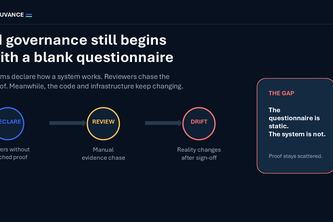
The description states that teams adopting AI are asked difficult questions about providers, models, controls, and evidence. Preuvance aims to turn scattered information into one reviewable dossier without pretending that AI-generated conclusions are legal certifications.
It positions itself as a documentation assistant for AI governance, not a compliance oracle or certification tool. The authors emphasize that the resulting dossier can be revisited and exported for review workflows, but it does not claim automatic legal compliance.
Inference Preuvance is positioned as an evidence-gathering and organizational tool, not a compliance or certification product. It focuses on transparency and traceability rather than automation of governance decisions.
Target Customer & ICP
The description does not name specific customer segments or personas. However, it implies that the target audience includes teams adopting AI systems who need to answer questions about providers, models, controls, and evidence.
It suggests a use case for developers or technical teams working on AI projects where documentation of dependencies, control mechanisms, and risk gaps is required.
Inference The ICP likely includes technical teams in organizations implementing AI systems, particularly those needing structured documentation of their AI governance practices.
Business Model & Pricing Evidence
There is no evidence provided about pricing, monetization strategy, or business model. The description does not mention any commercial offerings, subscriptions, or revenue streams.
Not evidenced
Technical & Delivery Signals
The project uses:
- GPT-5.6 for bounded reasoning tasks
- Browser-side scanners for dependency manifests (package.json, requirements*.txt)
- TypeScript rules to enforce evidence states and reviewer metadata
- Supabase for metadata storage with tenant-aware access controls
- React, Next.js, Tailwind, Cloudflare Workers, PostgreSQL, SQLite, Remotion
It includes:
- Explicit consent for local scan handoffs
- SHA-256 integrity hashing
- Model tracking in the assessment pipeline
- Deterministic schemas and evidence-state invariants
- Event history and optimistic revisions
Inference The technical stack suggests a modern SaaS or developer tool architecture with emphasis on privacy, traceability, and deterministic validation.
Traction & Maturity Signals
The description states that Preuvance existed before the Build Week event but was focused on new features during the hackathon. It includes a demo repository and testing instructions, but there is no evidence of actual users, customers, or adoption beyond the prototype.
It mentions:
- A downloadable sample PDF dossier
- Local running instructions with OpenAI API key requirement
- Demo workflow using fictional values
Not evidenced
Competitive Context
The description does not mention competitors or market positioning relative to other AI governance tools. It focuses on its own internal design and functionality without reference to existing solutions.
Not evidenced
Open Questions & Risks
- No commercial traction: The project is described as a hackathon prototype with no evidence of revenue, customers, or adoption.
- Self-reported only: All claims are unverified and based on the author's own description.
- Limited scope: The tool is designed for AI governance documentation, not compliance certification or automation.
- No pricing or monetization model: No indication of how it would be sold or monetized.
- Demo-only functionality: Testing instructions point to a local demo environment, not a production-ready system.
Inference The lack of any commercial evidence makes it difficult to assess viability as a product or business.
Questions the description leaves open
- What is the actual use case for this tool beyond the hackathon prototype?
- Has there been any real-world testing or feedback from potential users?
- How does the team plan to monetize or scale this solution?
- Are there any existing customers or pilot programs?
- What are the technical limitations of the current implementation that would prevent production deployment?
Overall Assessment
Not evidenced
The description provides no evidence of commercial traction, revenue, customers, or adoption. It describes a prototype tool built during a hackathon with no indication of market readiness or business model.
Confidence Low — the entire analysis is based on self-reported information without any external validation or historical data.
User Stories BotA demo video on every pull request
Get a demo video on every new feature
GitHub App that watches your pull requests and records a narrated, captioned demo.
Save time on demo prep and make informed decisions faster with a video walkthrough of every new feature.
Source
Submitted to the OpenAI 2026 hackathon on Devpost. Project home on Devpost. Back to the full gallery on Devpost.
This competitive analysis was produced by top-founders.com (opens in a new tab)
Generated by a language model from this project's public Devpost page — its tagline, the author's own write-up and any built-with tags listed there — as captured in August 2026. Short quotations are the author's words. It is an opinion on the idea as a business, not on the people behind it, and it reflects the description as published then. If the project has moved on, request a correction below. The analysis is not independent research and contains no verified traction, revenue or customer data.
An independent guide by KFG International LLC — not affiliated with, endorsed by, or connected to Devpost or OpenAI.