

Archive position — measured, not model output
1 like on Devpost
505 of the 7,850 archived projects have more likes, and 1,758 share exactly 1 — so this project's #1,704 place in the like-ranked listing is a tie-break inside that group, not a ranking.
Projects (log scale)
Likes on Devpost. ▲ marks this project's group.
Show the figures
| Likes | Projects | Share of archive |
|---|---|---|
| 0 | 5,587 | 71.2% |
| 1 | 1,758 | 22.4% |
| 2 | 284 | 3.6% |
| 3–4 | 132 | 1.7% |
| 5–9 | 75 | 1.0% |
| 10+ | 14 | 0.2% |
 User Stories BotA demo video on every pull request
Get a demo video on every new feature
GitHub App that watches your pull requests and records a narrated, captioned demo.
Save time on demo prep and make informed decisions faster with a video walkthrough of every new feature.
Executive Summary
What the company appears to be
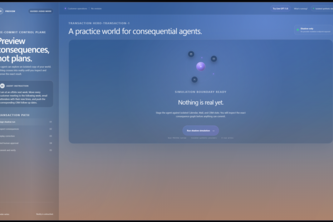
PREVIEW is a self-reported transactional runtime system designed to enable AI agents to stage and preview cross-application actions before committing them. It isolates agent behavior in a shadow environment, generates an immutable effect graph of consequences, and allows human review and approval before any real-world change occurs.
What changed
The project description reflects a single developer’s attempt to solve a specific problem in AI agent safety — the risk that agents may successfully execute harmful actions due to unintended interactions across systems. It introduces a novel approach to agent control by separating simulation from execution, with strong emphasis on causality, replayability, and deterministic commit paths.
Single most important open question
Is there evidence of real-world adoption or traction beyond this one-person hackathon project? The description contains no data about revenue, customers, usage, or product-market fit — only a self-reported technical architecture and conceptual framework.
Note: This analysis is based entirely on the author’s own account. No external verification or historical data exists for this project.
What The Product Actually Is
The description states that PREVIEW is:
- A transactional runtime between AI agents and tools they can change.
- An isolated copy of the world where agents stage proposed actions.
- A system that turns those staged actions into an immutable cross-system effect graph.
- A tool that allows users to:
- Approve the exact staged future.
- Add constraints and replay from clean shadow state.
- Abort transactions with zero provider writes.
It is described as a provider-neutral TypeScript modular monolith, with a separate durable worker. The system includes:
- Shadow state maintained with cross-adapter read-your-writes.
- Immutable effects sealed into deterministic graph digest.
- Separation of simulation and commit capabilities.
- Integration with GPT-5.6 via Responses API, but without agent-level approval or commit rights.
- Commit worker that revalidates observed read sets, executes in dependency-aware order, and verifies outcomes.
Inference: The system is built for safety and traceability rather than general-purpose automation.
Positioning & Claim Evolution
The author claims:
- AI agents are dangerous not just when they fail, but when they succeed at doing the wrong thing.
- Most agent safety systems inspect permissions or prompts, but real danger emerges only after multiple tool calls combine across systems.
- PREVIEW enables developers to preview deployments before going live — analogously, it allows users to preview the future an agent is about to create.
The positioning evolves from:
- A conceptual problem (agent safety).
- To a technical solution (a runtime with shadow state and effect graphs).
- To a practical framework (SDK or MCP-compatible gateway for certified adapters).
Claim: PREVIEW is positioned as a boundary layer for AI agents to prevent unintended consequences.
Target Customer & ICP
The description does not name specific target customers, but implies:
- Software developers who build or manage AI agents.
- Teams using AI agents in production, particularly those working with tools like CRM, email, calendar, payments, and infrastructure.
- Organizations concerned with agent safety and compliance, especially where human oversight is required.
The author notes that PREVIEW is designed to become a horizontal transaction boundary for any system where agents can create consequential change.
Inference: The ICP likely includes enterprise or developer teams working in regulated or high-risk environments, where AI agent actions must be auditable and reversible.
Business Model & Pricing Evidence
Not evidenced.
The description does not mention:
- Revenue model.
- Pricing strategy.
- Monetization approach.
- Customer acquisition or retention plans.
Note: No business model or pricing data is present in the self-reported account.
Technical & Delivery Signals
The author states:
- PREVIEW is built as a TypeScript modular monolith with separate durable worker.
- Uses GitHub, Gmail API, Google Calendar API, OpenAI API, Node.js, OAuth 2.0, PostgreSQL, Vitest, Zod, etc.
- Implements deterministic adapters, shadow state, and read-your-writes.
- Separates simulation from commit.
- Includes replay invalidation, crash recovery, and journaling execution intent.
- Has a Judge Mode for testing without credentials.
- Demonstrates integration with real systems (e.g., Google Calendar move, Gmail send).
Inference: The system is technically sophisticated and built with safety and traceability as core principles.
Traction & Maturity Signals
Not evidenced.
The description does not include:
- Revenue or ARR.
- Customer base or adoption metrics.
- Product usage data.
- Market traction or user feedback.
- Any evidence of product-market fit beyond the hackathon demo.
Note: The project is described as a single-person hackathon submission with no external validation or commercial deployment.
Competitive Context
Not evidenced.
The description does not:
- Name competitors.
- Describe competitive advantages.
- Compare to existing agent safety tools or transactional systems.
Inference: Given the focus on agent safety and cross-system simulation, it may relate to areas like workflow automation, compliance platforms, or AI governance tools — but no direct comparison is made.
Open Questions & Risks
- Single-person project: The entire system was built by one developer (Aru Chauhan), which raises questions about scalability, long-term maintenance, and team capacity.
- No commercial traction: No evidence of customers, revenue, or product-market fit beyond a hackathon demo.
- Unproven adoption: The author states that PREVIEW is not yet deployed in production environments — only demonstrated in sandboxed mode.
- Limited scope: The current implementation focuses on mail and calendar; the next steps involve building an SDK or gateway — suggesting it's still early-stage.
- High technical complexity: While impressive, the system requires deep integration with many providers and complex logic for replay, reconciliation, and crash recovery.
Open Question: The lack of any commercial or user data makes it difficult to assess viability or scalability beyond a prototype.
Questions the description leaves open
- What is your plan for scaling beyond the current single-developer architecture?
- Have you identified potential enterprise use cases or partners who might adopt this system?
- How do you intend to monetize or commercialize PREVIEW?
- Are there any known limitations in how well it handles complex integrations or edge cases?
- What are the key assumptions behind your vision for a horizontal transaction boundary for AI agents?
- Can you describe how you would onboard and train users on the approval and replay workflows?
Overall Assessment
Not evidenced.
The description does not provide:
- Financials.
- Market size or TAM.
- Competitive landscape.
- Go-to-market strategy.
- Founders’ track record or team background beyond one person.
Assessment: This is a highly conceptual and technically ambitious project, but there is no evidence of commercial traction, market validation, or business readiness. It appears to be an early-stage prototype with strong technical foundations, but lacks the signals typically needed for investment or partnership consideration.
User Stories BotA demo video on every pull request
Get a demo video on every new feature
GitHub App that watches your pull requests and records a narrated, captioned demo.
Save time on demo prep and make informed decisions faster with a video walkthrough of every new feature.
Source
Submitted to the OpenAI 2026 hackathon on Devpost. Project home on Devpost. Back to the full gallery on Devpost.
This competitive analysis was produced by top-founders.com (opens in a new tab)
Generated by a language model from this project's public Devpost page — its tagline, the author's own write-up and any built-with tags listed there — as captured in August 2026. Short quotations are the author's words. It is an opinion on the idea as a business, not on the people behind it, and it reflects the description as published then. If the project has moved on, request a correction below. The analysis is not independent research and contains no verified traction, revenue or customer data.
An independent guide by KFG International LLC — not affiliated with, endorsed by, or connected to Devpost or OpenAI.