

Archive position — measured, not model output
0 likes on Devpost
2,263 of the 7,850 archived projects have more likes, and 5,587 share exactly 0 — so this project's #7,589 place in the like-ranked listing is a tie-break inside that group, not a ranking.
Projects (log scale)
Likes on Devpost. ▲ marks this project's group.
Show the figures
| Likes | Projects | Share of archive |
|---|---|---|
| 0 | 5,587 | 71.2% |
| 1 | 1,758 | 22.4% |
| 2 | 284 | 3.6% |
| 3–4 | 132 | 1.7% |
| 5–9 | 75 | 1.0% |
| 10+ | 14 | 0.2% |
 User Stories BotA demo video on every pull request
Get a demo video on every new feature
GitHub App that watches your pull requests and records a narrated, captioned demo.
Save time on demo prep and make informed decisions faster with a video walkthrough of every new feature.
Executive Summary
Company: Voice Lab
Self-reported basis: The description is entirely self-reported and unverified, based on a Devpost submission for an OpenAI 2026 hackathon project. No independent verification or third-party corroboration exists.
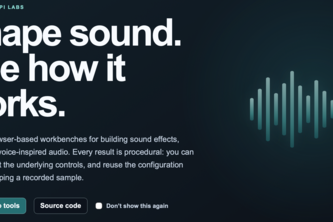
What it appears to be: A tool that allows users to hum, sing, or beatbox into a microphone, which then gets converted into digital sound configurations compatible with the Web Audio API — intended for game developers and creators without musical training.
What changed: The project evolved from a personal hackathon tool (used in a previous project) into a more general-purpose tool that accepts voice input and translates it into audio parameters for Web Audio API use.
Single most important open question: What is the actual utility or adoption of this tool beyond its creator’s own use case, and how does it compare to existing tools or APIs for audio generation?
What The Product Actually Is
The description states that Voice Lab:
- Records a short clip of a user humming a melody, making a sound effect, or creating a beat.
- Sends the audio to multiple APIs for analysis.
- Generates a configuration for the Web Audio API to attempt to recreate the input.
- Allows users to edit the config and combine multiple configs into a primary track.
The author also notes that this is a tool built for game developers or creators who aren’t musically inclined, and that it was inspired by their previous use of the Web Audio API in a hackathon project.
Inference: The product is likely a prototype or proof-of-concept tool, not a commercial offering. It appears to be a lightweight web-based interface that integrates with audio analysis APIs and outputs Web Audio API configurations.
Positioning & Claim Evolution
The author states:
- The tool was inspired by their previous hackathon project where they used the Web Audio API.
- They wanted to make it easier for non-musically inclined creators to generate sounds using voice input.
- The tool allows users to manipulate generated audio through sliders and UI controls.
Claim: The product is positioned as a tool for game developers or other creators who aren’t musically trained, aiming to democratize sound generation.
Inference: The positioning evolved from a personal hackathon utility into a more general-purpose tool. However, there is no evidence of any commercial or market traction, nor of how the tool differentiates from existing audio APIs or tools.
Target Customer & ICP
The description states:
- The tool is intended for “game developers or other creators who aren’t musically inclined.”
Inference: The target customer segment appears to be indie game developers or creative professionals with limited musical expertise. However, no evidence exists of actual users, market research, or customer validation.
Business Model & Pricing Evidence
The description does not mention:
- Any pricing model.
- Revenue streams.
- Monetization strategy.
- Subscription plans or usage fees.
Not evidenced: No indication of how the product would generate revenue or whether it is intended to be monetized.
Technical & Delivery Signals
The author states:
- The tool was built using Codex and VS Studio Code.
- It uses multiple APIs for audio analysis.
- It outputs configurations compatible with the Web Audio API.
- The UI/UX is described as intuitive and powerful.
Inference: The tool appears to be a prototype or early-stage product, likely built in a short timeframe for a hackathon. There is no evidence of scalability, performance, or production-grade delivery.
Traction & Maturity Signals
The description states:
- It was submitted to the OpenAI 2026 hackathon.
- The author notes that results are still not where they want them to be.
- The author plans to work with an audio engineer for further insights.
Not evidenced: No evidence of:
- Customers or users.
- Revenue or monetization.
- Product adoption or usage metrics.
- Any form of traction beyond the hackathon submission.
Competitive Context
The description does not mention:
- Competitors.
- Existing tools in the audio generation space.
- How this product compares to other Web Audio API tools or voice-to-sound generation platforms.
Not evidenced: No competitive analysis or positioning relative to existing solutions.
Open Questions & Risks
- Prototype nature: The tool appears to be a hackathon project, not a mature product.
- Unclear utility: There is no evidence of real-world adoption or user feedback.
- Technical limitations: The author admits the results are not yet satisfactory and that audio analysis is complex.
- No commercialization strategy: No pricing, monetization, or go-to-market plan is evident.
- Founder-only team: Only one person is involved, which may limit development velocity or scalability.
Questions the description leaves open
- What specific use cases are you targeting beyond your own hackathon project?
- Have you tested the tool with actual users or developers? If so, what feedback did you get?
- How do you plan to monetize this tool, if at all?
- What are the limitations of the current audio analysis APIs you're using, and how do they affect output quality?
- Are there any technical or legal constraints that might prevent scaling this product?
- How does this tool compare to existing tools in the Web Audio API or voice-to-sound generation space?
Overall Assessment
Not evidenced: No evidence of commercial viability, traction, or market demand.
Inference: This is a hackathon prototype with no demonstrated product-market fit, revenue, or customer base. It is not ready for investment or partnership consideration at this stage. The tool may have potential as a future product but lacks any current commercial signals.
User Stories BotA demo video on every pull request
Get a demo video on every new feature
GitHub App that watches your pull requests and records a narrated, captioned demo.
Save time on demo prep and make informed decisions faster with a video walkthrough of every new feature.
Source
Submitted to the OpenAI 2026 hackathon on Devpost. Project home on Devpost. Back to the full gallery on Devpost.
This competitive analysis was produced by top-founders.com (opens in a new tab)
Generated by a language model from this project's public Devpost page — its tagline, the author's own write-up and any built-with tags listed there — as captured in August 2026. Short quotations are the author's words. It is an opinion on the idea as a business, not on the people behind it, and it reflects the description as published then. If the project has moved on, request a correction below. The analysis is not independent research and contains no verified traction, revenue or customer data.
An independent guide by KFG International LLC — not affiliated with, endorsed by, or connected to Devpost or OpenAI.