

Archive position — measured, not model output
1 like on Devpost
505 of the 7,850 archived projects have more likes, and 1,758 share exactly 1 — so this project's #1,701 place in the like-ranked listing is a tie-break inside that group, not a ranking.
Projects (log scale)
Likes on Devpost. ▲ marks this project's group.
Show the figures
| Likes | Projects | Share of archive |
|---|---|---|
| 0 | 5,587 | 71.2% |
| 1 | 1,758 | 22.4% |
| 2 | 284 | 3.6% |
| 3–4 | 132 | 1.7% |
| 5–9 | 75 | 1.0% |
| 10+ | 14 | 0.2% |
 User Stories BotA demo video on every pull request
Get a demo video on every new feature
GitHub App that watches your pull requests and records a narrated, captioned demo.
Save time on demo prep and make informed decisions faster with a video walkthrough of every new feature.
Executive Summary
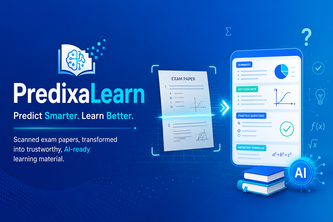
What the company appears to be: PredixaLearn is a local-first web application for transforming scanned exam papers into structured, source-linked learning materials. The author states it uses OCR to process PDFs and images locally, reconstructs content while preserving original source evidence, and supports teacher review with audit trails. It does not claim to predict future exam questions.
What changed: The project description shows a self-developed tool built by one person (a civil engineering student) that addresses personal learning challenges around exam paper organization and reuse. It represents a shift from traditional OCR tools toward a workflow that emphasizes evidence-based reconstruction, review, and accountability.
Single most important open question: Is there any evidence of real-world usage or adoption beyond the author's own testing? The description states no revenue, customers, or traction data are available — only self-reported claims about functionality and design choices.
What The Product Actually Is
The description states that PredixaLearn is a local-first exam-paper intelligence workspace for English exam papers. It allows users to upload PDFs or images of exam papers and process them locally with OCR.
Key technical features include:
- Local OCR processing
- Source-linked reconstruction of text, questions, marks, tables, figures
- Evidence-based question analysis
- Side-by-side source and reconstructed-content review
- Confidence overlays for content needing attention
- Manual corrections with append-only audit history
- Export formats: Markdown, JSON, DOCX
- Topic taxonomy and syllabus-import tools
- Teacher-approved question banks
- Duplicate review and multi-paper comparison
- Revision packs based on approved, source-linked questions
The author notes that it does not predict future exam questions — its purpose is to help learners and teachers understand and reuse existing exam papers.
Positioning & Claim Evolution
The description states the product aims to transform "scattered exam papers into structured, source-linked, teacher-reviewable learning materials." It positions itself as a tool that helps users make study materials more compact, cleaner, and easier to trust.
It does not claim to be predictive or generative — rather, it focuses on reusing existing content in an organized way. The author emphasizes:
- A practical learning path: Convert → Analyze → Review → History → Teacher → Revision
- Transparency about its limitations (e.g., English-only scope, non-predictive purpose)
- Responsible AI use through consent-based optional GPT analysis
This is a self-reported positioning — no external validation or market positioning data is provided.
Target Customer & ICP
The description states that PredixaLearn is designed for:
- Students preparing for exams
- Teachers who want to review and organize exam content
- Users who need compact, trustworthy learning materials
It appears targeted at educational users, particularly those in English-speaking contexts (as it's limited to English). The author identifies himself as a civil engineering student, suggesting a personal use case that may extend to other students or educators.
No explicit segmentation beyond "students and teachers" is described. No evidence of specific customer personas, buyer roles, or market targeting is provided.
Business Model & Pricing Evidence
The description does not mention any business model or pricing structure. It states the tool is built by one person and focuses on local processing and privacy — implying no commercial monetization at this stage.
There is no evidence of:
- Revenue streams
- Subscription plans
- Paid features
- Customer acquisition costs
- Pricing tiers
This is a self-reported absence, not a confirmed lack of business model.
Technical & Delivery Signals
The author states that PredixaLearn is built as a local-first web application with:
- FastAPI backend
- Browser-based interface (desktop, tablet, mobile)
- OCR workflow using local processing
- Preservation of source geometry for traceability
- Append-only audit history for corrections
- Optional GPT analysis requiring explicit consent
Key technical signals:
- Local-first design
- Privacy-focused architecture
- Source-linked reconstruction
- Responsive UI across devices
- Use of modern web technologies (e.g., TypeScript, Python, Playwright)
There is no evidence of:
- Cloud infrastructure or hosting details
- API integrations or third-party services
- Scalability considerations
- Deployment environments beyond local use
Traction & Maturity Signals
The description states that PredixaLearn was developed by one person (the author) and submitted to a hackathon. There is no evidence of:
- Revenue generation
- Customer base or user adoption
- Product usage metrics
- Market traction
- Iteration history or versioning beyond the current release
It also notes that the included "Judge Demo" is synthetic, not a real-world benchmark. Any future claims about accuracy will require permission-cleared papers and manually verified ground truth.
Competitive Context
The description does not provide any information on:
- Competitors
- Market landscape
- Product differentiation
- Competitive advantages or disadvantages
It is unclear whether similar tools exist in the market, how PredixaLearn compares to them, or what its competitive positioning might be.
Open Questions & Risks
Several risks and open questions are evident from the self-reported description:
- No commercial traction: The product has no demonstrated revenue, customers, or adoption.
- Single-person development: The entire project was built by one individual — raises questions about scalability, maintenance, and long-term viability.
- Limited scope: It is restricted to English exam papers and does not claim predictive capabilities, which may limit its utility.
- Self-reported accuracy: No real-world testing or benchmarking data is provided; the demo is synthetic.
- No monetization strategy: No indication of how the tool would be commercialized if it were to grow beyond personal use.
These are inferences based on self-reporting, not confirmed facts.
Questions the description leaves open
- What specific educational institutions or users have tested PredixaLearn?
- How does the author plan to scale beyond a single-person development model?
- Are there any plans for monetization or commercial partnerships?
- Has the tool been tested with real exam papers from multiple sources, and what were the results?
- What are the long-term goals for expanding beyond English-language exam papers?
- How does the author intend to ensure data privacy and compliance in a potential commercial setting?
Overall Assessment
The description indicates that PredixaLearn is currently a personal project developed by one individual, with no evidence of traction, revenue, or customer adoption.
It is not evident whether this represents a viable business opportunity or a prototype for future development. The author's stated vision aligns with educational technology trends but lacks commercial validation.
Confidence level: Low — based entirely on self-reported information without external corroboration.
This project appears to be an early-stage idea, possibly a hackathon submission or proof-of-concept, rather than a mature product or business. Any investment or partnership decision should be contingent upon further evidence of real-world usage, scalability, and commercial viability.
User Stories BotA demo video on every pull request
Get a demo video on every new feature
GitHub App that watches your pull requests and records a narrated, captioned demo.
Save time on demo prep and make informed decisions faster with a video walkthrough of every new feature.
Source
Submitted to the OpenAI 2026 hackathon on Devpost. Project home on Devpost. Back to the full gallery on Devpost.
This competitive analysis was produced by top-founders.com (opens in a new tab)
Generated by a language model from this project's public Devpost page — its tagline, the author's own write-up and any built-with tags listed there — as captured in August 2026. Short quotations are the author's words. It is an opinion on the idea as a business, not on the people behind it, and it reflects the description as published then. If the project has moved on, request a correction below. The analysis is not independent research and contains no verified traction, revenue or customer data.
An independent guide by KFG International LLC — not affiliated with, endorsed by, or connected to Devpost or OpenAI.