

Archive position — measured, not model output
0 likes on Devpost
2,263 of the 7,850 archived projects have more likes, and 5,587 share exactly 0 — so this project's #5,627 place in the like-ranked listing is a tie-break inside that group, not a ranking.
Projects (log scale)
Likes on Devpost. ▲ marks this project's group.
Show the figures
| Likes | Projects | Share of archive |
|---|---|---|
| 0 | 5,587 | 71.2% |
| 1 | 1,758 | 22.4% |
| 2 | 284 | 3.6% |
| 3–4 | 132 | 1.7% |
| 5–9 | 75 | 1.0% |
| 10+ | 14 | 0.2% |
 User Stories BotA demo video on every pull request
Get a demo video on every new feature
GitHub App that watches your pull requests and records a narrated, captioned demo.
Save time on demo prep and make informed decisions faster with a video walkthrough of every new feature.
Executive Summary
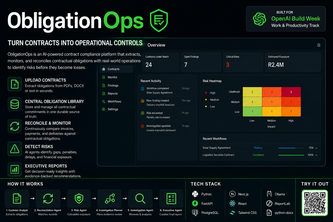
What the company appears to be: ObligationOps is a self-reported contract monitoring platform that extracts obligations from contracts and reconciles them against operational records (e.g., invoices, payments, deliveries). It claims to turn static contracts into live operational controls to catch compliance risks, payment gaps, and delivery failures before they become costly.
What changed: The project description indicates this was built as a hackathon submission for the OpenAI 2026 hackathon. No prior version or evolution is described; it is presented as a new product concept with no evidence of prior traction or customer base.
Single most important open question: Is there any evidence that ObligationOps has been used in production, or even tested with real contracts and operational data? The description states the system was built for demonstration purposes using sample agreements and local inference models, but does not indicate whether it has been deployed beyond a prototype.
What The Product Actually Is
The description states that ObligationOps is a full-stack application designed to extract structured obligations from contracts and store them as queryable records. It reconciles these against uploaded operational evidence (invoices, payments, deliveries) and produces executive-ready reports.
- Backend: Built with FastAPI for contract ingestion, record normalization, workflow orchestration, and reporting.
- Database: Durable model for contracts, obligations, fulfillment records, discrepancies, risk assessments, investigations, and reports.
- Frontend: Next.js-based UI with views for contracts, document uploads, live workflow polling, progress updates, issue summaries, and report downloads.
- AI/ML Tools Used: GPT-5.6 (for architecture design, debugging, and logic), Codex (for code generation), Ollama-backed local inference during development.
Inference: The system is described as a prototype built for a hackathon, not a production-ready product. It uses local tools like Ollama and GPT-5.6 for development but lacks evidence of integration with enterprise systems or scalable deployment.
Positioning & Claim Evolution
The author positions ObligationOps as a solution to the problem that “contracts make promises, but those promises usually disappear into PDFs the moment they are signed.” The platform aims to bridge this gap by turning contracts into live operational controls.
- Core Claim: Contracts should not be static documents; they must be connected to real-world evidence.
- Evolution of Claims:
- Initial claim: Turn contracts into live operational controls.
- Subsequent refinement: Identify discrepancies, assess risk and exposure, investigate evidence, and produce executive reports.
- Further evolution: Emphasis on transparency, trustworthiness, and actionable insights.
Inference: The positioning reflects a shift from document summarization to operational monitoring. However, the description does not show how this evolved from an idea into a working product beyond a hackathon prototype.
Target Customer & ICP
The author states that ObligationOps is built for “teams responsible for keeping promises visible before missed obligations become expensive surprises.”
- Target Customer: Finance, compliance, and operations teams within organizations managing contracts with suppliers or partners.
- ICP (Ideal Customer Profile): Not explicitly defined. The description implies a need for contract monitoring in large enterprises or procurement-heavy environments.
Not evidenced: No specific industry, company size, or use case examples are provided. No evidence of customer interviews, personas, or segmentation.
Business Model & Pricing Evidence
The description does not contain any information about pricing, monetization strategy, or business model.
- Pricing: Not evidenced.
- Monetization: Not evidenced.
- Revenue Streams: Not evidenced.
Inference: The project is a hackathon submission and thus likely not yet monetized. No indication of B2B SaaS pricing, freemium models, or enterprise licensing.
Technical & Delivery Signals
The system is described as a full-stack application with:
- FastAPI backend
- Next.js frontend
- Local Ollama-backed model for inference
- Asynchronous workflow system for background processing
- Durable database schema for storing obligations and reconciliation results
Inference: The technical stack suggests a modern, scalable architecture. However, the use of local models and prototype workflows indicates it is not yet production-ready.
Traction & Maturity Signals
There is no evidence of traction or maturity beyond the hackathon submission:
- No revenue data
- No customers or users
- No product usage metrics
- No deployment history or versioning
- No feedback from early adopters
Inference: The project is at a very early stage, likely a prototype or proof-of-concept. It has not been tested in real-world environments.
Competitive Context
The description does not mention any competitors or market analysis.
- Competitors: Not evidenced.
- Market Positioning: Not evidenced.
- Differentiation: Not evidenced.
Inference: The author does not reference existing tools for contract lifecycle management, compliance monitoring, or operational risk management. This leaves the competitive landscape unknown.
Open Questions & Risks
Several risks and open questions are evident from the description:
- Prototype Only: The system is described as a hackathon prototype with no evidence of production use.
- Local Inference Dependency: Reliance on Ollama for local inference suggests limited scalability or enterprise readiness.
- No Real-World Testing: No mention of testing with actual contracts or operational data.
- Unverified Claims: The author states that the most valuable AI workflow is one that connects documents to evidence, but no proof of this functionality exists.
- Lack of Commercial Evidence: No pricing, customers, or revenue data.
Questions the description leaves open
- What real-world contracts have been tested with ObligationOps? Were they from actual procurement or legal teams?
- How does the system handle ambiguity in contract language or incomplete operational records?
- Has the platform been integrated with any ERP, procurement, or financial systems?
- What is the current status of the product—has it moved beyond a prototype?
- Are there any internal or external users who have provided feedback on its utility?
Overall Assessment
Not evidenced: No evidence of traction, revenue, customers, or commercial viability exists in the description.
Confidence Level: Very low. The project is described as a hackathon submission with no indication of prior development, testing, or market validation.
Assessment: At this stage, ObligationOps appears to be an idea or prototype with potential but no demonstrated value proposition or business model. It would require significant further development and evidence before any investment or partnership consideration could be justified.
User Stories BotA demo video on every pull request
Get a demo video on every new feature
GitHub App that watches your pull requests and records a narrated, captioned demo.
Save time on demo prep and make informed decisions faster with a video walkthrough of every new feature.
Source
Submitted to the OpenAI 2026 hackathon on Devpost. Project home on Devpost. Back to the full gallery on Devpost.
This competitive analysis was produced by top-founders.com (opens in a new tab)
Generated by a language model from this project's public Devpost page — its tagline, the author's own write-up and any built-with tags listed there — as captured in August 2026. Short quotations are the author's words. It is an opinion on the idea as a business, not on the people behind it, and it reflects the description as published then. If the project has moved on, request a correction below. The analysis is not independent research and contains no verified traction, revenue or customer data.
An independent guide by KFG International LLC — not affiliated with, endorsed by, or connected to Devpost or OpenAI.