

Archive position — measured, not model output
0 likes on Devpost
2,263 of the 7,850 archived projects have more likes, and 5,587 share exactly 0 — so this project's #3,663 place in the like-ranked listing is a tie-break inside that group, not a ranking.
Projects (log scale)
Likes on Devpost. ▲ marks this project's group.
Show the figures
| Likes | Projects | Share of archive |
|---|---|---|
| 0 | 5,587 | 71.2% |
| 1 | 1,758 | 22.4% |
| 2 | 284 | 3.6% |
| 3–4 | 132 | 1.7% |
| 5–9 | 75 | 1.0% |
| 10+ | 14 | 0.2% |
 User Stories BotA demo video on every pull request
Get a demo video on every new feature
GitHub App that watches your pull requests and records a narrated, captioned demo.
Save time on demo prep and make informed decisions faster with a video walkthrough of every new feature.
Executive Summary
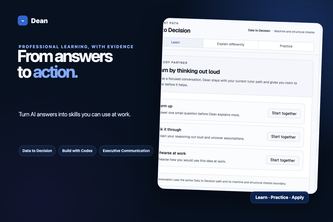
What the company appears to be: Dean is a self-reported learning platform designed for working adults, built as a hackathon project. It aims to transform AI-generated answers into practical professional skills by offering guided learning paths, practice exercises, and structured feedback. The system uses AI models (GPT-5.6, Codex) and tools (Next.js, Vercel Eve, SQLite) to create a structured experience that separates verifiable tasks from judgment-based feedback.
What changed: The project evolved from an idea about the gap between AI answers and actionable learning into a working prototype with three curated modules focused on data decision-making, tool-building with Codex, and executive communication. It was built as part of a hackathon submission.
The single most important open question: Is there evidence that Dean’s approach to structured learning and skill-building resonates with real professionals beyond the hackathon context? The description does not indicate any traction or user testing outside of the demo environment.
What The Product Actually Is
The description states that Dean is a Next.js application built using:
- GPT-5.6
- Codex
- Vercel Eve (for agent runtime)
- Vercel AI Gateway
- Zod (for typed contracts)
- SQLite (for deterministic checks)
It includes three curated professional-learning modules:
- Data to Decision
- Build a Work Tool with Codex
- Executive Communication
The system is described as turning a professional goal into a guided learning experience, using AI to generate explanations, practice tasks, and feedback while maintaining clear boundaries between verified work (e.g., SQL queries) and judgment-based feedback (e.g., communication).
It also uses structured events to render lesson blocks such as:
- Explanations
- Code exercises
- Diagrams
- Matching activities
- Quizzes
- Sliders
- Paced reveals
The learner interface is said to receive structured data and render components in a way that avoids arbitrary UI generation.
Inference: The product appears to be an AI-powered learning system designed for professionals who want to apply AI-generated answers into real-world skills, with a focus on structured guidance and evidence boundaries.
Positioning & Claim Evolution
The description states that Dean was inspired by the gap between AI giving smart answers and people needing to make decisions or build things at work. It positions itself as a system that moves beyond chatbot-style interactions into a clear path from “I got an answer” to “I can do the work.”
It claims to offer:
- A guided learning path
- Practice tasks
- Honest checks for real professional goals
The author emphasizes that Dean is deliberately honest about verification, distinguishing between:
- Deterministic checks (e.g., SQL queries)
- Guided feedback (e.g., communication)
This evolution from a generic AI assistant to a structured, skill-building platform suggests an intent to address the challenge of applying AI in professional settings.
Inference: Dean’s positioning reflects a shift from general-purpose AI tools toward specialized learning experiences tailored for working professionals. The claim is that it helps users move beyond passive consumption of AI output into active skill development.
Target Customer & ICP
The description states that Dean targets working adults who need to:
- Make decisions at work
- Build something useful
- Explain ideas clearly
It focuses on people who are looking for a way to apply AI answers into tangible outcomes, rather than just receiving information.
The modules suggest an audience interested in:
- Data analysis and decision-making
- Software development (via Codex)
- Communication skills
There is no explicit mention of industry verticals or job roles beyond general professional use.
Inference: The ICP likely includes mid-to-senior-level professionals seeking structured learning to improve their work-related capabilities. However, the description does not specify whether this is B2C or B2B, nor does it define a clear persona or segment.
Business Model & Pricing Evidence
No evidence of pricing, monetization strategy, or business model is provided in the description.
The project is presented as a hackathon submission, and no mention is made of:
- Revenue streams
- Customer acquisition plans
- Subscription models
- Licensing or enterprise features
Inference: There is no indication that Dean has moved beyond prototype stage or defined how it would generate value or income. The business model remains unreported.
Technical & Delivery Signals
The system is built with:
- Next.js
- Codex
- GPT-5.6
- Vercel Eve (agent runtime)
- Vercel AI Gateway
- Zod (typed contracts)
- SQLite
It uses structured events to render lesson components and separates model guidance from authoritative checks.
Key technical decisions include:
- Using deterministic checks for verifiable tasks (e.g., SQL)
- Employing a rubric-based system for judgment-based feedback
- Preserving learner mistakes and adapting lessons accordingly
The system is said to support:
- Durable sessions across time
- Adaptation based on specific errors
- Personalization without requiring prompt engineering from the user
Inference: The technical stack suggests a modern, AI-integrated web application with structured data handling and adaptive learning logic. However, no evidence of scalability or production deployment is provided.
Traction & Maturity Signals
The description states that Dean was built as part of a hackathon submission, and the team size is listed as 1 person (Tarik Moody).
There is no mention of:
- Customers
- Users
- Revenue
- Product usage metrics
- Market validation
- Feedback loops or iteration history
It does state that the system is a working learning system, not just a concept demo, and includes three modules with specific outcomes.
Inference: The product exists in prototype form but lacks any evidence of traction or real-world adoption. It is described as a functional demo, not a mature product.
Competitive Context
The description does not mention competitors or existing solutions in the space of AI-powered learning platforms for professionals.
It implies that current tools either:
- Provide generic answers without structured follow-up
- Fail to bridge the gap between AI output and practical skill-building
No direct comparison is made with other platforms like Coursera, Udemy, or internal corporate training systems.
Inference: The competitive landscape is unknown. Dean appears to target a niche where structured learning meets AI-generated content, but no evidence of prior art or market positioning exists in the description.
Open Questions & Risks
- No traction or user feedback: The project is described as a hackathon submission with no indication of real-world usage.
- Unproven value proposition: While it claims to help professionals apply AI answers into skills, there is no evidence that this approach works at scale or resonates with users.
- Limited scope: Only three modules are included, and the team size is one person — suggesting limited development capacity.
- Unclear monetization path: No business model or pricing strategy is described.
- Self-reported nature: All claims are unverified; no third-party validation or data exists.
Inference: The risk of overpromising without delivering real-world impact is high. The lack of evidence for traction, users, or revenue makes it difficult to assess viability beyond the demo stage.
Questions the description leaves open
- What specific professional goals did you observe in working adults that led to this idea?
- How do you plan to validate whether learners actually improve their skills using Dean?
- Are there any early adopters or pilot users who have tested the system beyond the hackathon?
- What is your roadmap for expanding beyond the three current modules?
- How will you scale the system beyond a single developer?
- What are the key assumptions about how people learn and apply AI in professional settings?
- Have you considered how to integrate Dean into existing workflows or platforms (e.g., Slack, LMS)?
- What metrics do you track to measure success for learners?
Overall Assessment
The description indicates that Dean is a self-reported hackathon project with no evidence of traction, revenue, or user validation.
It is described as a working prototype, not a product in the market. The team size is one person, and there are no signs of commercialization or go-to-market strategy.
Assessment: Not ready for investment or partnership at this stage. The idea shows promise in addressing a gap between AI answers and practical skill-building, but lacks evidence of execution, user testing, or business viability. Further development and validation would be required before any strategic move could be considered.
User Stories BotA demo video on every pull request
Get a demo video on every new feature
GitHub App that watches your pull requests and records a narrated, captioned demo.
Save time on demo prep and make informed decisions faster with a video walkthrough of every new feature.
Source
Submitted to the OpenAI 2026 hackathon on Devpost. Project home on Devpost. Back to the full gallery on Devpost.
This competitive analysis was produced by top-founders.com (opens in a new tab)
Generated by a language model from this project's public Devpost page — its tagline, the author's own write-up and any built-with tags listed there — as captured in August 2026. Short quotations are the author's words. It is an opinion on the idea as a business, not on the people behind it, and it reflects the description as published then. If the project has moved on, request a correction below. The analysis is not independent research and contains no verified traction, revenue or customer data.
An independent guide by KFG International LLC — not affiliated with, endorsed by, or connected to Devpost or OpenAI.